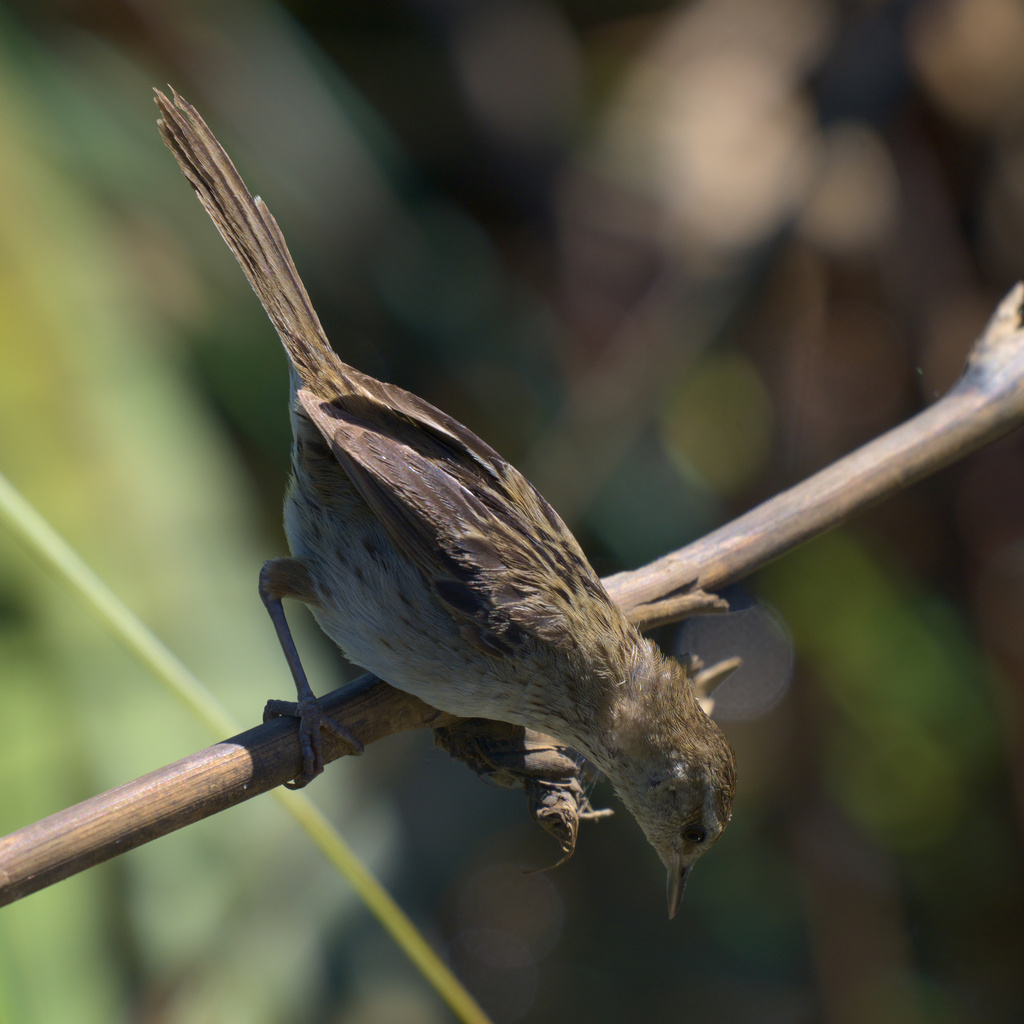
Little Grassbird
Photo © Thomas Jaeger
Photo © Thomas Jaeger — CC BY 4.0 — Source: iNaturalist #258199213Identification
The Little Grassbird is a small warbler measuring 13–15 cm, with subdued plumage that renders it more often heard than seen. It is olive-brown to brown-grey above, heavily streaked with dark grey on the crown, cheeks, and throat. The underparts are lighter grey and also streaky, with a pale eyebrow stripe and dark-edged wing feathers that show white margins. Males and females are visually indistinguishable to the naked eye, though males are slightly larger overall. Its plaintive voice is diagnostic: a sequence of 2–3 piping whistles repeated incessantly during breeding season, or a three-noted monotone described as "tee-ti-teee."
In the field, confusion is possible with the slightly larger and more rufous Tawny Grassbird, or with the Striated Fieldwren, which shows yellow underparts and distinctive white eyebrows. The Little Grassbird's combination of fine streaking, pale eyebrow, and grey-streaked throat are key identification marks.
Range & Habitat
The Little Grassbird is found across Eastern Australia and Tasmania, extending inland to Central and South-Western Australia, with a separate population in West Papua, Indonesia (where it is uncommon and localized). This species inhabits dense wetland vegetation including reed beds, rushes, sedges, and rank grass, as well as lignum swamps, saltmarsh, and low mangroves. After heavy rains, birds exploit temporary wetlands, living nomadically with no regular migration patterns.
Behaviour & Diet
Little Grassbirds are inconspicuous residents of dense vegetation, where they forage for insects and small arthropods. They are notably vocal and famously responsive to human contact—readily "engaging in conversation" with observers—yet remain largely hidden within their preferred cover. Breeding occurs from August to December, or opportunistically after rain. Pairs construct deep, cup-shaped nests from grass, twigs, and stems, lined with feathers (often from Australasian Swamphens), typically placed in tall grasses or low shrubs. Clutches consist of 3–5 whitish to pink-white eggs with grey speckles. Notably, breeding populations exhibit a highly male-biased sex ratio, with some territories supporting numerous unpaired males.
Best Time & Places to See It
The breeding season (August–December) is the best time to locate this species, as birds are most vocal and conspicuous then. Search reed beds, rushes, and wet grasslands of southeastern Australia, particularly in Victoria, New South Wales, Queensland, South Australia, Northern Territory, Western Australia, and Tasmania. Look for characteristic movement in dense vegetation and listen for the repeated piping whistles. After rain, check temporary wetlands and swamps, where nomadic birds may congregate.
Photography Tips
Photography of Little Grassbirds presents a genuine challenge due to their secretive habits and preference for dense cover. Early morning during breeding season offers the best light and increased vocal activity. Use a telephoto lens (at least 400–600 mm) to avoid flushing birds from vegetation. Patience is essential; position yourself quietly near known reed beds or marshes and wait for birds to move into open edges at dawn. The bird's responsiveness to calls means that judicious playback may draw individuals into view, though this should be used sparingly and ethically. Overcast days reduce harsh shadows in reed beds and may improve visibility.
Barrington Tops National Park
Belair National Park
Ben Boyd National Park
Blue Mountains National Park
Bribie Island National Park
Budj Bim National Park
Carnarvon National Park
Chiltern-Mt Pilot National Park
Cleland National Park
Nothing matches these filters.
No community photos yet. Log in to add the first one.
No community observations of this species yet.