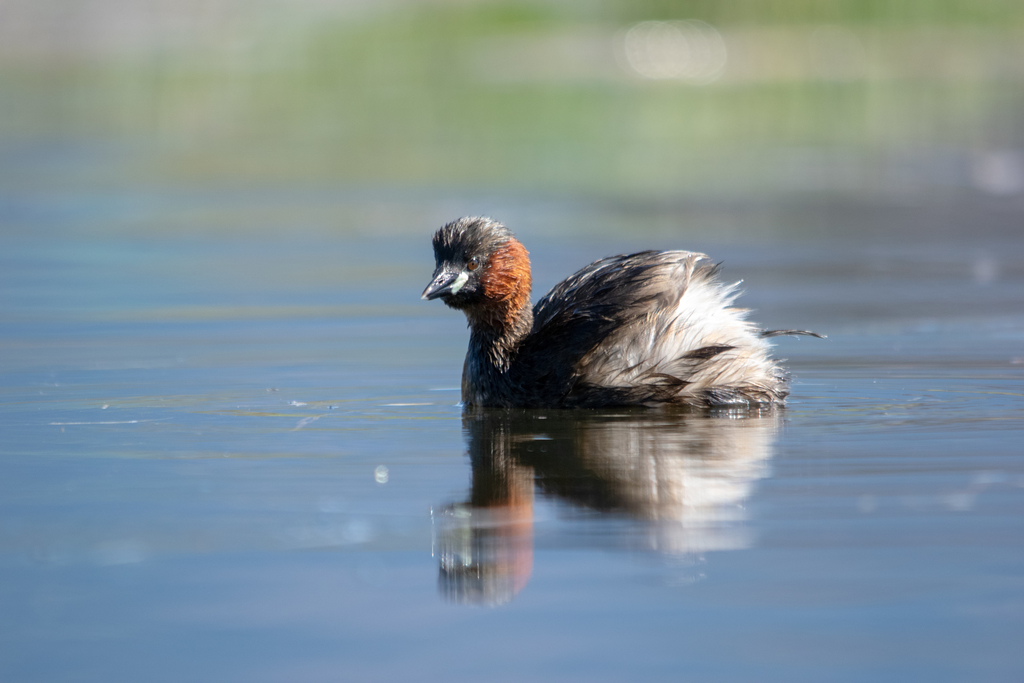
Little Grebe
Photo © Gergely Nigg
Photo © Gergely Nigg — CC BY 4.0 — Source: iNaturalist photo #119185427Identification
The Little Grebe, also known as the dabchick, is the smallest grebe species in Europe, Asia, and Africa, measuring just 23 to 29 centimetres in length. It is unmistakable in breeding plumage, displaying a predominantly dark upperside contrasted with a rich rufous neck, cheeks, and flanks, along with a distinctive bright yellow gape. The pointed bill and compact body are characteristic features of this species.
In winter and juvenile birds, identification is equally straightforward: look for buff-coloured plumage with a darker back and cap, and a distinctive "powder puff" rear end. Juveniles have a yellow bill with a small black tip and black-and-white streaks on the cheeks and neck sides. As birds mature, the bill gradually darkens to black. The rufous breeding colours are replaced by a dirty brownish-grey in non-breeding birds, providing a clear seasonal transformation.
Range & Habitat
The Little Grebe has an extensive range across Europe, much of Asia extending to New Guinea, and most of Africa. It breeds in small colonies in heavily vegetated freshwater lakes and wetlands. The species is commonly found in open bodies of water throughout most of its range, demonstrating remarkable adaptability to diverse aquatic environments.
Migration patterns vary geographically: birds are only migratory in parts of their range where waters freeze over. Outside the breeding season, Little Grebes move into more open water and occasionally appear in coastal areas, frequenting small bays. In India, breeding occurs during the rainy season, highlighting the species' ecological flexibility across different climatic zones.
Behaviour & Diet
The Little Grebe is an excellent swimmer and diver, pursuing fish and aquatic invertebrates underwater with remarkable agility. It uses waterside vegetation skilfully as shelter and feeding habitat. Like all grebes, this species has legs positioned far back on its body, making it essentially flightless on land and perfectly adapted for aquatic life.
Breeding birds construct floating nests at the water's edge, where females typically lay four to seven eggs. Adults demonstrate remarkable care, covering eggs with weeds before leaving the nest—a behaviour that reduces detection by predators. Chicks are precocial, leaving the nest and swimming within hours of hatching. Young birds are frequently carried on the backs of swimming adults. The species' breeding call is distinctive: a trilled repeated "weet-weet-weet" or "wee-wee-wee," resembling a horse's whinny and often given in duet.
Best Time & Places to See It
Little Grebes are best observed during breeding season in heavily vegetated freshwater lakes and wetlands across their extensive range. Breeding birds are more visible and vocal during this period, making them easier to locate. In winter, look for them in more open water habitats and occasionally in coastal bays, where they become more exposed and observable than during the breeding season when they hide among vegetation.
The species' year-round presence in many parts of its range means it can be observed in suitable habitat throughout the year, though seasonal movements and changing plumage will affect visibility and identification. Patience and observation of quiet water margins during dawn and dusk hours will reward travellers searching for this diminutive grebe.
Photography Tips
Photograph Little Grebes during breeding season when they display their striking rufous neck and cheeks—the most visually distinctive plumage. Early morning and late afternoon light enhances the richness of breeding colours. The bright yellow gape is a particularly photogenic feature worth capturing in close-up shots.
Since Little Grebes are excellent swimmers and divers, anticipate their underwater movements and be ready to photograph them surfacing. The characteristic "powder puff" rear end, particularly visible in winter plumage, makes a distinctive identification feature. Capturing adults carrying chicks on their backs provides compelling wildlife images. Use vegetation-lined waterways as natural framing, but approach slowly and quietly to avoid alarming these wary birds.
Bwindi Impenetrable National Park
Kanha Tiger Reserve
Lake Mburo National Park
Mabamba Swamp
Minneriya National Park
Queen Elizabeth National Park
Aberdare National Park
Abijata-Shalla Lakes National Park
Abruzzo, Lazio and Molise National Park
Nothing matches these filters.
No community photos yet. Log in to add the first one.
No community observations of this species yet.