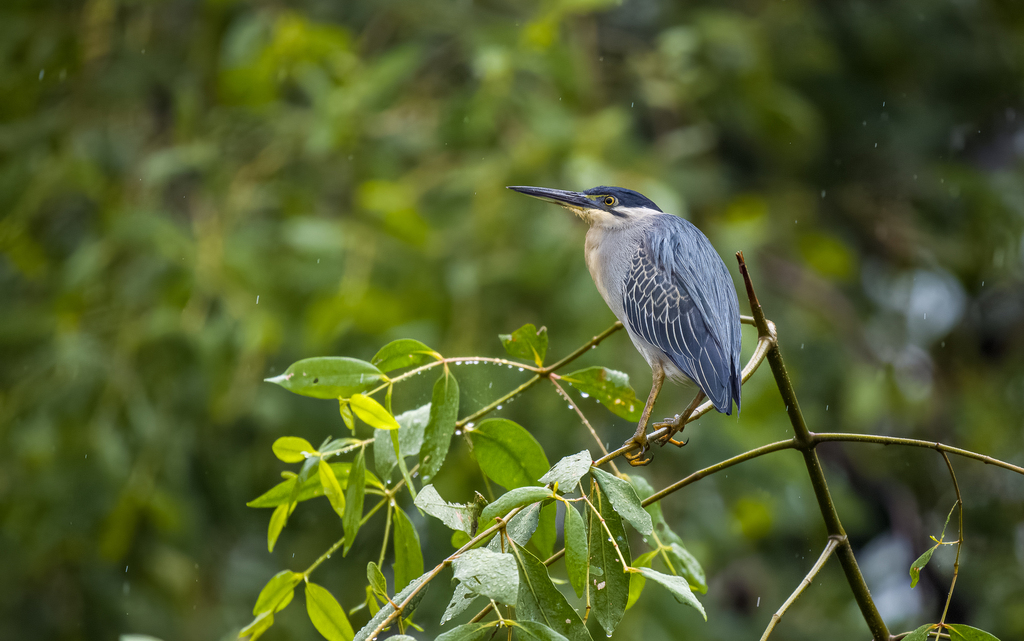
Little Heron
Photo © Forest Botial-Jarvis
Photo © Forest Botial-Jarvis — CC BY 4.0 — Source: iNaturalist photo #259898995Identification
The little heron is a diminutive member of the heron family, measuring 35–48 cm in length with a wingspan of 52–60 cm and weighing just 130–250 g. Adults are unmistakable: they display a blue-grey back and wings contrasting with white underparts, a distinctive black cap, and a dark line extending from the bill under the eye. Their legs are short and yellow. Juveniles appear browner above and are streaked below, making them initially harder to identify. The two Australian subspecies exhibit remarkable variation, with both grey and rufous colour morphs occurring in the same population.
Range & habitat
The little heron is distributed across the Old World tropics from Sub-Saharan Africa east to Japan and south to Australia, with twenty recognized subspecies reflecting this vast range. The species is mostly sedentary and shows considerable flexibility in its habitat preferences, inhabiting both freshwater and saltwater environments. It typically frequents mangroves but readily adapts to vegetation along rivers and streams, making it relatively accessible to travellers across its broad geographic range.
Behaviour & diet
This heron employs a characteristic sit-and-wait hunting strategy, standing motionless at the water's edge before ambushing unsuspecting prey. Its diet consists primarily of small fish, frogs, and aquatic insects. During breeding season, little herons construct well-concealed nests hidden amongst shrubs or branches. Clutches typically contain 2–5 eggs, which are incubated for 19–25 days. The chicks, covered in pale-grey down with white markings, develop rapidly and fledge at around five weeks of age.
Best time & places to see it
Given the species' broad tropical distribution spanning Africa, Asia, and Australia, opportunities to encounter little herons are widespread. The bird's preference for mangroves and waterside vegetation makes it most readily found in coastal wetlands and freshwater systems throughout its range. Its sedentary nature means populations remain in their preferred habitats year-round, offering reliable viewing opportunities regardless of season in most locations.
Photography tips
The little heron's small size and patient hunting behaviour make it an engaging subject for wildlife photographers. Its habit of remaining stationary at the water's edge allows photographers to approach carefully and frame detailed shots of its distinctive black cap and facial markings. Early morning light, when these herons are most active, provides ideal conditions for capturing the subtle blue-grey tones of the plumage. The species' affinity for dense mangrove vegetation may require patience and attention to background composition to isolate the bird effectively.
Lake Mburo National Park
Murchison Falls National Park
Queen Elizabeth National Park
Arusha National Park
Awash National Park
Bribie Island National Park
Bwabwata National Park
Cape Range National Park
Chobe National Park
Nothing matches these filters.
No community photos yet. Log in to add the first one.
No community observations of this species yet.