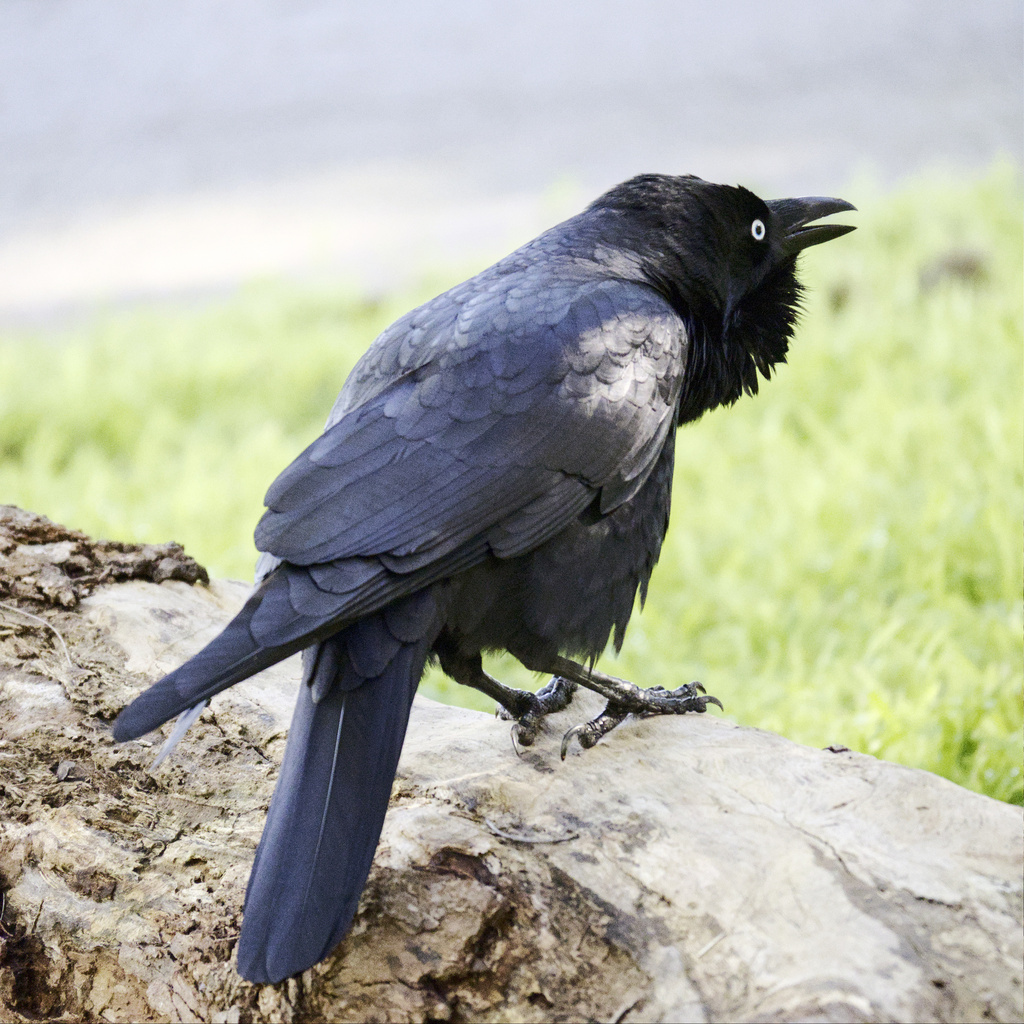
Little Raven
Photo © Thomas Jaeger
Photo © Thomas Jaeger — CC BY 4.0 — Source: iNaturalist #176928542Identification
The Little Raven is a medium-sized corvid measuring approximately 48–50 cm in length, making it somewhat smaller than its close relative, the Australian Raven, though size ranges do overlap between the two species. It is entirely black in plumage, with a black beak and legs. Like all Australian corvid species, the black feathers have grey bases, and the distinctive white iris of adults is a key identifying feature. Eye colour changes with age: nestlings have blue-grey eyes, juveniles develop brown eyes, and immature birds show hazel eyes with blue eyerings until maturity, when they turn white.
The Little Raven's call is a harsh, guttural "kar-kar-kar-karrr" or "ark-ark-ark-arrk," often accompanied by slight outward flicking of the wings. The species is notably more sociable than the Australian Raven, frequently forming large, mobile flocks. Though capable of vocal mimicry like all corvids, this behaviour is rarely observed in the wild.
Range & Habitat
The Little Raven is endemic to southeastern Australia, with its range spanning southern South Australia, Victoria, and New South Wales, including Kangaroo Island and King Island in Bass Strait. The species is absent from west Gippsland, where forest ravens dominate. It inhabits diverse landscapes including scrub, agricultural areas, grazing pasture, woodlands, treeless plains, coasts, and suburban environments.
Since the 1980s, the Little Raven has become increasingly abundant and widespread in Melbourne, spreading northwards and westwards with remarkable adaptability to urban settings. In contrast, the species remains uncommon in Canberra and Sydney, where the Australian Raven has become the dominant urban corvid. Its large range, abundance, and stable population classify it as Least Concern on the IUCN Red List.
Behaviour & Diet
Little Ravens are highly gregarious, often nesting in loose colonies of up to fifteen pairs with nests only metres apart. Their breeding territories are compact, while feeding is conducted communally over much wider areas. They frequently nest in proximity to Australian Ravens, suggesting minimal food competition despite their sympatry. The species shows flexibility in nest-site selection, utilising even dead trees with bare branches rather than requiring dense cover.
Nests are constructed as thin cups of sticks lined with bark, grass, and wool to form a thick mat. The communal foraging behaviour and nomadic tendencies of the Little Raven reflect its adaptation to the variable environmental conditions of southeastern Australia.
Best Time & Places to See It
Melbourne and its surroundings offer excellent opportunities to observe Little Ravens, particularly since their expansion through the city from the 1980s onward. Agricultural regions, coastal areas, and open woodlands across southeastern Australia are reliable locations. The species' gregarious nature and preference for open habitats make it relatively easy to encounter, especially when birds are foraging in flocks or nesting in loose colonies.
Photography Tips
The entirely black plumage of the Little Raven presents exposure challenges in bright conditions; metering carefully on the bird itself rather than surrounding landscape will prevent underexposure. The white iris provides a striking focal point and is worth capturing to confirm identification. Photograph birds in flight to capture the characteristic wing-flicking behaviour during vocalisations, and aim to capture the dynamic flock behaviour that distinguishes this species from solitary or paired Australian Ravens. Early morning and late afternoon light will add subtle dimension to the black plumage.
Alpine National Park
Barrington Tops National Park
Belair National Park
Ben Boyd National Park
Blue Mountains National Park
Budawang National Park
Budj Bim National Park
Chiltern-Mt Pilot National Park
Cleland National Park
Nothing matches these filters.
No community photos yet. Log in to add the first one.
No community observations of this species yet.