Identification
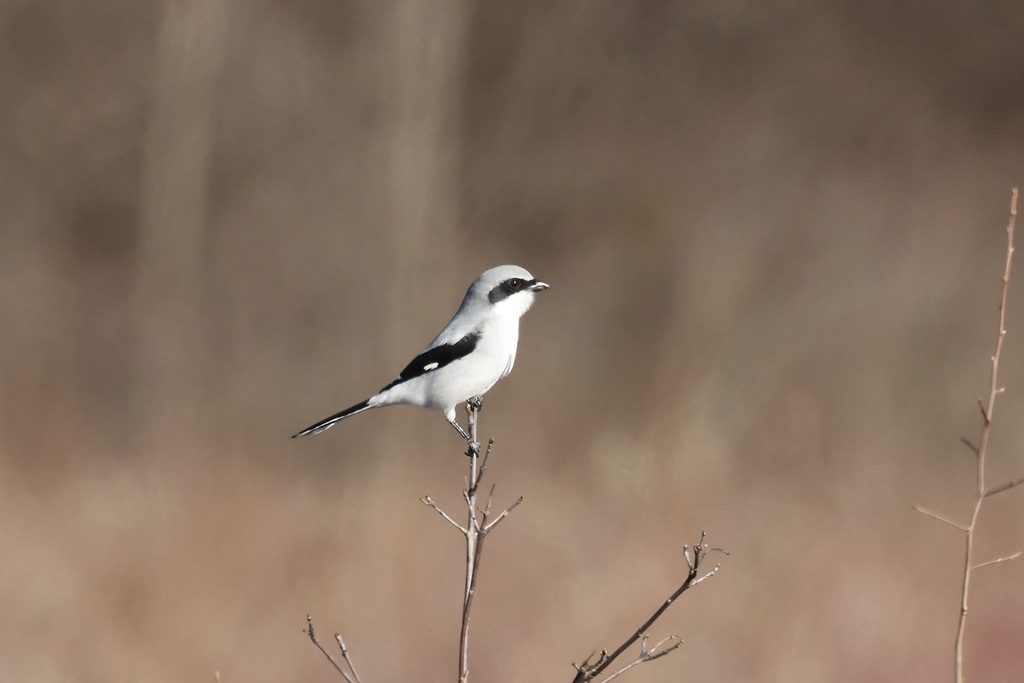
The loggerhead shrike is a medium-sized passerine measuring 7.9–9.1 inches in length with a wingspan of 11.0–12.6 inches, weighing approximately 1.8 ounces. Its most distinctive feature is a prominent black mask extending across the eyes to the bill, which gives the bird a striking appearance. The plumage is grey above with a white to pale grey breast, black wings marked with a white patch on the primaries, and a black tail edged with white. The bird's most unusual characteristic is its relatively large head compared to body size—a trait that inspired its common name. The short, black, hooked bill contains a tomial tooth adapted for tearing prey.
Adult loggerhead shrikes are sexually monochromatic, making field identification of sex difficult. They can be distinguished from the closely related northern shrike by their smaller size, darker grey plumage, more extensive black face mask that completely covers the eye, and shorter bill with less prominent hook. Juveniles display paler grey plumage with subtle vermiculation.
Range & Habitat
The loggerhead shrike is the only shrike species endemic to North America. Historically distributed across southern Canada, the contiguous United States, and Mexico, the species now exhibits significantly fragmented populations following heavy declines since the 1960s. Seven recognized subspecies occupy different regions: L. l. excubitorides in central North America, L. l. migrans in eastern North America, L. l. ludovicianus in southeastern coastal areas, and four subspecies in southern California and northwestern Mexico, including the island-endemic L. l. mearnsi found only on San Clemente Island. Populations have declined particularly sharply in Midwestern, New England, and Mid-Atlantic areas.
Behaviour & Diet
Earning the nickname "butcherbird" for its predatory habits, the loggerhead shrike feeds on insects, amphibians, lizards, small mammals, and small birds. Uniquely adapted to its small size and weak talons, this shrike impales its prey upon thorns or barbed wire, which facilitates consumption and also serves as a food storage and display method. This distinctive behavior, where prey items are left hanging at a site—often in a tree—is characteristic of the species.
The shrike's vocal repertoire is broad and varied, described as harsh and jarring, including squeaky whistles, shrill trills, and guttural warbles. Males are significantly more vocal than females, particularly during breeding season when their territorial calls become more frequent. When alarmed, shrikes produce distinctive shrieking calls while spreading their tail feathers.
Best Time & Places to See It
Loggerhead shrikes are best observed in open and semi-open habitats within their remaining range, particularly in central and eastern North America and the southwestern United States. Due to population declines, patience and careful observation are required. Breeding season activity and vocal behavior make spring an ideal time for detection. Coastal southeastern populations and those in California's coastal regions remain more stable than interior populations.
Photography Tips
The loggerhead shrike's striking black mask and contrasting pale plumage make it visually distinctive. Photograph the bird perched on open perches, thorny shrubs, or wire fences where it hunts and displays prey. The characteristic posture—alert and upright—showcases the disproportionately large head. Capture the white wing patches and tail markings in flight. Early morning light reveals the grey plumage and dark facial markings most effectively. Patient observation at known hunting sites increases chances of photographing this increasingly uncommon species.
Point Pelee & Algonquin Park
Nothing matches these filters.
Alligator River National Wildlife Refuge
Arches National Park
Badlands National Park
Bear River Migratory Bird Refuge
Big Bend National Park
Biscayne National Park
Bitter Lake National Wildlife Refuge
Black Canyon of the Gunnison National Park
Blackwater National Wildlife Refuge
Nothing matches these filters.
No community photos yet. Log in to add the first one.
No community observations of this species yet.