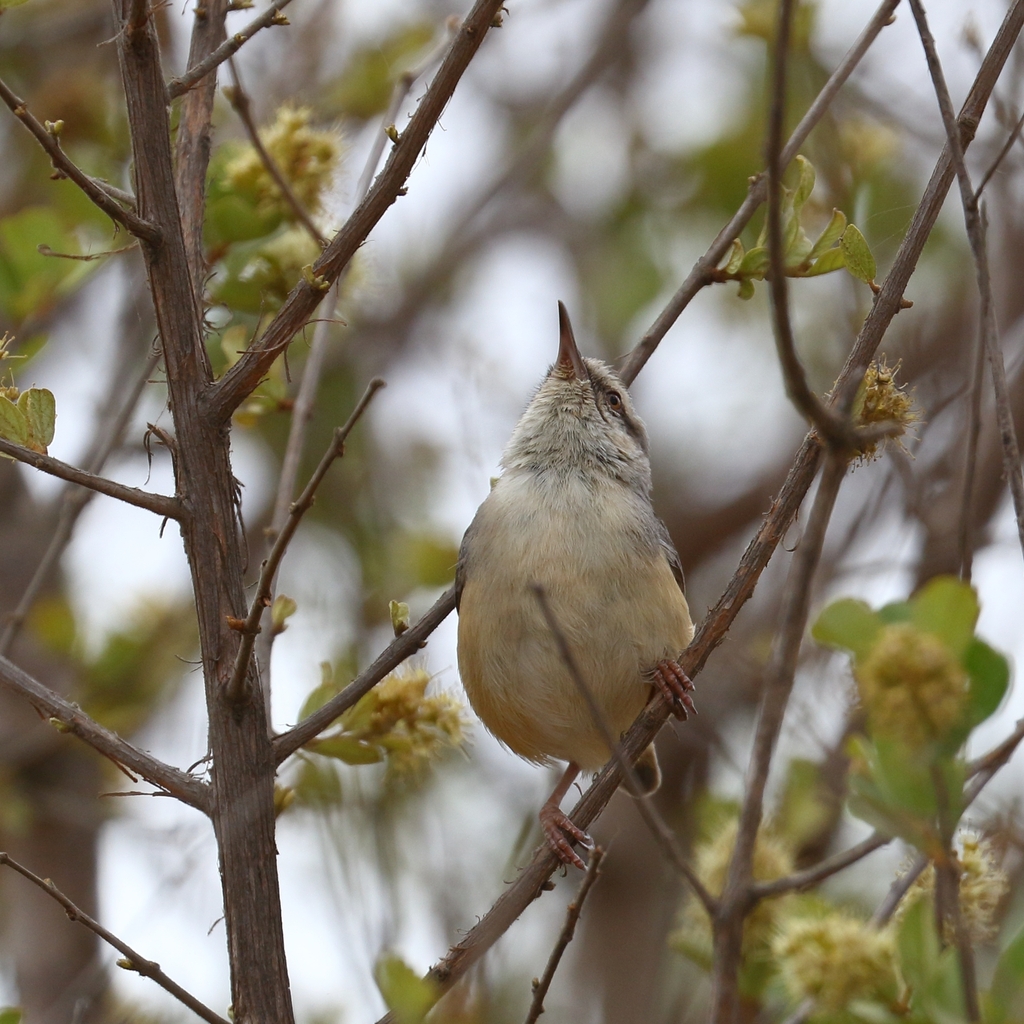
Long-billed Crombec
Photo © Alan Manson
Photo © Alan Manson — CC BY 4.0 — Source: iNaturalist #249636373Identification
The long-billed crombec is a small warbler, measuring just 12 cm in length and weighing around 16 g, with a distinctively long, slightly curved blackish bill that gives the species its name. Despite its diminutive size, this bird is nearly tailless, creating a compact, front-heavy silhouette. The upperparts are brownish grey-brown, while a pale grey supercilium (eyebrow stripe) separates the whitish throat from a dark eye stripe, giving the face a neat, marked appearance. The whitish breast gradually shades into a buff belly. The sexes are similar in plumage, and juveniles resemble adults, making age determination difficult in the field. The bird's call is distinctive: a variable series of trilled notes, including patterns like trreee-rriiit trreee-rriiit, interspersed with harsh pttt sounds.
Range & Habitat
This species breeds throughout southern Africa, with its range extending from the Democratic Republic of the Congo, Zambia, and Tanzania southwards to South Africa. The long-billed crombec is a common bird across a variety of semi-arid and open habitats, including fynbos (Mediterranean-type shrubland), open woodland, savannah, and dry Acacia scrub. It shows a preference for areas with scattered trees and shrubs that provide both foraging substrate and nesting sites.
Behaviour & Diet
This is a territorial, monogamous species that pairs for life. The long-billed crombec constructs a distinctive large, hanging bag-shaped nest made of grasses, spider webs, and plant fibres, which it attaches to the lower limbs of trees, often Acacias. The female lays one to three white eggs, which are incubated for approximately two weeks. Chicks remain in the nest for another two weeks before fledging, with both parents sharing feeding duties.
The bird forages methodically from the bottom to the top of bushes and trees, usually observed alone, in pairs, or in family groups as it searches for insects and grass seeds. It readily joins mixed-species feeding flocks and moves between trees with a characteristic bouncy flight pattern.
Best Time & Places to See It
As a common species with a large range across southern Africa, the long-billed crombec is relatively easy to locate throughout suitable habitat. Look for it in open woodlands, savannah, and Acacia scrubland from Tanzania and Zambia southwards through the Democratic Republic of the Congo region and into South Africa. The bird's methodical foraging behaviour and preference for lower vegetation make it accessible to patient observers.
Photography Tips
Photograph this species in open, well-lit habitats where the pale supercilium and facial markings are clearly visible. The bird's small size and tendency to forage methodically through vegetation offers opportunities for detailed portraits if you can position yourself with good lighting on the bird's face. Its bouncy flight between trees and preference for lower perches make it relatively accessible for photographers. Early morning light often provides the best conditions to capture the subtle grey-brown and buff tones of its plumage and to highlight the diagnostic long, curved bill.
Addo Elephant National Park
Agulhas National Park
Augrabies Falls National Park
Bontebok National Park
Bwabwata National Park
Camdeboo National Park
Cederberg Wilderness Area
Chobe National Park
Dorob National Park
Nothing matches these filters.
No community photos yet. Log in to add the first one.
No community observations of this species yet.