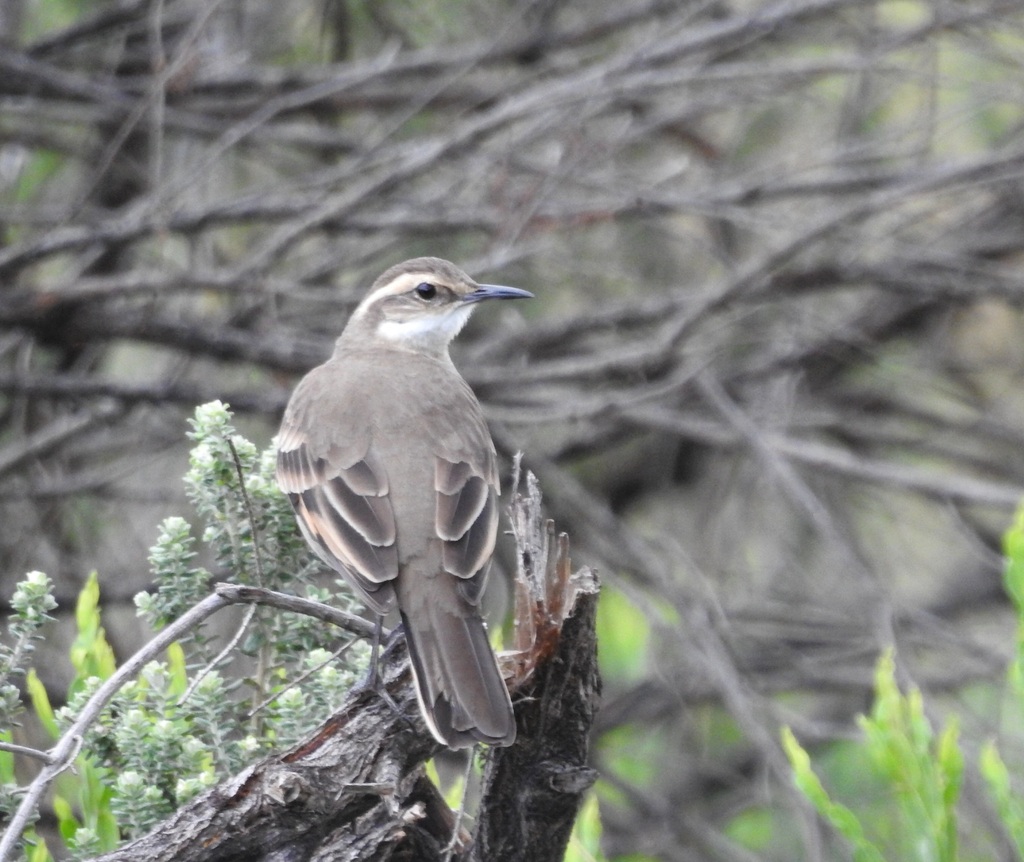
Long-tailed Cinclodes
Photo © Marcelo Schmidt Roberti
Photo © Marcelo Schmidt Roberti — CC BY 4.0 — Source: iNaturalist #354809522The long-tailed cinclodes (Cinclodes pabsti) is a Near Threatened species of bird in the Furnariinae subfamily of the ovenbird family Furnariidae. It is endemic to Brazil. == Taxonomy and systematics == The long-tailed cinclodes is basal to the genus Cinclodes and is not very closely related to other species of the genus. It has two subspecies, the nominate C. p. pabsti (Sick, 1969) and C. p. espinhacensis (Freitas, Chaves, Costa, Santos, FR & Rodrigues, 2012). The second was described as a full species but differs little genetically and morphologically from the nominate. The long-tailed cinclodes' specific epithet commemorates the Brazilian botanist Guido Frederico João Pabst. == Description == The long-tailed cinclodes is 20 to 22 cm (7.9 to 8.7 in) long and weighs 43 to 55 g (1.5 to 1.9 oz). It is a large cinclodes with a fairly long and straight bill. The sexes have the same plumage. Adults of the nominate subspecies have a wide, distinct, white supercilium that narrows past the eye and a dark band through the eye that widens over the ear coverts. Their upperparts are grayish brown with their crown slightly darker than the back. Their wing has two wide but indistinct cinnamon-buff bars…
Serra do Cipó National Park
Brazil
+379 birds+5 mammals
Where granite escarpments rise above the Atlantic Forest transition zone in southeastern Brazil, Serra do Cipó National Park unfolds across a landscape of dramatic ridges, cascading…
VIEW NATIONAL PARKSão Joaquim National Park
Brazil
+222 birds+9 mammals
Where the southern Brazilian highlands rise above the Atlantic Forest, São Joaquim National Park protects nearly 1,000 square kilometers of montane terrain that shifts between temperate…
VIEW NATIONAL PARKSerra Geral National Park
Brazil
+211 birds+2 mammals
Where basalt cliffs and sandstone escarpments rise above the subtropical forests of southern Brazil, Serra Geral National Park preserves one of the Atlantic region's most dramatic…
VIEW NATIONAL PARKNo community photos yet. Log in to add the first one.
No community observations of this species yet.