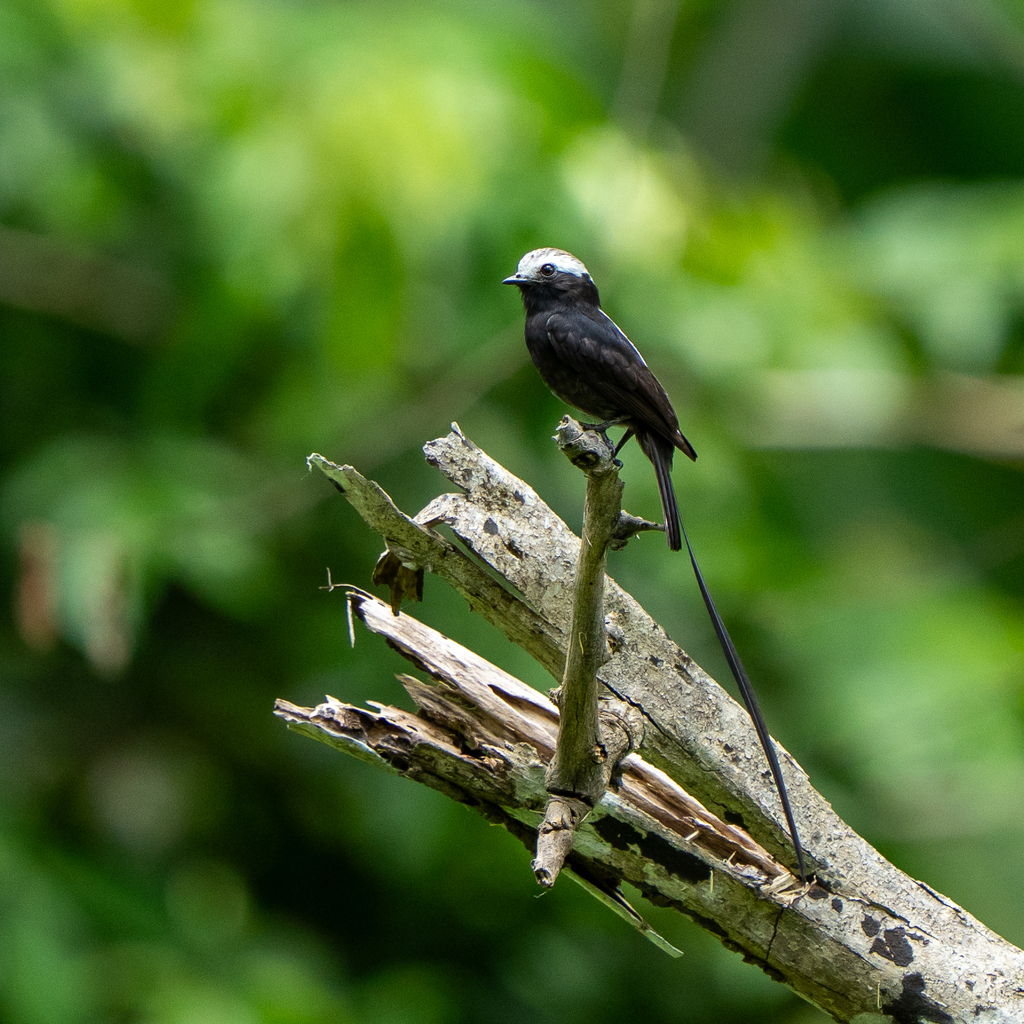
Long-tailed Tyrant
Photo © Anthony Batista
Photo © Anthony Batista — CC BY 4.0 — Source: iNaturalist photo #503861386Identification
The long-tailed tyrant is a small but unmistakable flycatcher, with males measuring 23–28 cm and females 18–22 cm in length—measurements that exclude their extraordinary elongated central tail feathers. Adult males of the nominate subspecies are mostly dull black with a striking white forehead and forecrown, whitish rump, and grayish-black belly. Their most distinctive feature is a pair of central tail feathers that extend up to 13 cm beyond the others, often appearing worn or broken. Females are noticeably paler and grayer than males, with a darker crown, grayer rump, shorter tail streamers, and a white-mottled belly. All subspecies share a dark iris, short wide black bill, and black legs and feet. Juveniles are paler sooty gray with a faint whitish crown stripe and only slightly projecting tail feathers.
Range & Habitat
This species has a disjunct distribution across Central America and South America, found from Honduras south through every mainland South American country except Chile and Uruguay. It inhabits a variety of semi-open landscapes in tropical and lower subtropical zones, including forest edges, woodland, gallery forest, early successional growth, plantations with snags, and natural gaps in the forest interior. Elevations vary by region: it ranges from sea level to 900 m in Central America, reaching up to 1,300 m in Colombia, 2,300 m in Peru, and mostly below 1,200 m across the rest of its range in South America.
Behaviour & Diet
The long-tailed tyrant is a year-round resident throughout most of its range, with populations at the southern extreme possibly moving north during the austral winter. It feeds exclusively on insects, specializing in stingless bees in some areas such as Costa Rica. This bird typically forages in pairs or small family groups, never joining mixed-species flocks. It adopts a characteristic hunting style, perching high and openly on dead snags or exposed branches—often the same tree where it nests—flicking its tail streamers up and down before hawking for prey in mid-air and returning to its perch after each capture.
Best Time & Places to See It
The breeding season varies geographically: March to July in Central America, Colombia, and Venezuela; October to January in Argentina. The species is considered fairly common in Honduras and Costa Rica, and locally common in Colombia. Look for it in semi-open forest edges and around standing snags in plantations, where its distinctive silhouette and tail-flicking behavior make it relatively easy to spot once you know where to search.
Photography Tips
The long-tailed tyrant's open perching behavior and habit of returning to the same snag make it an excellent subject for patient photographers. Position yourself with early morning or late afternoon light to capture the glossy black plumage and the dramatic elongated tail streamers. The bird's distinctive tail-flicking display provides dynamic compositional opportunities. Look for individuals perched at forest edges or in open gaps where you can achieve clear sight lines and favorable lighting without excessive background clutter.
Amazônia National Park
Araucárias National Park
Arenal Volcano National Park
Bahuaja Sonene National Park
Barbilla National Park
Barra del Colorado National Wildlife Refuge
Brasília National Park
Braulio Carrillo National Park
Cahuita National Park
Nothing matches these filters.
No community photos yet. Log in to add the first one.
No community observations of this species yet.