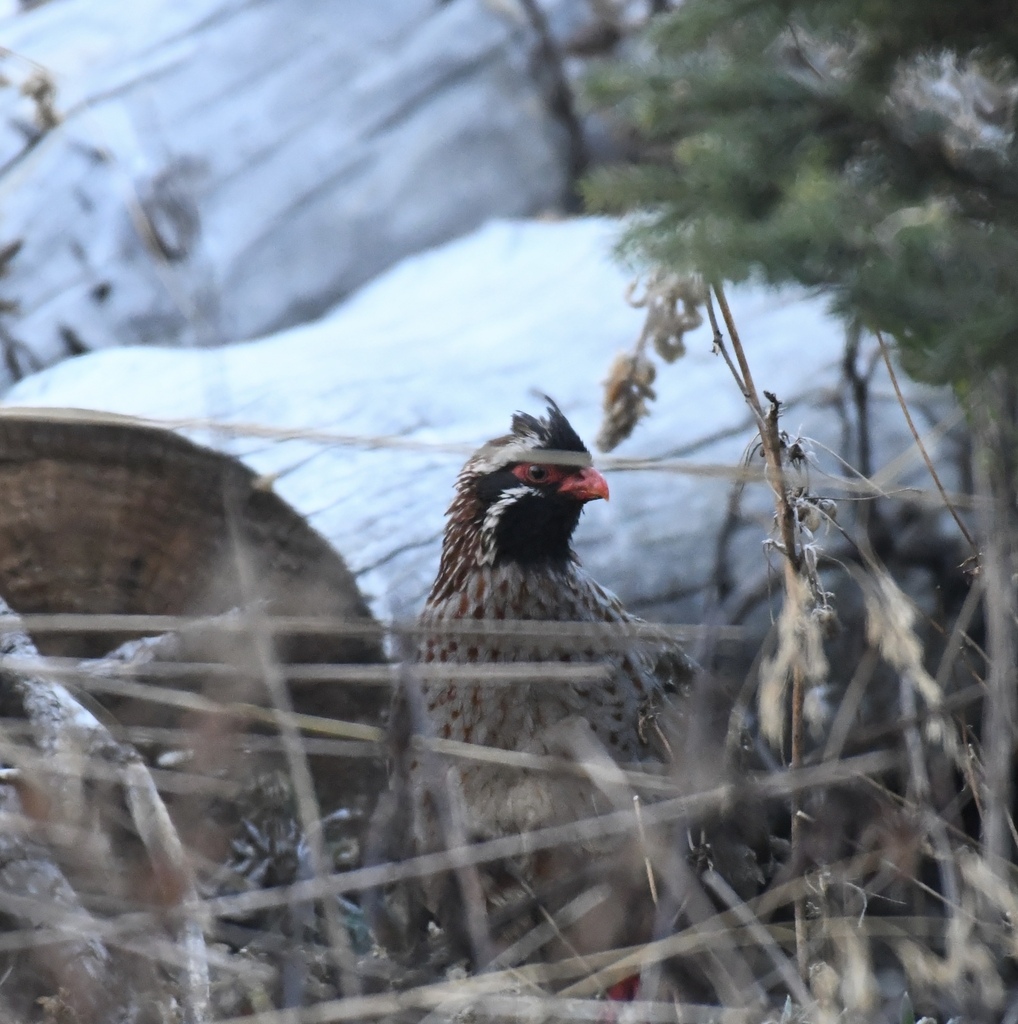
Long-tailed Wood Partridge
Photo © Alberto Alcalá
Photo © Alberto Alcalá — CC BY 4.0 — Source: iNaturalist #198682597Identification
The long-tailed wood partridge is a distinctive member of the New World quail family, measuring 29 to 42 centimetres in length and weighing between 266 and 465 grams, with males noticeably heavier than females. Both sexes sport an elongated tail, though females carry a somewhat shorter version. The bird's most striking features include a predominantly black head with white streaking above and below the eye, and a short crest on the crown tipped with buff colouration. The upper back displays rich chestnut tones edged with grey, while the lower back shows a complex mottling of olive brown, black, and tawny. The breast appears bluish-grey with chestnut streaking. Juveniles resemble adults but display dark brown spotting and less chestnut on their underparts.
Six subspecies are recognised, distributed across different regions of Mexico, with variations in plumage colouration among them, though it remains unknown whether vocal or genetic differences exist beyond these visual distinctions.
Range & Habitat
The long-tailed wood partridge is found exclusively in Mexico, where six subspecies occupy four discrete geographical zones spanning from east-central to southern regions. The species inhabits humid montane forests characterised by dense understories, including pine-oak, pine, fir, and montane evergreen forest types. These birds are creatures of elevation, ranging between 1,200 and 3,300 metres above sea level, making them inhabitants of Mexico's highland regions.
Behaviour & Diet
This partridge is primarily a ground forager, scratching through leaf litter in search of food, though it also climbs low branches to feed. Its diet consists mainly of seeds and small fruits, supplemented by small arthropods and leaves. The species is notably vocal during breeding season, which extends from February through September, with actual nesting beginning in late April. Birds produce a complex, loud, and rhythmic song typically delivered as a duet by paired birds, described as a "loud, ringing korr-EEE-oh" repeated several times. Pairs vocalise at any hour during breeding season and primarily at dawn and dusk from their night roost otherwise. They also produce a distinctive alarm call comprising repetitions of short, low-pitched squeaky notes.
Best Time & Places to See It
The breeding season, from February to September, offers the best opportunity to locate this species through its loud, distinctive vocalisation. The long-tailed wood partridge's range encompasses multiple Mexican states including Veracruz, Mexico State, Morelos, Jalisco, Michoacán, Guerrero, and Oaxaca. Birders should focus on montane forest habitats within the elevation range of 1,200 to 3,300 metres, particularly in areas with dense understories that provide good cover for these relatively elusive birds.
Photography Tips
The dense understory habitat and ground-foraging behaviour of the long-tailed wood partridge make it challenging to photograph. Early morning and dusk visits during breeding season will increase the likelihood of hearing birds vocalise, which may lead to sightings. The bird's striking black head with white facial streaks and distinctive crest, combined with its chestnut and grey upper parts, make for compelling subjects when photographed in good light. Patience is essential, as this species tends to remain concealed within dense vegetation. A telephoto lens is recommended for capturing detail without disturbing the birds.
No community photos yet. Log in to add the first one.
No community observations of this species yet.