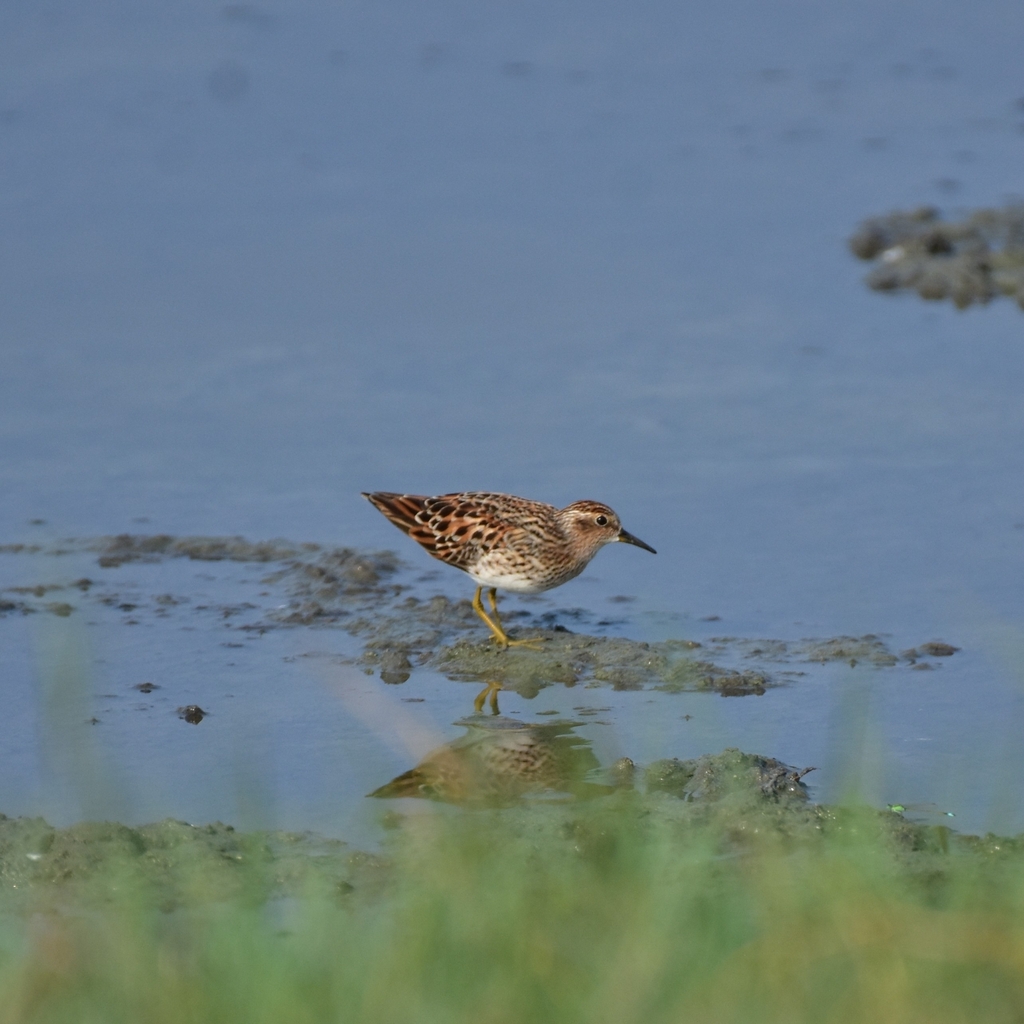
Long-toed Stint
Photo © Renjith Jacob Mathews
Photo © Renjith Jacob Mathews — CC BY 4.0 — Source: iNaturalist #190557678Identification
The long-toed stint is a diminutive wader, measuring just 13 to 16 centimetres in length with a wingspan of 26.5 to 30.5 centimetres. At around 25 grams, it ranks among the tiniest shorebirds. Its most distinctive features include yellowish legs, a short dark bill with a pale base on the lower mandible, and a notably slender neck. The bird's proportions are refined and delicate, with long, slender toes—particularly the middle toe—that are proportionally longer than in related species.
Breeding adults display rich brown upperparts with darker feather centres, white underparts, a brown crown, and a pale streak above the eye. Winter plumage shifts to grey above. Juveniles are brightly patterned with rufous colouration and white mantle stripes. The long-toed stint's more slender build, longer neck, longer toes, brighter colours, and weaker wingbar distinguish it from the very similar least sandpiper of North America. Its distinctive flight call and characteristic stance further aid identification in the field.
Range & Habitat
This strongly migratory species breeds across northern Asia during the Northern Hemisphere summer, with populations concentrated in Siberia including the Chukchi Peninsula, Koryak Plateau, Commander Islands, Kuril Islands, regions bordering the Sea of Okhotsk, north Verkhoyansky District, and areas around the Ob and Irtysh rivers. Its breeding habitat comprises tundra, taiga, open grassy bogs, and swamps, typically featuring mosses, sedges, and dwarf willows.
After breeding, the species undertakes impressive migrations southward through China, Indochina, Malaysia, and the Philippines, and westward to Burma, Bangladesh, Nepal, Sri Lanka, and the Maldive Islands. It winters across south and southeast Asia and Australasia, including New Guinea and Australia. In overwintering ranges, it frequents shallow freshwater or brackish wetlands, lakes, swamps, floodplains, marshes, lagoons, and muddy shores. It is a very rare vagrant to western Europe and occurs irregularly in the northwestern USA, Hawaii, Melanesia, Sweden, Great Britain, and South Africa.
Behaviour & Diet
Long-toed stints forage in wet habitats, methodically picking up food by sight and sometimes probing the ground with their bills. Their diet comprises small crustaceans, molluscs, insects, snails, amphibians, and other invertebrates, along with seeds. They roost in hollows within soft mud or low vegetation bordering their feeding areas, remaining close to their foraging grounds.
Little is documented about their breeding habits, though they nest on the ground in well-hidden, shallow depressions typically situated on mounds of sedge or dried grass. Males perform distinctive display flights during the breeding season. The species' flight call is diagnostic and helps distinguish it from other similar sandpipers in the field.
Best Time & Places to See It
In Asia and Australasia, the species is best observed during its winter months (Northern Hemisphere winter) when concentrations of migrants and wintering birds visit suitable wetlands. Key overwintering habitats—shallow lakes, swamps, floodplains, and muddy shores throughout south and southeast Asia, New Guinea, and Australia—offer the best opportunities for encounters. Sewage ponds and other marginal wetlands can attract this species during migration.
Breeding birds are primarily accessible in remote Siberian regions during the brief northern summer, requiring specialized expedition travel. Western European observers should note that sightings remain exceptionally rare vagrants, though occasional records occur in Great Britain and Scandinavia, typically during migration periods.
Photography Tips
Photograph long-toed stints in their preferred wet habitats where their feeding behaviour is most active and predictable. Early morning light enhances visibility of their subtle plumage details—the pale eyebrow stripe, brown crown, and pale underparts. The bird's characteristic stance, with its slender neck extended and body held upright, is photogenic and diagnostic.
Capturing their probing behaviour and distinctive gait requires patience and a slow approach. In breeding plumage, the rich brown upperparts and speckled breast are more colourful and photogenic than winter greys. Their small size necessitates longer focal lengths and good light conditions. Focus on the head and eye to showcase identifying features, and attempt to capture their unique flight profile and posture, which differ subtly from superficially similar stint species.
Fitzgerald River National Park
Fitzgerald River National Park, Australia
+209 birds+11 mammals
Where granite peaks rise above windswept heathlands and pristine river systems carve through untamed wilderness, one of Australia's most biodiverse landscapes unfolds across the southwestern corner…
VIEW NATIONAL PARKSt. Paul Island
Saint Paul, United States
+255 birds+8 mammals
Windswept tundra rolls across this remote Pribilof island, where volcanic basalt cliffs plunge into the Bering Sea and fog rolls in thick enough to erase the…
VIEW PROTECTED LANDSCAPEBaikal National Park
Ольхонский район, Russia
+184 birds+11 mammals
Where the world's deepest freshwater lake meets ancient Siberian taiga, Baikal National Park sprawls across 66,203 square kilometers of one of Earth's most singular ecosystems. The…
VIEW NATIONAL PARKBako National Park
Kuching, Malaysia
+210 birds+17 mammals
Weathered sandstone cliffs rise dramatically from the South China Sea, their ochre faces sculpted by millennia of wind and tide into a landscape of extraordinary geological…
VIEW NATIONAL PARKWest Bali National Park
Gerokgak, Indonesia
+240 birds+8 mammals
Across West Bali's northwestern reaches, where the Indian Ocean meets volcanic slopes and limestone cliffs plunge toward turquoise shallows, sprawls a protected realm of roughly 325…
VIEW NATIONAL PARKHustai National Park
Altanbulag, Mongolia
+198 birds+16 mammals
Where the steppe rolls endlessly beneath vast Mongolian skies, Hustai National Park preserves one of Central Asia's most dynamic grassland ecosystems. Rolling hills and open prairie…
VIEW NATIONAL PARKGobi Gurvan Saikhan National Park
Tsagaan Subarga Hural, Mongolia
+183 birds+23 mammals
Where rust-coloured badlands rise from the southern Gobi steppe, the terrain transforms into a landscape of geological drama that few visitors expect to find in Mongolia's…
VIEW NATIONAL PARKStirling Range National Park
Australia
+149 birds+7 mammals
Where ancient quartzite ranges rise abruptly from the southwestern Australian plateau, Stirling Range National Park unfolds as a realm of dramatic escarpments, deep valleys, and surprising…
VIEW NATIONAL PARKNortheast China Tiger and Leopard National Park
Mu Dan Jiang Shi, China
+202 birds+19 mammals
Across the temperate forests of northeastern China, where winters grip the landscape in subzero silence and summers remain cool and brief, the Mudanjiang region supports a…
VIEW NATIONAL PARKPoyang Lake National Nature Reserve
Shangrao, China
+270 birds+7 mammals
Where the Yangtze River's massive floodplain spreads across central China, Poyang Lake National Nature Reserve encompasses one of the continent's most dynamic and water-rich wetland systems.…
VIEW NATURE RESERVEQinghai Lake National Nature Reserve
Hainan Tibetan Autonomous Prefecture, China
+243 birds+11 mammals
At 3,200 metres above sea level on the Tibetan plateau, where winter temperatures plunge far below freezing and snow blankets the landscape for half the year,…
VIEW NATURE RESERVENo community photos yet. Log in to add the first one.
No community observations of this species yet.