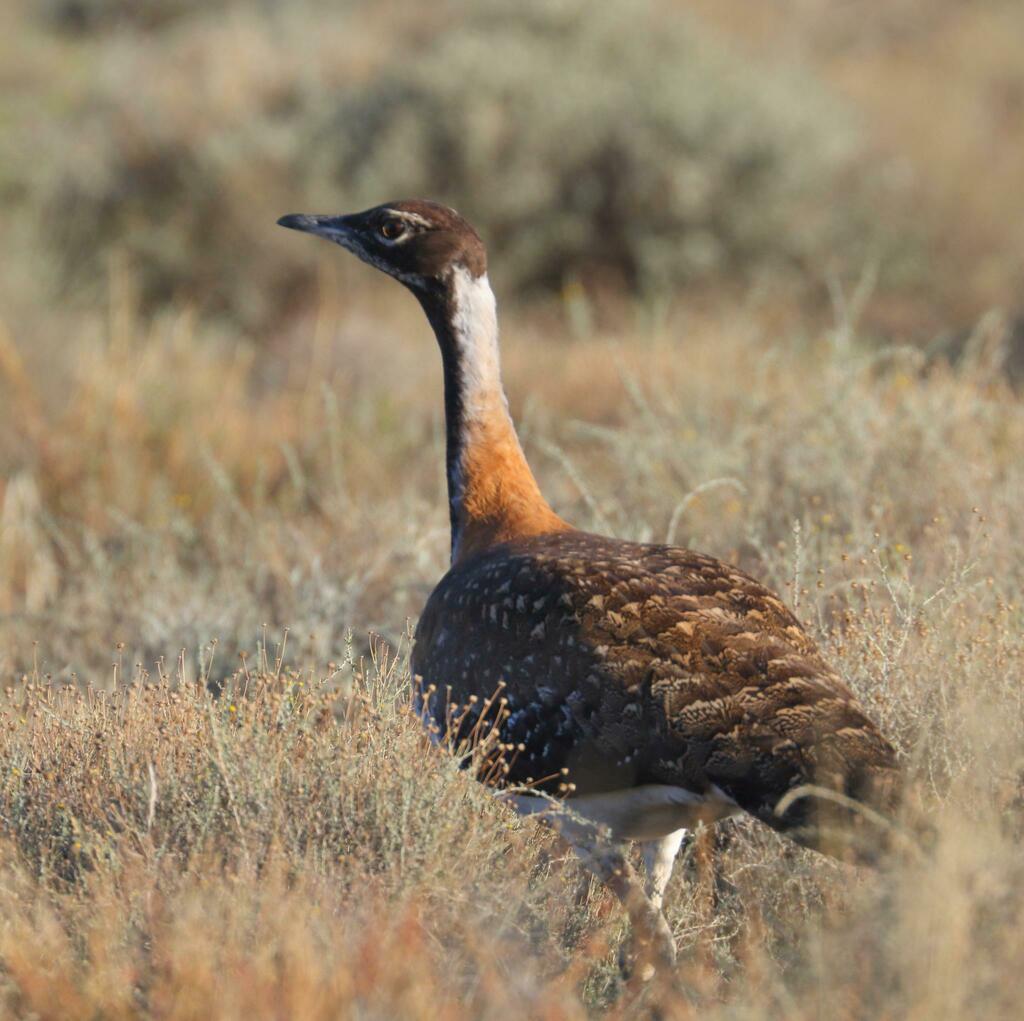
Ludwig’s Bustard
Photo © Alan Manson
Photo © Alan Manson — CC BY 4.0 — Source: iNaturalist #154811053Identification
Ludwig's bustard is a medium-to-large terrestrial bird, with males significantly larger than females. Males measure 80–95 cm in length and weigh an average of 6.3 kg, while females are smaller at 76–85 cm and around 3.4 kg. The species has a distinctive appearance: the face and front neck are grey-brown, contrasting sharply with a white back of the neck and face, and a dull orange nape. Females and juveniles are noticeably smaller and have slightly lighter coloring on the face and front neck.
Ludwig's bustard is often confused with Denham's bustard (Neotis denhami), which shares similar proportions and grassland habitat. However, Denham's bustard has paler grey facial markings, a browner nape, and distinctive black-and-white crown stripes that Ludwig's bustard lacks. Careful attention to these field marks will help distinguish the two species in the field.
Range & Habitat
This bustard is confined to the western side of Southern Africa, with populations primarily in western South Africa, Namibia, and occasionally in Botswana, across a range of roughly 380,000 km². The species inhabits grasslands and semi-arid regions typical of bustard ecology, and shows a strong preference for modified habitats such as agricultural fields and pastures. The total population is estimated at approximately 114,000 birds in South Africa alone, with historical estimates from the 1980s suggesting 56,000–81,000 individuals across their full range.
Behaviour & Diet
Ludwig's bustards are not gregarious birds, typically seen in small groups averaging 2.13 individuals in summer and 3.56 in winter. Their diet is varied and opportunistic, including insects (particularly locusts), small ground-dwelling vertebrates, flowers, and seeds. The species' mating call is a distinctive deep 'bloop' vocalization, though detailed information on other vocalizations remains limited.
Breeding occurs during March in Namibia, though scientific study of reproductive behavior has been limited due to the remote, difficult terrain occupied by the species and their sensitivity to human disturbance. A major conservation concern is the species' vulnerability to collision with powerlines—estimated at 4,000–11,900 deaths annually. This occurs because bustards' visual anatomy creates blind spots that prevent detection of obstacles when looking downward during flight, potentially threatening the species' long-term survival.
Best Time & Places to See It
Ludwig's bustard is best observed in the grasslands and semi-arid regions of western South Africa and Namibia, where the largest populations occur. The species is most reliably found in modified agricultural habitats and pastures rather than pristine wilderness. Patience and careful scanning of open terrain are essential, as birds are typically encountered in small, dispersed groups rather than congregations. Early morning hours often offer the best viewing conditions, though the species is active throughout the day in suitable habitat.
Photography Tips
Photographing Ludwig's bustard requires patience and a vehicle-based approach, as the birds' aversion to direct human approach necessitates distance. A telephoto lens (400–600mm) is essential for obtaining frame-filling images. Wide-angle shots capturing the bird in its grassland habitat can effectively convey the species' ecological context and comportment. Early morning light provides optimal color rendition, particularly for the subtle grey-brown and white head patterns and orange nape. Keep movements slow and avoid sudden changes in vehicle direction, as these birds are easily alarmed and will flush at close approach.
Addo Elephant National Park
Augrabies Falls National Park
Bontebok National Park
Camdeboo National Park
Dorob National Park
Etosha National Park
Mokala National Park
Mountain Zebra National Park
Namib-Naukluft National Park
Nothing matches these filters.
No community photos yet. Log in to add the first one.
No community observations of this species yet.