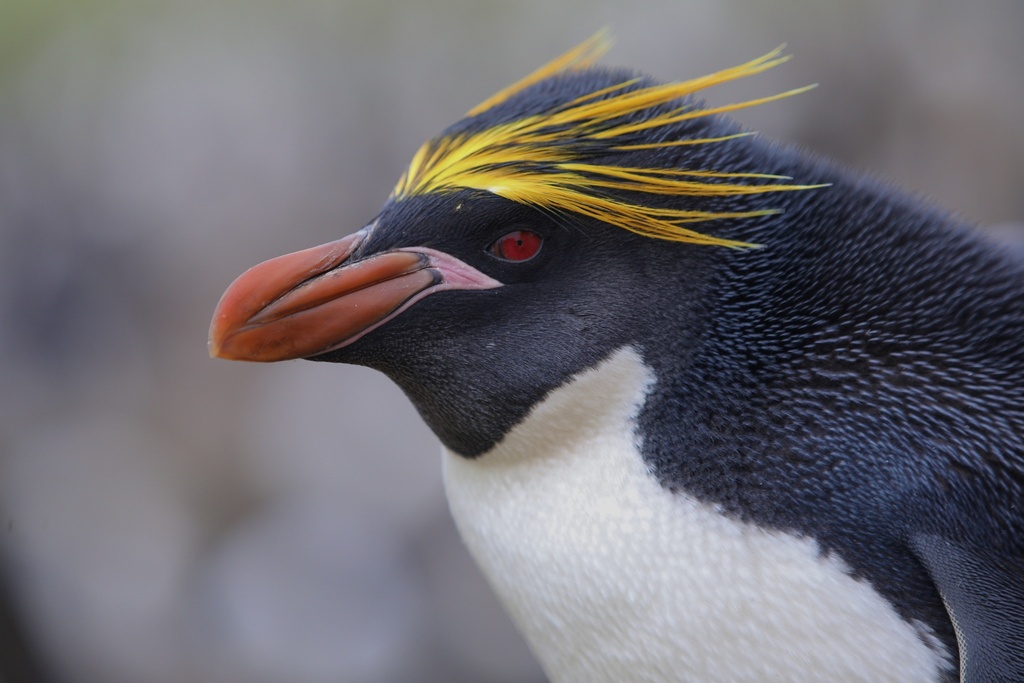
Macaroni Penguin
Photo © eloise kerroux
Photo © eloise kerroux — CC BY 4.0 — Source: iNaturalist photo #451026730Identification
The macaroni penguin is a large crested penguin averaging 70 cm (28 in) in length and weighing around 5.5 kg (12 lb) on average. Its most distinctive feature is a striking yellow crest that arises from the forehead and extends horizontally backward to the nape. The head, chin, throat, and upperparts are black and sharply contrasted against pure white underparts. Adults have a large, bulbous orange-brown bill, red iris, and pinkish bare skin patches extending from the bill base to the eye. The flippers are blue-black above with white trailing edges, and mainly white below with black tips. Males are slightly larger than females and possess relatively larger bills, a useful field distinction.
Immature birds are smaller with duller, brown bills, dark grey chins and throats, and absent or underdeveloped head plumes—often just scattered yellow feathers. The crest reaches full development by three to four years of age, a year or two before breeding maturity.
Range & Habitat
Macaroni penguins range from the Subantarctic to the Antarctic Peninsula, with at least 216 breeding colonies recorded across 50 sites worldwide. With approximately 18 million individuals, they represent the most numerous penguin species globally. After spending summer breeding ashore, they disperse into the oceans for six months. A 2009 study documented macaroni penguins from Kerguelen travelling over 10,000 km (6,200 mi) through the central Indian Ocean, demonstrating their remarkable pelagic range.
Behaviour & Diet
Macaroni penguins breed in colonies numbering up to 100,000 individuals—among the largest and densest of all penguin species. They moult once annually, spending three to four weeks ashore to replace all feathers. During this flightless period, they do not feed, having first accumulated fat reserves over approximately two weeks. Survival rates for breeding adults vary considerably, ranging from 49% to 78% in some populations.
Their diet comprises primarily krill and other crustaceans, supplemented by small fish and cephalopods. Remarkably, macaroni penguins consume more marine life annually than any other seabird species. However, widespread population declines have been recorded since the mid-1970s, leading to their vulnerable conservation status.
Best Time & Places to See It
Spring is the optimal season to observe macaroni penguins as they return to their breeding colonies following their winter ocean dispersal. The largest and most accessible colonies are found throughout the Subantarctic and Antarctic Peninsula regions, with significant populations breeding at multiple established sites across their range.
Photography Tips
The macaroni penguin's striking yellow crest and bold black-and-white plumage provide excellent photographic contrast, particularly in bright polar conditions. Capture the distinctive forehead crest and horizontal extension to the nape as your key identifying feature. During breeding season, dense colony behaviour offers opportunities for dramatic group compositions, while individual portraits should emphasize the red iris, orange bill, and facial bare skin patches. Exercise patience during moult periods when birds remain ashore, as this presents prolonged observation and photography opportunities without the disturbance of constant water entry and exit.
Cabo de Hornos National Park
Cooper Bay
Deception Island
Elsehul Bay
Fortuna Bay
Half Moon Island
Kidney Island
Murrell Farm
Port Stephens
Nothing matches these filters.
No community photos yet. Log in to add the first one.
No community observations of this species yet.