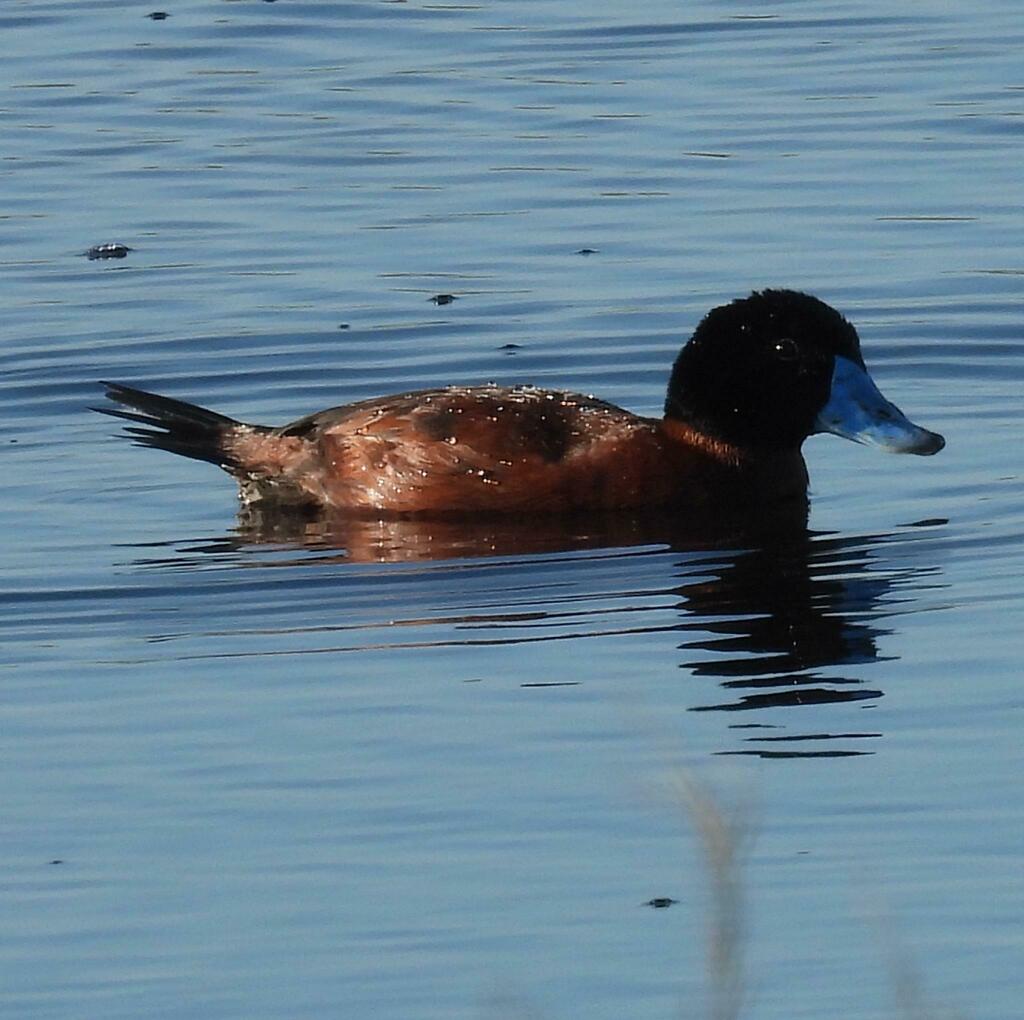
Maccoa Duck
Photo © Henry de Lange
Photo © Henry de Lange — CC BY 4.0 — Source: iNaturalist #191439273Identification
The Maccoa duck is a stiff-tailed diving duck easily recognised by its distinctive posture: members of this group are often found wading in water with their tail feathers cocked upwards. Their bodies are highly specialised for underwater swimming, with legs positioned far back on the body—an adaptation that makes them awkward walkers on land but agile divers in water.
Breeding males are unmistakable, featuring a striking cobalt blue bill extending from a completely black head and throat. The breast and back are chestnut-coloured, while the underparts are greyish-brown, the rump dark brown, and the tail and feet black. In flight, white axillaries and off-white underwing feathers are visible. Females are considerably duller, with a greyish-black bill tipped with light, a light brown face marked by a dark crown and cheek stripe, and an off-white throat. Both sexes have black tail feathers and feet. Non-breeding males resemble females but retain a darker crown and hints of chestnut on the back, while juveniles are similar to females but possess slimmer, notched tail feathers and darker brown crowns.
Range & Habitat
The Maccoa duck is found throughout Eastern and Southern Africa as a sedentary species, meaning it does not migrate seasonally but rather moves locally to find suitable wetlands. The global population in 2012 was believed to be approximately 11,000 individuals, with roughly 75 percent residing in Southern Africa; South Africa alone hosts half of the global population. Main populations are spread far apart across the continent with large gaps between them, likely due to climatic variation and the scarcity of desirable wetland habitats.
Outside the breeding season, these ducks occupy inland waters ranging from fresh to brackish, including lakes, ponds, salty flooded water pans, dams, and river mouths—even sewage ponds. During breeding, they prefer similar habitats but require both open freshwater and adjacent emerging vegetation, particularly Typha species, where they build hidden nests. Interestingly, human infrastructure has inadvertently benefited the species; large populations have established behind dams across Namibia, including the Friedenau Dam, Borodino Dam, and Walvis Bay Sewage Works, where deep freshwater habitats provide ideal conditions for these diving ducks.
Behaviour & Diet
Maccoa ducks are omnivores whose diet consists primarily of aquatic invertebrates and plants. They dive to the bottom of lakes and ponds, filling their bills with dark debris; average dives last between 15 and 22 seconds. Males produce distinctive vocalisations during mating displays, including short whistles or a prrrr'ing sound lasting 2 to 3 seconds. When threatened, both sexes emit low grunts as a warning.
Best Time & Places to See It
Southern Africa, particularly South Africa, offers the best opportunities for viewing Maccoa ducks, as the region holds approximately half the global population. The species is sedentary year-round, so viewing is possible throughout the year at suitable wetland sites. Notable locations include the major dam systems across Namibia—the Friedenau Dam, Borodino Dam, and Walvis Bay Sewage Works—where large, accessible populations have become established.
Photography Tips
The striking plumage of breeding males makes them particularly photogenic subjects. Position yourself near open water where these diving ducks surface after feeding runs; the characteristic cocked tail posture offers distinctive silhouettes. Capture males in flight to showcase the white underwing feathers and axillaries. Since Maccoas are awkward on land due to their rear-positioned legs, focus on water-based shots where they display natural behaviour and grace. Early morning light will best highlight the cobalt blue bill and black head markings of breeding males.
Serengeti National Park
Tanzania
+558 birds+57 mammals
Across Tanzania's northern plateau, where volcanic soils meet acacia woodland and open grassland, unfolds one of Earth's most dynamic ecosystems. The Serengeti National Park sprawls across…
VIEW NATIONAL PARKArusha National Park
Tanzania
+555 birds+16 mammals
Where the slopes of Mount Mawenzi rise above the Arusha region, a compact yet ecologically rich national park unfolds across montane forest, moorland, and alpine zones.…
VIEW NATIONAL PARKKhaudum National Park
Botswana
+213 birds+13 mammals
Where the Okavango's northern tributaries meander through miombo woodland and riverine forest, Khaudum National Park unfolds across a landscape of profound ecological richness and isolation. This…
VIEW NATIONAL PARKAmboseli National Park
Etonet/Lenkism ward, Kenya
+501 birds+43 mammals
Where the Amboseli basin opens toward the Tanzanian frontier, a shallow alkaline lake mirrors vast skies across one of East Africa's most iconic savanna landscapes. The…
VIEW NATIONAL PARKTarangire National Park
Tanzania
+527 birds+50 mammals
Acacia woodland and grassland sweep across the Manyara Region where the Tarangire River carves through low hills and volcanic soils, creating one of East Africa's most…
VIEW NATIONAL PARKNgorongoro Conservation Area
Tanzania
+626 birds+55 mammals
Volcanic calderas and open grassland dominate this high plateau in northern Tanzania, where the landscape rises above 2,000 metres and ancient geological forces have shaped both…
VIEW WILDLIFE MANAGEMENT AREAGarden Route National Park
George, South Africa
+353 birds+54 mammals
Sweeping across the Western Cape's coastal and mountainous terrain, this sprawling national park encompasses over five thousand square kilometers of extraordinarily diverse landscape—from coastal limestone cliffs…
VIEW NATIONAL PARKPilanesberg National Park
Moses Kotane Local Municipality, South Africa
+364 birds+49 mammals
Granite peaks and volcanic ridges rise unexpectedly from the savanna floor across this 734-square-kilometre expanse in the North West province, creating a landscape of profound ecological…
VIEW NATIONAL PARKMokala National Park
Siyancuma Local Municipality, South Africa
+246 birds+35 mammals
Across the semi-arid savanna of the Northern Cape, where red earth meets sparse acacia woodland and open grassland punctuated by rocky outcrops, lies a landscape shaped…
VIEW NATIONAL PARKKruger National Park
Ba-Phalaborwa Local Municipality, South Africa
+540 birds+91 mammals
Across the low-lying savanna of northeastern South Africa unfolds one of Africa's largest and most ecologically intact protected areas, where acacia woodlands merge into mopane scrub…
VIEW NATIONAL PARKAgulhas National Park
Cape Agulhas Local Municipality, South Africa
+224 birds+13 mammals
Where the Atlantic and Indian Oceans meet at Africa's southernmost tip, Agulhas National Park stretches across 892 square kilometres of windswept coastal landscape and rugged limestone…
VIEW NATIONAL PARKTankwa-Karoo National Park
Hantam Local Municipality, South Africa
+201 birds+20 mammals
Across the semi-arid heartland of the Northern Cape, where winter rains carve ephemeral watercourses through endless ochre plains, Tankwa-Karoo National Park sprawls across more than 3,100…
VIEW NATIONAL PARKAddo Elephant National Park
Sundays River Valley Local Municipality, South Africa
+388 birds+55 mammals
Where the Eastern Cape's semi-arid scrublands meet transitional woodland, Addo sprawls across 13,478 square kilometres of one of southern Africa's most biodiverse landscapes. The terrain rises…
VIEW NATIONAL PARKKhaudum National Park
Namibia
+221 birds+13 mammals
Where the Kavango River flows through northeastern Namibia, vast miombo woodlands and riverine forests create one of southern Africa's most remote and biodiverse wilderness corridors. Khaudum…
VIEW NATIONAL PARKSperrgebiet National Park
Barcelona, Namibia
+181 birds+18 mammals
Where the Namib's ancient gravel plains meet the Atlantic coast, one of Africa's most remote and geologically austere landscapes unfolds across more than 56,000 square kilometres.…
VIEW NATIONAL PARKDorob National Park
Henties Bay, Namibia
+230 birds+13 mammals
Where the Skeleton Coast meets the Namib Desert's inland reaches, Dorob National Park sprawls across 34,021 square kilometres of one of southern Africa's most austere and…
VIEW NATIONAL PARKSkeleton Coast Park
Barcelona, Namibia
+143 birds+7 mammals
Where the Atlantic's cold Benguela Current collides with one of Africa's most hostile coastlines, the Skeleton Coast Park sprawls across more than 104,000 square kilometres of…
VIEW OBSERVATION POINTEtosha National Park
Namibia
+356 birds+58 mammals
Across northern Namibia's stark semi-arid plateau, a vast shallow depression transforms seasonally into one of Africa's most dramatic wildlife theaters. Etosha National Park, encompassing more than…
VIEW NATIONAL PARKAbijata-Shalla Lakes National Park
Ethiopia
+438 birds+7 mammals
Two crater lakes of contrasting chemistry define this remote corner of Ethiopia's Rift Valley, where soda lakes and freshwater basins create a mosaic of distinct aquatic…
VIEW NATIONAL PARKLake Nakuru National Park
Nakuru West, Kenya
+494 birds+32 mammals
Alkaline waters ringed by acacia woodland and grassland create one of East Africa's most distinctive wetland ecosystems, where the interplay of geology and climate sustains a…
VIEW NATIONAL PARKAberdare National Park
Mweiga ward, Kenya
+394 birds+30 mammals
Where the central highlands of Kenya rise to their elemental grandeur, the Aberdare range unfolds across Nyeri County as a montane stronghold of cool, misty forest…
VIEW NATIONAL PARKNo community photos yet. Log in to add the first one.
No community observations of this species yet.