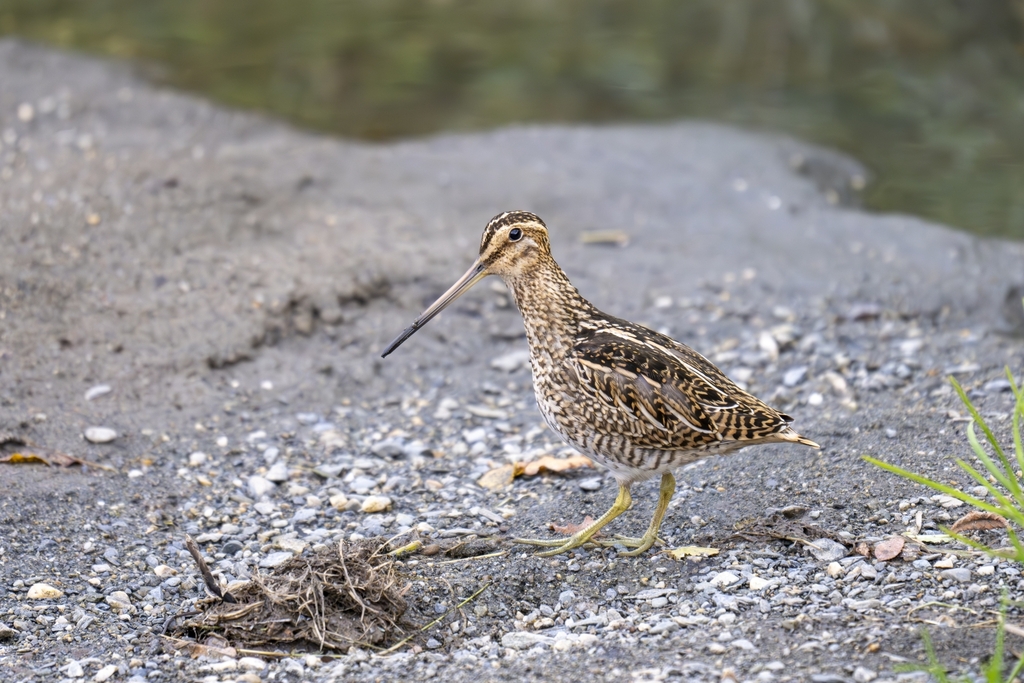
Magellanic Snipe
Photo © Charlotte Kirchner
Photo © Charlotte Kirchner — CC BY 4.0 — Source: iNaturalist photo #468029974Identification
The Magellanic snipe is a compact wading bird with cryptic plumage that blends seamlessly into its wetland surroundings. Its face displays distinctive tan and darker brown stripes, while its upperparts show a complex pattern of muted whitish, buffy, rufous, and black markings on a brown background. The breast is finely vermiculated, and the flanks feature dark and light barring. Look for its characteristic long, thick bill with a dull pinkish colour and black tip—a feature shared with other snipes but useful for identification. The upper tail surface is rufescent with irregular bars and white tips, and its yellowish legs complete the picture of a bird perfectly adapted to concealment in damp grasslands.
Range & Habitat
The Magellanic snipe is found exclusively in South America, ranging from north-central Chile and northwestern Argentina south into Tierra del Fuego and the Falkland Islands. It is a partial migrant, with populations from Tierra del Fuego and mainland areas moving north for the austral winter, reaching northeastern Argentina and Uruguay during this period. Some birds remain on the Falklands year-round, though most apparently migrate to the mainland.
This species favours a variety of damp and wet landscapes, making it adaptable across different terrain types. Look for it in pampas, peat bogs, flooded steppe, tussock grasslands, marsh edges, and occasionally swampy woods. Its preference for wet habitats makes it most active during dawn and dusk when moisture levels are typically highest and invertebrates are most accessible.
Behaviour & Diet
The Magellanic snipe forages by probing in soft mud and wet soil, using its sensitive bill to detect prey beneath the surface. While its complete diet remains poorly documented, it feeds on invertebrates including insect larvae and earthworms. Like other snipes, it is most active during low-light hours when feeding opportunities are greatest.
During breeding season—which spans August to November on the mainland and August to October on the Falklands—males perform spectacular winnowing displays, flying high in circles before taking shallow dives to produce a distinctive sound created by air flowing over the outer tail feathers. The bird's repertoire of calls is remarkably varied, including chip calls, chipper calls, flight calls, and flush calls, all serving different communication purposes from ground level to flight.
Best Time & Places to See It
The austral breeding season (August to November on the mainland, August to October on the Falklands) offers the best chance to encounter this species, when winnowing displays and vocalisations make birds more detectable. During the non-breeding season, northeastern Argentina and Uruguay host visiting populations from further south. The Falkland Islands support year-round residents, though numbers fluctuate seasonally.
Search peat bogs, flooded steppe, and marsh edges where waterlogged ground provides ideal probing habitat. Early morning and evening visits to suitable wetland areas offer the greatest likelihood of observation, as the snipe's cryptic plumage makes daytime spotting challenging.
Photography Tips
The Magellanic snipe's camouflaged plumage presents a significant photographic challenge, but patience and a methodical approach pay dividends. Visit wet grasslands and bog areas during dawn or dusk when birds are most active. Use a telephoto lens (at least 400mm) to capture details without disturbing the bird. Focus on the head markings and distinctive bill to distinguish this species from other snipes.
If you visit during breeding season, position yourself to observe or photograph the male's winnowing display, a dramatic behaviour that makes excellent documentary footage. Sound recording of the varied vocalisations also complements visual documentation. Remember that snipes flush readily when approached, so move slowly and deliberately, allowing the bird's natural curiosity to work in your favour.
Sea Lion Island
Sealion Island Settlement, Falkland Islands
+74 birds+3 mammals
Windswept tussock grasslands roll across volcanic terrain where Southern Ocean swells crash against rocky shores, creating one of the Falkland Islands' most dramatic wildlife theatres. This…
VIEW ISLAND & ARCHIPELAGOMurrell Farm
falskland islands, Falkland Islands
+54 birds
Rolling grasslands sweep across windswept plateaux where the South Atlantic exerts its relentless influence on the vegetation, sculpting tussock grassland into a tapestry of browns and…
VIEW NATURE RESERVECape Dolphin
falskland islands, Falkland Islands
+54 birds+1 mammals
Where windswept grasslands meet dramatic coastal cliffs, the Falkland Islands' northern reaches reveal one of the Southern Hemisphere's most compelling seabird sanctuaries. The terrain here is…
VIEW NATURE RESERVEVolunteer Point
Stanley, Falkland Islands
+70 birds+3 mammals
Windswept grasslands meet volcanic black sand beaches where three penguin species converge in the South Atlantic's most theatrical wildlife theatre. This remote peninsula on East Falkland…
VIEW NATURE RESERVEWest Point Island
West Point, Falkland Islands
+67 birds+3 mammals
Windswept cliffs plunge dramatically into the South Atlantic, their rust-coloured rock faces sculpted by millennia of gales and spray. This northwestern outpost of the Falkland Islands…
VIEW ISLAND & ARCHIPELAGOChiloé National Park
Dalcahue, Chile
+122 birds+6 mammals
Temperate rainforest cloaks the Chiloé archipelago's northwestern reaches, where granite ridges thrust through dense, moisture-laden canopy and freshwater streams carve ravines toward the Pacific. Across approximately…
VIEW NATIONAL PARKCabo de Hornos National Park
Cape Horn, Chile
+88 birds+9 mammals
Where the Andes plunge into the Southern Ocean and the Drake Passage churns between two continents, Cabo de Hornos National Park sprawls across one of Earth's…
VIEW NATIONAL PARKTorres del Paine National Park
Torres del Paine, Chile
+143 birds+10 mammals
Where granite spires pierce the Patagonian sky, Torres del Paine commands one of South America's most dramatic landscapes. Across 4,106 square kilometres of southern Chile, jagged…
VIEW NATIONAL PARKLaja National Park Lagoon
Antuco, Chile
+123 birds+1 mammals
Where the Andes descend into the Biobío Region's temperate forests, a vast lagoon fills the caldera of the extinct Antuco volcano, cradled by steep native woodland…
VIEW NATIONAL PARKCerro Castillo National Park
Coyhaique, Chile
+89 birds+3 mammals
Granite peaks and windswept steppe converge across this vast Patagonian landscape, where the Andes' eastern flank drops into terrain sculpted by ice age glaciers and relentless…
VIEW NATIONAL PARKPatagonia National Park
Cochrane, Chile
+133 birds+8 mammals
Where the Andes meet the Patagonian steppe, vast grasslands and shrublands sweep across rolling terrain carved by ancient glaciation, their contours softened by distance and dramatic…
VIEW NATIONAL PARKReserva Nacional Magallanes
Punta Arenas, Chile
+78 birds+2 mammals
Where windswept steppe meets sub-Antarctic forest near the southern tip of continental South America, Reserva Nacional Magallanes unfolds across roughly 352 square kilometres of profound ecological…
VIEW NATIONAL PARKParque Provincial Península de Magallanes
Argentina
+125 birds+4 mammals
Granite peaks and windswept steppe converge across this 415-square-kilometre peninsula jutting into the cold Atlantic waters of southern Patagonia, where the Magallanes landscape embodies the raw,…
VIEW NATIONAL PARKMonte León National Park
Argentina
+100 birds+4 mammals
Where the Patagonian steppe meets the Atlantic, Monte León National Park protects a landscape of windswept coastal cliffs, rocky outcrops, and semi-arid grassland spanning over 1,200…
VIEW NATIONAL PARKLos Glaciares National Park
Argentina
+121 birds+3 mammals
Where granite peaks and sprawling ice fields dominate the landscape, Los Glaciares National Park encompasses over ten thousand square kilometres of Patagonian wilderness in southern Argentina.…
VIEW NATIONAL PARKPerito Moreno National Park
Argentina
+78 birds
Where the Patagonian steppe descends into a landscape carved by ancient ice, Perito Moreno National Park sprawls across nearly 1,590 square kilometres of some of South…
VIEW NATIONAL PARKNahuel Huapi National Park
Argentina
+124 birds+11 mammals
Where the Andes descend toward Patagonia, vast glacial lakes cut through a landscape of southern beech forest and granite peaks, creating one of South America's most…
VIEW NATIONAL PARKLanín National Park
Argentina
+128 birds+7 mammals
Where the volcanic spine of the Andes plunges into Patagonian steppe, Lanín National Park sprawls across nearly 4,700 square kilometers of one of Argentina's most visually…
VIEW NATIONAL PARKLago Puelo National Park
Argentina
+109 birds+1 mammals
Where temperate forests descend to crystalline waters in the foothills of the Andes, Lago Puelo National Park sprawls across nearly 300 square kilometers of pristine wilderness…
VIEW NATIONAL PARKLos Alerces National Park
Argentina
+84 birds+3 mammals
Where the temperate rainforests of southern Patagonia sweep down towards crystalline lakes, Los Alerces National Park unfolds across nearly 3,000 square kilometres of one of South…
VIEW NATIONAL PARKNo community photos yet. Log in to add the first one.
No community observations of this species yet.