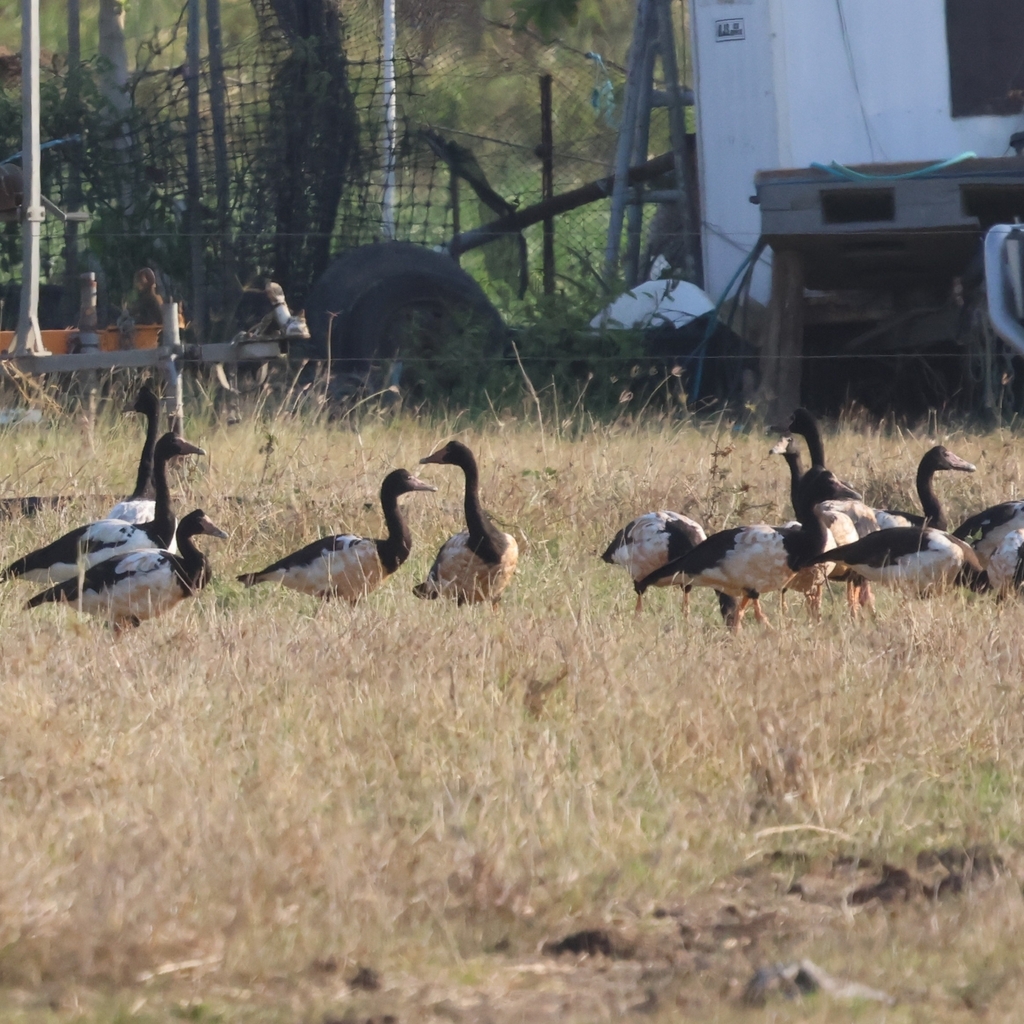
Magpie Goose
Photo © Luke Lythgoe
Photo © Luke Lythgoe — CC BY 4.0 — Source: iNaturalist #320633444Identification
The magpie goose is unmistakable among Australian and New Guinean waterbirds, thanks to its striking black-and-white plumage that appears in both sexes. This distinctive waterfowl measures 75–90 cm in length and weighs around 3 kg on average. It is characterized by a long neck and legs, a long hooked bill, and yellowish legs that make it easy to spot in its wetland habitat. Males are noticeably larger than females. Unlike true geese, the magpie goose undergoes a gradual molt, meaning it never becomes flightless—a unique adaptation among its relatives. Its loud honking call is a distinctive and often-heard feature of Australian wetlands where these birds congregate.
Range & Habitat
The magpie goose is found in northern Australia and southern New Guinea, inhabiting a variety of open wetland areas including floodplains and swamps. Historically, the species was widespread across southern Australia, ranging as far south as the Coorong and the wetlands of southeast South Australia and Western Victoria, but it has largely disappeared from these regions due to wetland drainage. Though not truly migratory, the birds sometimes travel large distances to find food and water, particularly outside the breeding season, and occasionally venture outside their core range.
Behaviour & Diet
Magpie geese are fairly sedentary except for some movement during the dry season. They feed on vegetation both in water and on land, consuming dry grass blades, grass seeds, spike rush bulbs, and wild rice. Their partially webbed feet are adapted for wading as much as swimming. These birds are colonial breeders and highly gregarious, forming large and noisy flocks of up to a few thousand individuals outside the breeding season. Nesting occurs on the ground or in trees up to five meters or higher, with typical clutches of five to 14 eggs. Remarkably, some males mate with two females, and all adults raise the young together—an unusual polygamous arrangement that increases chick survival rates when predation is high.
Best Time & Places to See It
The magpie goose is plentiful across its northern Australian range, where it is a reliable and rewarding sighting for nature travellers and photographers. The species is abundant enough to support a controlled hunting season and is a significant tourist attraction in the region. The birds are particularly vocal and conspicuous when gathered in large flocks outside the breeding season, making this an excellent period for observation. Northern Australia's wetlands, floodplains, and swamps offer the best opportunities to encounter these striking waterbirds in their natural habitat.
Photography Tips
The magpie goose's bold black-and-white plumage provides excellent contrast for photography, especially in the bright Australian light. The birds' tall stance, long necks, and yellowish legs create distinctive silhouettes that photograph well against water and sky. When gathered in flocks, magpie geese offer opportunities to capture group behaviour and interaction. The loud honking calls of these vocal birds provide audio cues to help locate concentrations of birds. Early morning and late afternoon light will enhance the striking contrast of their plumage. Patient photographers may also capture nesting behaviour and family groups during the breeding season.
Mount Coolum National Park
Sunshine Coast, Australia
+124 birds+3 mammals
Rising abruptly from the hinterland plateau of Queensland's Sunshine Coast, Mount Coolum commands attention as a distinctive volcanic remnant clothed in open eucalypt woodland and heathland…
VIEW NATIONAL PARKHerberton Range National Park
Australia
+115 birds+10 mammals
Rainforest-clad ridges and rocky outcrops define this 324-square-kilometre reserve in far north Queensland, where the mountainous terrain of the Herberton Range rises through layered eucalypt woodland…
VIEW NATIONAL PARKKakadu National Park
Kakadu, Australia
+273 birds+46 mammals
Kakadu National Park is Australia’s largest national park and one of the world’s most remarkable protected areas, covering nearly 20,000 square kilometres in the tropical north…
VIEW NATIONAL PARKDaintree National Park
Dedin, Australia
+362 birds+37 mammals
Daintree National Park is one of the world’s oldest and most biologically diverse tropical rainforests, protecting an extraordinary landscape where ancient forests meet the Great Barrier…
VIEW NATIONAL PARKLower Glenelg National Park
Australia
+161 birds+12 mammals
Where the Glenelg River carves through southeastern Victoria's limestone country, Lower Glenelg National Park unfolds across nearly 800 square kilometres of river gorge, eucalypt woodland, and…
VIEW NATIONAL PARKSpringbrook National Park
Australia
+195 birds+25 mammals
Subtropical rainforest meets open eucalypt woodland across a mountainous terrain where the McPherson Range rises sharply from the Queensland coast, creating a patchwork of microclimates and…
VIEW NATIONAL PARKLamington National Park
Australia
+227 birds+24 mammals
Where subtropical rainforest rises steeply from the Queensland coast, Lamington National Park spreads across 541 square kilometres of one of Australia's most biodiverse mountain landscapes. The…
VIEW NATIONAL PARKLittle Desert National Park
Australia
+200 birds+11 mammals
Across northwestern Victoria's semi-arid interior, sandstone ridges and heathland plateaus rise from red earth in a landscape sculpted by fire and drought rather than water. Little…
VIEW NATIONAL PARKLockyer National Park
Australia
+130 birds+5 mammals
Steep ridges and weathered escarpments rise from the Brisbane Valley in southeastern Queensland, where Lockyer National Park sprawls across 267 square kilometres of eucalypt woodland and…
VIEW NATIONAL PARKEndeavour River National Park
Philadelphia, Australia
+203 birds+1 mammals
Where the Endeavour River winds through northeastern Queensland's tropical lowlands, a compact mosaic of rainforest, open woodland, and riverine corridor creates one of Australia's most ecologically…
VIEW NATIONAL PARKRinyirru National Park
Lakefield, Australia
+258 birds+7 mammals
Where the savanna grasslands of far north Queensland meet seasonal wetlands and eucalypt woodlands, Rinyirru National Park sprawls across more than 12,500 square kilometres of rugged,…
VIEW NATIONAL PARKGlass House Mountains National Park
Australia
+151 birds+8 mammals
Conical peaks of volcanic origin rise dramatically from the coastal lowlands of southeastern Queensland, their weathered slopes cloaked in eucalyptus woodland and open sclerophyll forest that…
VIEW NATIONAL PARKBribie Island National Park
Brisbane, Australia
+284 birds+20 mammals
Across tidal flats and shallow waterways north of Brisbane, Bribie Island National Park spreads across nearly four hundred square kilometres of subtropical coastal wilderness—a patchwork of…
VIEW NATIONAL PARKWhitsunday Islands National Park
Whitsundays, Australia
+163 birds+9 mammals
Crystalline waters lap against seventy-four islands where rainforest canopies tumble down to pristine beaches and coral gardens flourish in the shallows. This archipelago off Queensland's coast…
VIEW NATIONAL PARKLitchfield National Park
Australia
+175 birds+15 mammals
Where weathered sandstone plateaus rise above the savanna woodlands of Australia's Top End, Litchfield National Park unfolds as a landscape of dramatic contrasts shaped by a…
VIEW NATIONAL PARKNitmiluk National Park
Australia
+186 birds+27 mammals
Dramatic sandstone gorges carved by the Katherine River slice through the tropical savanna of Australia's Top End, creating a landscape where escarpments tower above crystalline pools…
VIEW NATIONAL PARKGreat Sandy National Park
Australia
+306 birds+40 mammals
Where coastal dunes rise inland from the Queensland coastline, Great Sandy National Park encompasses a landscape of remarkable ecological diversity shaped by subtropical humid conditions year-round.…
VIEW NATIONAL PARKGirringun National Park
Australia
+231 birds+10 mammals
Where granite gorges cleave through subtropical woodland in North Queensland, Girringun National Park unfolds across rugged terrain shaped by millions of years of weathering and erosion.…
VIEW NATIONAL PARKWooroonooran National Park
Australia
+240 birds+28 mammals
Where the Great Dividing Range rises sharply inland from Queensland's tropical coast, Wooroonooran National Park encompasses a landscape of steep, forested gorges and cascading waterways carved…
VIEW NATIONAL PARKNoosa National Park
Marcus Beach, Australia
+216 birds+8 mammals
Subtropical eucalypt woodland and open forest meet coastal heathland along the Noosa Peninsula, where the temperate waters of the Tasman current moderate the Queensland climate into…
VIEW NATIONAL PARKGreat Otway National Park
Australia
+255 birds+42 mammals
Temperate rainforest and wet eucalyptus woodland cloak the ridges and gullies of Victoria's Great Otway National Park, where persistent moisture and mild year-round temperatures sustain a…
VIEW NATIONAL PARKNo community photos yet. Log in to add the first one.
No community observations of this species yet.