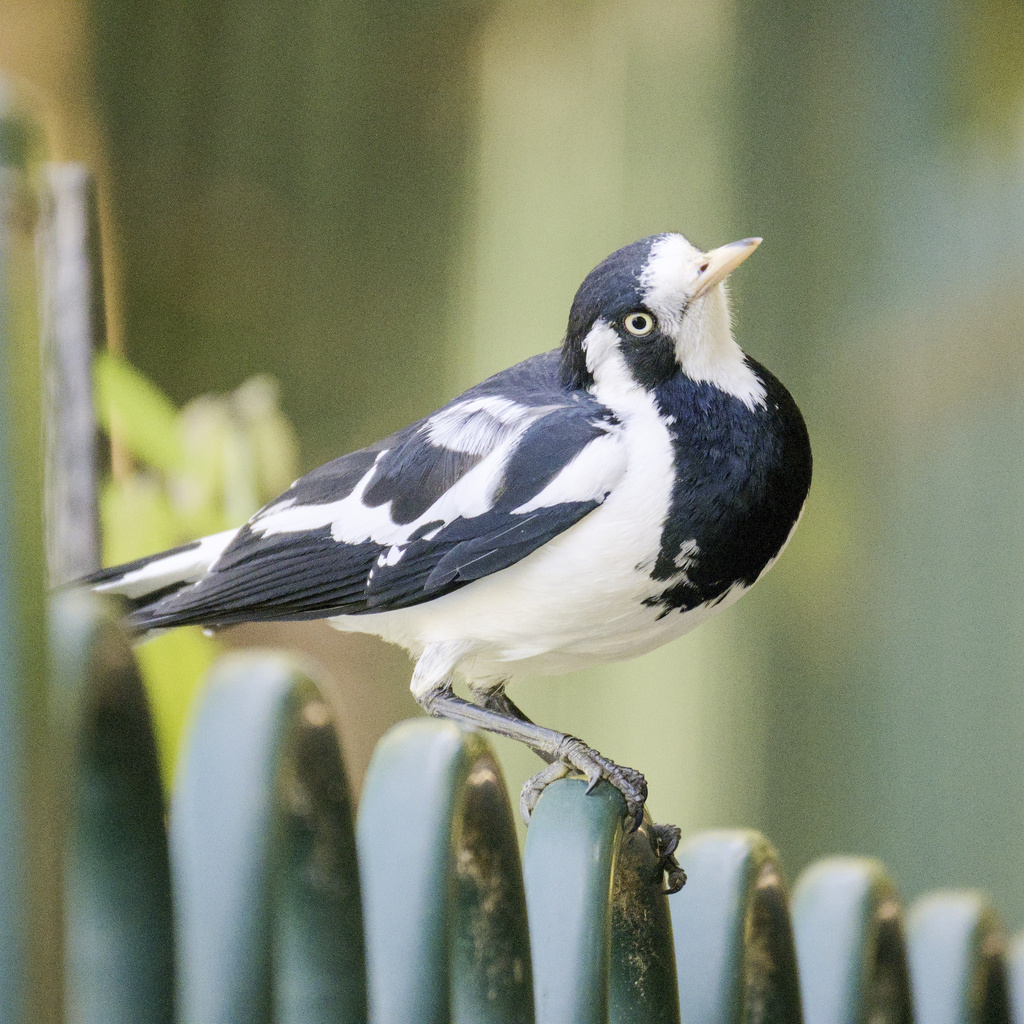
Magpie-lark
Photo © Thomas Jaeger
Photo © Thomas Jaeger — CC BY 4.0 — Source: iNaturalist #187329555Identification
The magpie-lark is a small to medium-sized bird, reaching 25 to 30 centimetres in length—roughly the same size as a European common blackbird. Both sexes display striking black and white plumage, though with distinctly different patterns that make them easy to tell apart. Males have a black throat and distinctive white "eyebrow," while females display a white throat instead. Juveniles and immatures exhibit a combination of features: the white throat of females paired with the black eyestripe of males, plus a white belly. The black plumage can show a subtle bluish sheen, which is reflected in the bird's scientific name, derived from Ancient Greek words meaning "dark blue" and "white."
Range & Habitat
The magpie-lark is a common and widespread bird across Australia, appearing in all regions except Tasmania and some inland desert areas of far northwestern Western Australia. The species is also found in southern New Guinea and on the island of Timor, and was introduced to Lord Howe Island in 1924, where it has since become widespread. This adaptable bird thrives in both urban and rural settings, making it a familiar sight on telephone wires and in suburban gardens across the continent.
The species requires only modest habitat essentials: soft, bare ground for foraging, a supply of mud for nest construction, and a tree in which to build. It is commonly seen patrolling patches of bare ground, particularly around foreshores and swamps. The magpie-lark has benefited greatly from agricultural development, including forest clearing in fertile zones and the provision of water in arid areas, making it well-suited to short-grass and bare-ground feeding.
Behaviour & Diet
The magpie-lark is primarily carnivorous, feeding on all manner of small creatures. It is an aggressively territorial species, fearlessly defending its territory against much larger birds such as magpies, ravens, kookaburras, and even wedge-tailed eagles. Birds typically pair for life, though divorce does occasionally occur, and pairs defend their territory together.
Group gatherings of magpie-larks are frequently observed, with loose flocks of dozens of individuals perching on vantage points near houses and fences to mark territory and seek mates. This behaviour, particularly common in rural and suburban areas, produces excessive high-pitched shrieks that can be frustrating to residents. The birds will also aggressively defend their nesting areas, attacking people if necessary, though their assaults are generally less aggressive than those of masked lapwings or Australian magpies. They are also known to attack mirrors, windows, and other reflective surfaces, mistaking their own reflections for territorial intruders.
Best Time & Places to See It
The magpie-lark is a common sight throughout Australia's urban and rural areas, making it accessible to nature travellers in most locations across the continent. Look for them perched on telephone wires, fences, and other vantage points in suburban gardens, parks, and farmland. They are particularly visible around foreshores, swamps, and patches of bare ground where they forage. Their presence near human habitation and loud, distinctive calls make them relatively easy to locate during daylight hours.
Photography Tips
The bold black and white plumage of the magpie-lark makes it a striking photographic subject with excellent contrast. Photograph males and females separately to capture the distinct differences in throat and eyebrow markings. The bird's habit of perching on exposed vantage points such as wires, fences, and tree branches provides excellent opportunities for clean, clear shots. Early morning and late afternoon light will enhance the subtle bluish sheen sometimes visible on the black plumage. Be prepared for sudden, aggressive defensive behaviour if photographing near nesting areas, and exercise caution around territorial birds during breeding season.
Alpine National Park
Annan River (Yuku Baja-Muliku) National Park
Bald Rock National Park
Barrington Tops National Park
Belair National Park
Ben Boyd National Park
Blue Mountains National Park
Boodjamulla National Park
Bouddi National Park
Nothing matches these filters.
No community photos yet. Log in to add the first one.
No community observations of this species yet.