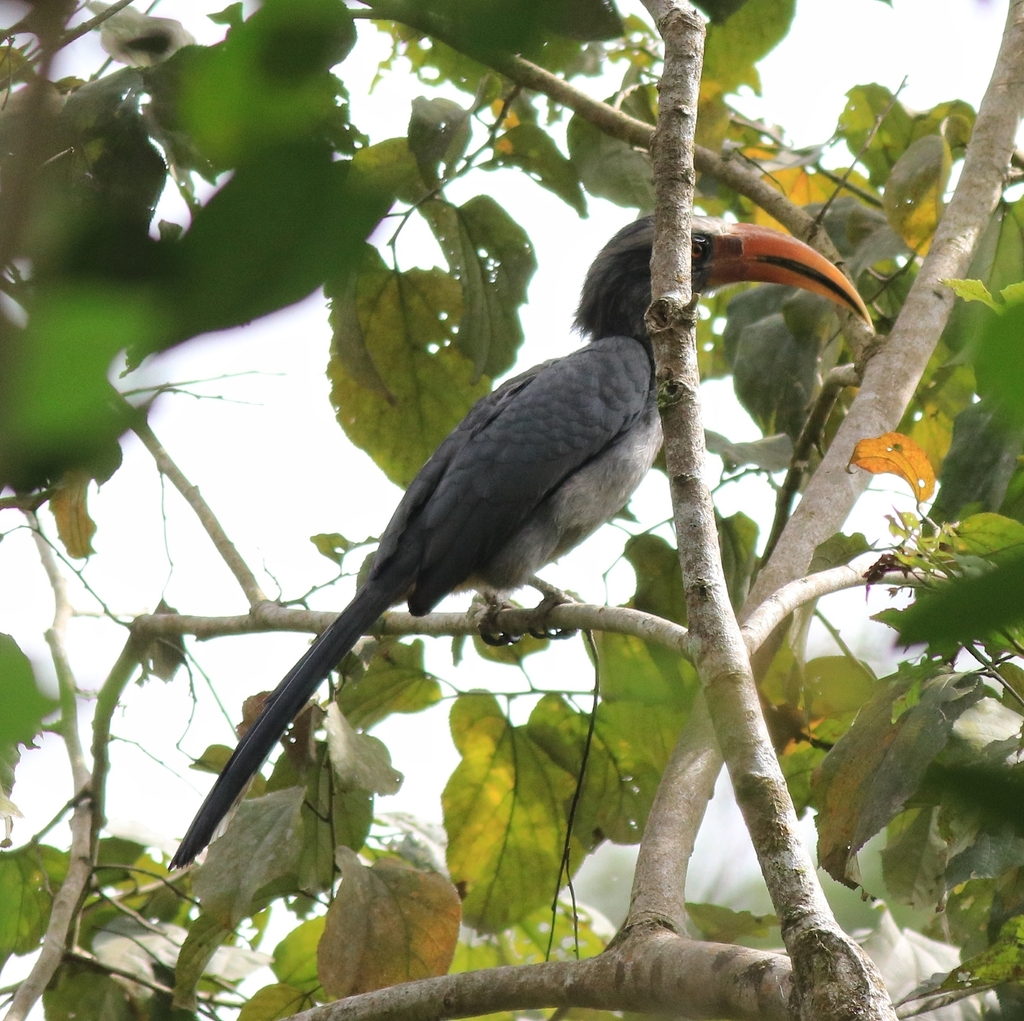
Malabar Grey Hornbill
Photo © Afsar Nayakkan
Photo © Afsar Nayakkan — CC BY 4.0 — Source: iNaturalist #224450068Identification
The Malabar Grey Hornbill is a large bird measuring 45 to 58 cm in length, making it the smallest of the Asian hornbills. It is immediately distinguished from its close relative, the Indian Grey Hornbill, by the absence of a prominent casque (the bony protrusion on the bill). Males display a distinctive reddish bill with a yellow tip, while females have a plain yellow bill with black markings at the base of the lower mandible and along the culmen. Both sexes show a striking broad whitish superciliary band running from above the eye down to the neck. The plumage features brown-grey wings with a white carpal patch, black primary flight feathers tipped with white, a grey back, and cinnamon vent. The long blackish tail has a white tip, and the underparts are grey with white streaks. Immature birds are browner above with a yellow bill and dull white or yellow iris.
Range & Habitat
The Malabar Grey Hornbill is endemic to the Western Ghats mountain range of southern India, ranging from approximately Nashik in the north to the southernmost hills. This species inhabits elevations from about 50 metres near the coast to around 1,500 metres in the mountains, with populations most densely concentrated in dense forest habitats between 500 and 1,200 metres. They favour evergreen forests and are frequently found around rubber, arecanut, and coffee plantations where adequate tree cover exists. Unlike the Indian Grey Hornbill, which prefers the thinner dry forests of the plains, the Malabar Grey Hornbill requires good forest cover and avoids more open habitats.
Behaviour & Diet
These birds move around in pairs or small groups, spending much of their time hopping heavily on the outer branches of large fruiting trees. They are large frugivores, feeding primarily on figs and other forest fruits, and play an important ecological role as seed dispersal agents for many fruit-bearing forest trees. They also supplement their diet with small vertebrates, including insects, small rodents, and reptiles. Their presence is often announced by their distinctive loud calls—described as "hysterical cackling," "laughing," and "screeching"—which make them familiar to local people throughout their range.
Best Time & Places to See It
The breeding season from January to May is an excellent time to observe these hornbills, as they are more active during this period. Look for them in dense evergreen forests throughout the Western Ghats, particularly in protected areas and regions with good tree cover. Key habitats include areas with large fruiting trees and old-growth forests containing trees with natural cavities. Early morning is often the best time for sightings, when the birds are most vocal and active in feeding.
Photography Tips
Photographing the Malabar Grey Hornbill requires patience and knowledge of their preferred feeding trees, particularly large fruiting fig trees where they congregate. Position yourself quietly in areas with good tree cover before dawn. The birds' strong, distinctive flight pattern—characterized by flapping and gliding—offers dynamic shooting opportunities. Focus on capturing the male's striking reddish and yellow bill, the whitish superciliary band, and the white patches on the wings. The bird's large size and relatively bold behaviour in forested areas make it a rewarding subject for wildlife photographers visiting the Western Ghats.
Eravikulam National Park
Devikulam, India
+192 birds+7 mammals
High in the Western Ghats of Kerala, where monsoon mists cling to slopes that rise above 2,000 metres, Eravikulam National Park preserves one of South India's…
VIEW NATIONAL PARKPeriyar National Park
Mlappara, India
+232 birds+4 mammals
Dawn breaks over mist-shrouded ridges where the Western Ghats tumble toward Kerala's spice-scented lowlands. Here, ancient tropical forests envelope a glittering artificial lake, creating a mosaic…
VIEW NATIONAL PARKPampadum Shola National Park
Vattavada, India
+258 birds+14 mammals
Where misty shola forests cling to the high plateaus of the Nilgiri Mountains, ancient evergreen remnants create a world apart. This 2,316-hectare reserve protects one of…
VIEW NATIONAL PARKBandipur National Park
Hirehalli, India
+302 birds+19 mammals
Where the Western Ghats descend into the Deccan plateau, ancient deciduous forests blanket a landscape carved by the Nugu River. Bandipur unfolds across 880 square kilometres…
VIEW NATIONAL PARKNagarahole Tiger Reserve
Nalkeri Forest, India
+323 birds+23 mammals
Where granite escarpments rise above dense deciduous forests and the Kabini River carves through pristine wilderness, one of India's most biodiverse landscapes unfolds across the Western…
VIEW NATIONAL PARKNo community photos yet. Log in to add the first one.
No community observations of this species yet.