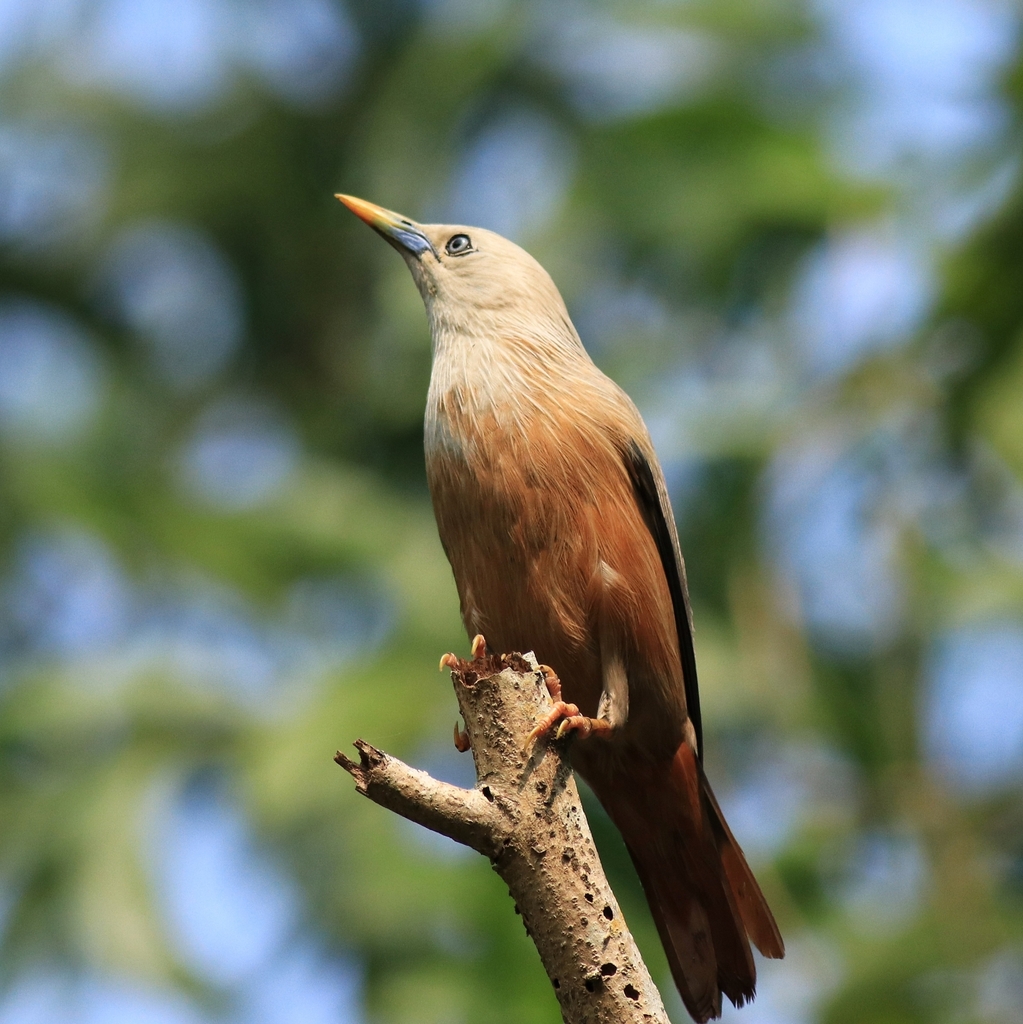
Malabar Starling
Photo © Afsar Nayakkan
Photo © Afsar Nayakkan — CC BY 4.0 — Source: iNaturalist #255647719The Malabar starling (Sturnia blythii) is a species of starling found in southwestern India. It was previously considered a subspecies of the chestnut-tailed starling. They nest in tree holes 3-15 mm above the ground. Nestlings eat insects, lepidopteran larvae, beetles, small vertebrates, and nectar. == Taxonomy == The Malabar starling was formerly placed in the genus Sturnus. A molecular phylogenetic study published in 2008 found that the genus was polyphyletic. In the reoganization to create monotypic genera, the Malabar starling was one of five starlings moved to the resurrected genus Sturnia that had been introduced in 1837 by René Lesson. The species is monotypic: no subspecies are recognised. The Malabar starling was formerly considered to be conspecific with the chestnut-tailed starling (Sturnia malabarica).
Eravikulam National Park
Devikulam, India
+192 birds+7 mammals
High in the Western Ghats of Kerala, where monsoon mists cling to slopes that rise above 2,000 metres, Eravikulam National Park preserves one of South India's…
VIEW NATIONAL PARKPeriyar National Park
Mlappara, India
+232 birds+4 mammals
Dawn breaks over mist-shrouded ridges where the Western Ghats tumble toward Kerala's spice-scented lowlands. Here, ancient tropical forests envelope a glittering artificial lake, creating a mosaic…
VIEW NATIONAL PARKPampadum Shola National Park
Vattavada, India
+258 birds+14 mammals
Where misty shola forests cling to the high plateaus of the Nilgiri Mountains, ancient evergreen remnants create a world apart. This 2,316-hectare reserve protects one of…
VIEW NATIONAL PARKBandipur National Park
Hirehalli, India
+302 birds+19 mammals
Where the Western Ghats descend into the Deccan plateau, ancient deciduous forests blanket a landscape carved by the Nugu River. Bandipur unfolds across 880 square kilometres…
VIEW NATIONAL PARKNagarahole Tiger Reserve
Nalkeri Forest, India
+323 birds+23 mammals
Where granite escarpments rise above dense deciduous forests and the Kabini River carves through pristine wilderness, one of India's most biodiverse landscapes unfolds across the Western…
VIEW NATIONAL PARKNo community photos yet. Log in to add the first one.
No community observations of this species yet.