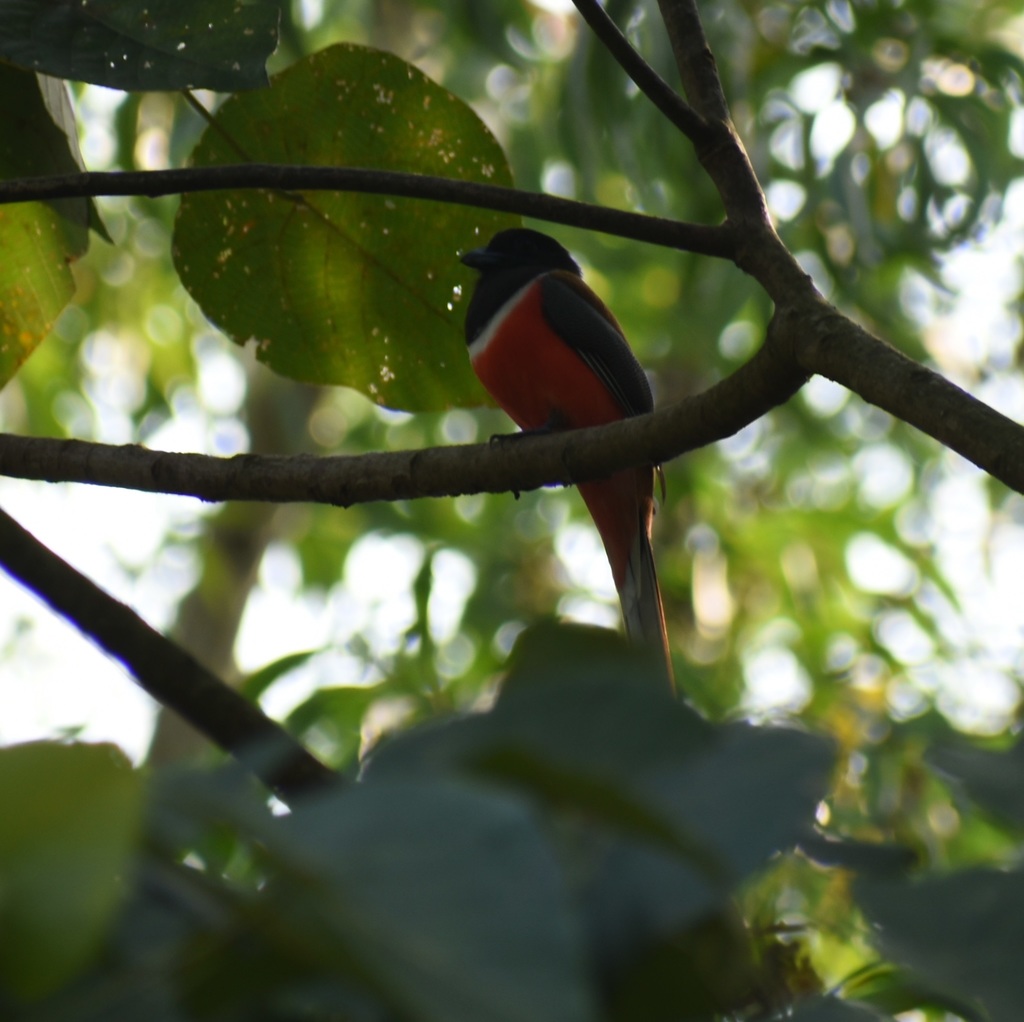
Malabar Trogon
Photo © Jewel Johnson
Photo © Jewel Johnson — CC BY 4.0 — Source: iNaturalist #36015542Identification
The Malabar trogon is a striking, brightly coloured bird with marked sexual dimorphism. Males are unmistakable, displaying a slaty-black head and breast with a white border separating the black bib from vivid crimson underparts. Their olive-brown to chestnut back contrasts with black wing coverts finely marked with white vermiculations. The graduated tail is particularly diagnostic: central feathers are chestnut with black tips, middle pairs predominantly black, and outer pairs adorned with long white tips. Females lack this dramatic contrast, instead showing a slightly darker head and breast that blends into olive-brown upperparts, with ochre replacing the male's crimson underside. Both sexes share distinctive features including a bluish beak, blue eye-ring, dark brown iris, and pale blue feet. The nostrils are notably covered by tufts of filoplumes.
Several geographic races exist, with the nominate subspecies found in Sri Lanka being smaller with brighter upperparts than the Western Ghats population. The central Indian subspecies, occasionally recognised, is slightly larger and longer-winged.
Range & Habitat
This species inhabits the forests of India and Sri Lanka, with its primary stronghold in the Western Ghats of India. It also occurs in hill forests of central India and parts of the Eastern Ghats. In the Nilgiri hills, it behaves as an altitudinal migrant, retreating to higher elevations during summer. While generally not migratory, these birds may move seasonally in response to monsoon rainfall in hill forest regions, following the availability of insects in different areas.
Behaviour & Diet
Malabar trogons are exclusively insectivorous, feeding on a variety of arthropods including caterpillars, bugs, flies, and orthopterans. They typically forage at heights of 5 to 10 metres within the forest canopy, with females tending to feed lower than males. These birds employ diverse hunting techniques, including gleaning from bark, descending to ground level to search leaf litter, and even hovering to snatch prey from mid-air. They sometimes hang upside down to access insects on vertical surfaces and prop themselves with their tails while foraging on decaying stumps, much like woodpeckers.
Behaviourally, these birds are characteristically still and secretive, often perching motionless for extended periods and frequently facing away from observers—a habit that makes them easy to overlook despite their colourful plumage. Their calls are low and guttural, audible only at close range. Males produce percussive "kyau" songs, while both sexes use various contact, territorial, and alarm calls. They are reluctant flyers but capable of swift flight. Breeding occurs from February to May in India and March to June in Sri Lanka, with pairs excavating nest cavities in rotting trees over approximately one month. Clutches typically comprise two eggs, incubated by both parents for about 19 days. Young remain dependent on their parents for 5 to 6 months after fledging, and pairs maintain bonds lasting more than a single season.
Best Time & Places to See It
The Malabar trogon is best sought in the wet hill forests of the Western Ghats during the breeding season (February to May in India, March to June in Sri Lanka), when birds are more vocal and active. The species is becoming increasingly scarce in many parts of India due to forest fragmentation and habitat loss, making sightings less predictable than historically. Early morning visits to undisturbed hill forest patches offer the best opportunities, though patience is essential given their cryptic behaviour and low, hard-to-hear calls.
Photography Tips
Photographing Malabar trogons presents considerable challenges due to their secretive, stationary nature and preference for perching deep within the forest canopy, often facing away from observers. Position yourself carefully to avoid alarming birds, as they will remain frozen in place when disturbed. Early morning light filtering through the canopy works best for capturing their vibrant plumage, particularly the male's crimson underparts and black-and-white patterned wings. Be prepared for long waits; these birds may remain motionless for extended periods. Use telephoto lenses to maintain distance, and keep ISO settings high to cope with the dim, dappled light of dense forest interiors. Patient, quiet observation will eventually reward with views of this elusive and beautifully coloured species.
Eravikulam National Park
Devikulam, India
+192 birds+7 mammals
High in the Western Ghats of Kerala, where monsoon mists cling to slopes that rise above 2,000 metres, Eravikulam National Park preserves one of South India's…
VIEW NATIONAL PARKPeriyar National Park
Mlappara, India
+232 birds+4 mammals
Dawn breaks over mist-shrouded ridges where the Western Ghats tumble toward Kerala's spice-scented lowlands. Here, ancient tropical forests envelope a glittering artificial lake, creating a mosaic…
VIEW NATIONAL PARKPampadum Shola National Park
Vattavada, India
+258 birds+14 mammals
Where misty shola forests cling to the high plateaus of the Nilgiri Mountains, ancient evergreen remnants create a world apart. This 2,316-hectare reserve protects one of…
VIEW NATIONAL PARKBandipur National Park
Hirehalli, India
+302 birds+19 mammals
Where the Western Ghats descend into the Deccan plateau, ancient deciduous forests blanket a landscape carved by the Nugu River. Bandipur unfolds across 880 square kilometres…
VIEW NATIONAL PARKNagarahole Tiger Reserve
Nalkeri Forest, India
+323 birds+23 mammals
Where granite escarpments rise above dense deciduous forests and the Kabini River carves through pristine wilderness, one of India's most biodiverse landscapes unfolds across the Western…
VIEW NATIONAL PARKNo community photos yet. Log in to add the first one.
No community observations of this species yet.