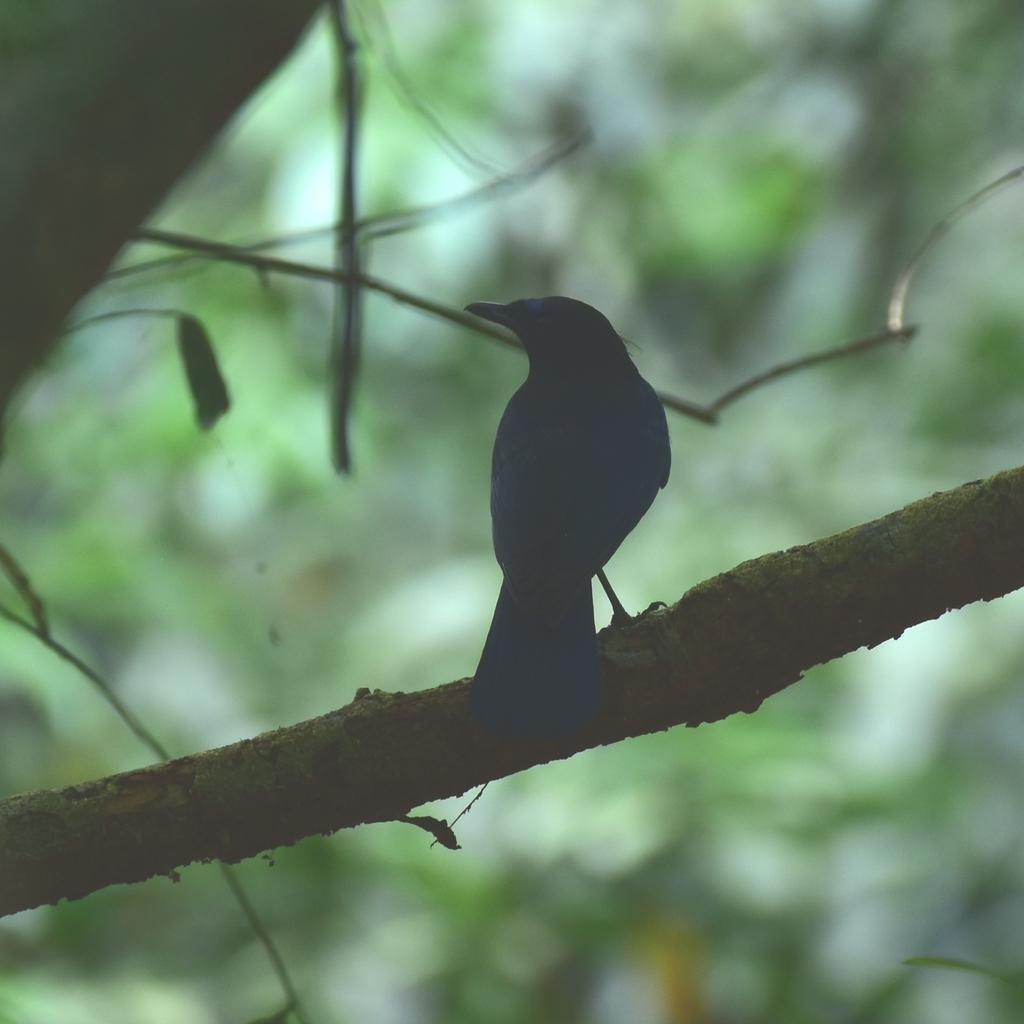
Malabar Whistling Thrush
Photo © Renjith Jacob Mathews
Photo © Renjith Jacob Mathews — CC BY 4.0 — Source: iNaturalist #209754397Identification
The Malabar whistling thrush is a large thrush measuring 25–30 cm, with males displaying a striking blackish upper body adorned with shiny metallic patches of blue on the forehead and shoulders. The most distinctive feature is glossy royal-blue scaling on the back, scapulars, and mid-breast to belly. The bill and legs are black. Females are very similar but display weaker scaling below. Juveniles are black with a glossy blue shoulder patch and wing edgings. The brilliant blue plumage is particularly visible in oblique lighting and results from ultraviolet reflectance, a characteristic shared with other whistling thrushes. The bird weighs approximately 101–130 g.
Range & Habitat
This resident species is endemic to peninsular India, occurring throughout the Western Ghats and associated hills, as well as the Satpura range extending to Chhattisgarh and parts of the Eastern Ghats including northwestern Orissa. The species is found from the foothills up to 2,200 m above sea level, descending to the plains during the rainy season. Malabar whistling thrushes favour dark undergrowth in dense riverine forests, typically foraging in margins, beds, and adjacent ground of rocky hill streams and rivers in primary forest, secondary growth, and plantations.
Behaviour & Diet
Usually seen singly or in pairs, these birds are often found near human habitation where suitable habitat exists. Males sing a varied and melodious whistling song from trees during summer, particularly around dawn, though they also utter sharp single or two-note high-pitched whistles at other times. They bathe frequently, typically in mornings and evenings, and more often during hot weather. The species is omnivorous, feeding primarily on insects, snails, worms, crabs, and small frogs, supplemented by drupes, wind-fallen figs, and berries. Occasionally they consume small snakes, with rare records of larger species such as rat snakes.
Best Time & Places to See It
Breed from March to December, beginning with the monsoon arrival, making this an excellent time to observe singing males and breeding activity. The bird's year-round residency means sightings are possible throughout the year, though winter dispersal movements may shift populations. Look for them in rocky hill streams and rivers within forested areas throughout the Western Ghats, particularly in protected areas and reserve forests with dense riverine vegetation. Their preference for dark undergrowth near water makes early morning visits most productive.
Photography Tips
Capturing the bird's striking blue plumage requires attention to lighting—the metallic scaling and ultraviolet reflectance are best revealed in oblique or side-angled light rather than direct frontal illumination. Photograph birds during bathing sessions in early morning and evening when they are most active and predictable near streams. The species' preference for dense, shadowy undergrowth demands faster shutter speeds and higher ISO settings. Their relatively large size and habit of frequenting rocky streambeds near human habitation make them more approachable than many forest species, offering good opportunities for patient photographers willing to wait quietly near suitable habitat.
Eravikulam National Park
Devikulam, India
+192 birds+7 mammals
High in the Western Ghats of Kerala, where monsoon mists cling to slopes that rise above 2,000 metres, Eravikulam National Park preserves one of South India's…
VIEW NATIONAL PARKKanha Tiger Reserve
Kanha Kisli F.V., India
+321 birds+23 mammals
Where sal forests give way to emerald meadows and crystalline streams carve through ancient valleys, one of India's finest wilderness reserves unfolds across the Maikal Range.…
VIEW NATIONAL PARKBandhavgarh National Park
Garhpuri, India
+285 birds+17 mammals
Where granite ridges rise dramatically above sal and bamboo forests, one of India's most pristine tiger reserves unfolds across the Vindhyan plateau. Ancient rock formations tower…
VIEW NATIONAL PARKPeriyar National Park
Mlappara, India
+232 birds+4 mammals
Dawn breaks over mist-shrouded ridges where the Western Ghats tumble toward Kerala's spice-scented lowlands. Here, ancient tropical forests envelope a glittering artificial lake, creating a mosaic…
VIEW NATIONAL PARKPampadum Shola National Park
Vattavada, India
+258 birds+14 mammals
Where misty shola forests cling to the high plateaus of the Nilgiri Mountains, ancient evergreen remnants create a world apart. This 2,316-hectare reserve protects one of…
VIEW NATIONAL PARKBandipur National Park
Hirehalli, India
+302 birds+19 mammals
Where the Western Ghats descend into the Deccan plateau, ancient deciduous forests blanket a landscape carved by the Nugu River. Bandipur unfolds across 880 square kilometres…
VIEW NATIONAL PARKNagarahole Tiger Reserve
Nalkeri Forest, India
+323 birds+23 mammals
Where granite escarpments rise above dense deciduous forests and the Kabini River carves through pristine wilderness, one of India's most biodiverse landscapes unfolds across the Western…
VIEW NATIONAL PARKNo community photos yet. Log in to add the first one.
No community observations of this species yet.