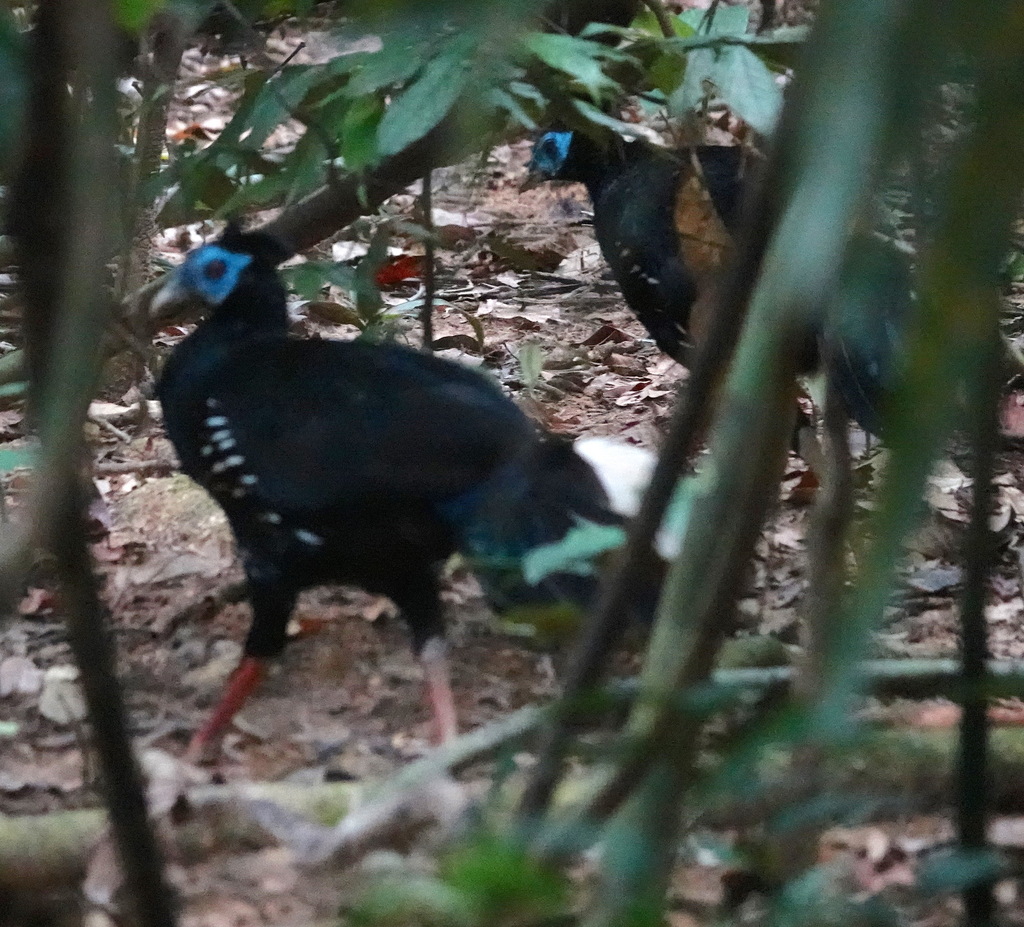
Malayan Crested Fireback
Photo © desertnaturalist
Photo © desertnaturalist — CC BY 4.0 — Source: iNaturalist #133086508Identification
The Malayan crested fireback is a medium-sized pheasant reaching up to 70 cm in length. Males are unmistakable with their peacock-like dark crest, bluish-black plumage, and reddish-brown rump. They possess striking red irises and bare blue facial skin, along with black outer tail feathers and distinctive white central tail feathers. The red legs further distinguish males from their Bornean relatives. Females are more subdued, displaying brown plumage with a shorter crest, blue facial skin, and spotted black-and-white underparts.
Range & Habitat
This species is endemic to lowland forests of the Thai-Malay Peninsula and Sumatra. It inhabits humid, dense forest environments where it forages among leaf litter and understory vegetation. The bird's preference for lowland forest makes it particularly vulnerable to habitat conversion and forest fragmentation across its limited range.
Behaviour & Diet
Like other pheasants, the Malayan crested fireback is primarily a ground-dwelling bird that feeds by foraging in the forest floor. It searches through leaf litter and soil for insects and plant material, using its strong legs and feet to scratch and probe. The male's elaborate crest and striking plumage serve courtship displays, though detailed behavioral observations in the wild remain limited due to the species' elusive nature and remote forest habitat preferences.
Best Time & Places to See It
Finding this species requires patience and access to pristine lowland forest reserves within the Thai-Malay Peninsula and Sumatra. Early morning hours typically offer the best chances, as the bird is most active during cooler parts of the day. Protected forest areas and nature reserves offer the most reliable viewing opportunities, though sightings remain uncommon due to the species' shy temperament and preference for dense vegetation.
Photography Tips
Photographing this bird demands considerable patience and a telephoto lens (400mm or longer) to capture detail from a distance without disturbing the bird. Early morning light provides optimal conditions for capturing the iridescent quality of the male's bluish-black plumage and the vibrant red facial skin. Use a fast shutter speed to compensate for movement through dense understory vegetation. Scout locations near fruiting trees and along established forest trails where these pheasants are known to forage. Remaining motionless and using camouflage or a hide will significantly improve your chances of obtaining quality images.
No community photos yet. Log in to add the first one.
No community observations of this species yet.