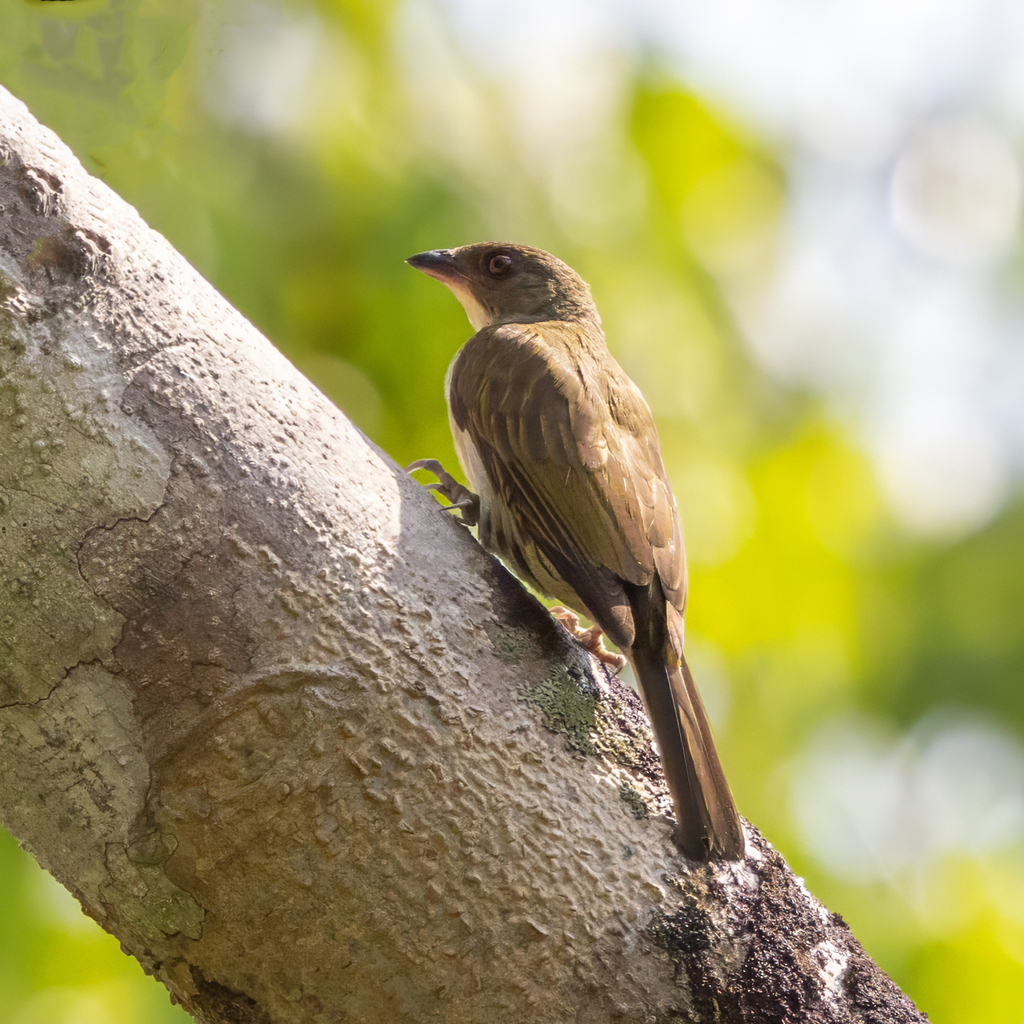
Malaysian Honeyguide
Photo © Dan Vickers
Photo © Dan Vickers — CC BY 4.0 — Source: iNaturalist #345268093The Malaysian honeyguide (Indicator archipelagicus) is a bird in the family Indicatoridae, which are paleotropical near passerine birds related to the woodpeckers. The species is native to Southeast Asia. == Description == It is a medium-sized, up to 18 cm long, olive-brown honeyguide with greenish streaks, reddish iris, thick grey bill and greyish white below. The male has a yellow patch on the shoulder, while the female has none. The young resembles the female with streaked underparts. == Habitat and range == The Malaysian honeyguide occurs throughout lowland broadleaved forests of western Thailand, Peninsular Malaysia, Borneo and the island of Sumatra. == Habits == The call of the Malaysian honeyguide is a cat-like "meow", followed by a rattling sound. The diet consists mainly of insects, especially wild bees and wasps. It nests in tree hollows. == Status == Due to ongoing habitat loss, local and sparse population, the Malaysian honeyguide is evaluated as Near Threatened on the IUCN Red List of Threatened Species.
Taman Negara National Park
Kampong Samas, Malaysia
+393 birds+48 mammals
Where ancient rainforest meets limestone peaks, one of Southeast Asia's oldest protected wilderness preserves sprawls across 4,343 square kilometers of primordial landscape. Dipterocarp giants tower overhead,…
VIEW NATIONAL PARKGunung Mulu National Park
Long Seridan, Malaysia
+280 birds+39 mammals
Where granite monoliths pierce the rainforest canopy of Sarawak, an ancient limestone karst landscape reveals one of Southeast Asia's most biodiverse strongholds. Soaring peaks cloaked in…
VIEW NATIONAL PARKWay Kambas National Park
Lampung Timur, Indonesia
+237 birds+20 mammals
Across the low swamplands of eastern Lampung, where freshwater wetlands merge into tidal mangrove forests along the Sunda Strait, sprawls one of Sumatra's most vital sanctuaries.…
VIEW NATIONAL PARKNo community photos yet. Log in to add the first one.
No community observations of this species yet.