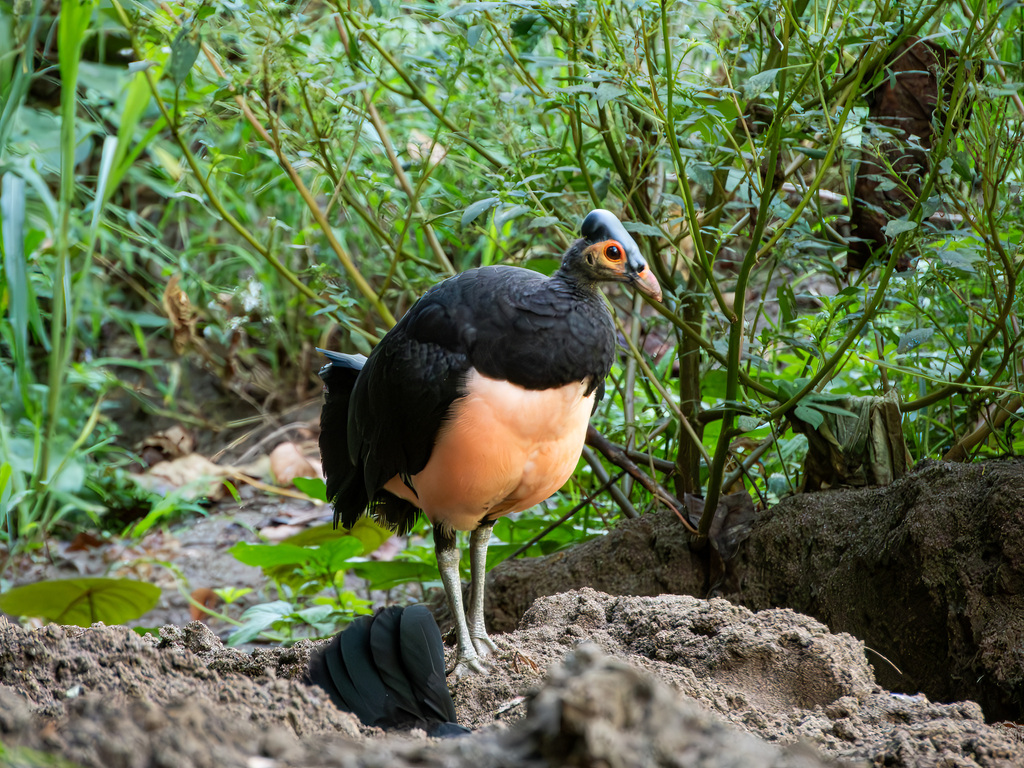
Maleo
Photo © Jason Alexander
Photo © Jason Alexander — CC BY 4.0 — Source: iNaturalist photo #525998067Identification
The maleo is a large megapode, measuring 55–60 cm in length, with distinctive features that make it unmistakable in the field. The bird is predominantly blackish with striking rosy salmon underparts and bare yellow facial skin surrounding a reddish-brown iris. Its reddish-orange beak and greyish-blue feet with four long, sharp claws separated by a membranous web are also characteristic. Most notably, the maleo's crown is ornamented with a prominent, bony, dark casque—a feature so distinctive that its genus name, Macrocephalon, derives from the Greek words for "large" and "head."
The sexes are nearly identical, though females are slightly smaller and duller than males. Juvenile birds are quite different in appearance, with largely brownish and paler heads, short blackish-brown crests, and browner upper parts, which can make young birds challenging to identify for the inexperienced observer.
Range & Habitat
The maleo is endemic to the Indonesian island of Sulawesi and the nearby smaller island of Buton. It is typically found at elevations not exceeding 1,000 meters, preferring lowland hills and tropical rainforests. However, the species exhibits a unique dual habitat requirement: while it inhabits forest cover for much of the year, it must venture to open areas for breeding. Ideal nesting locations include river banks, lake shores, and coastal areas where sand or volcanic soils are heated naturally by the sun or geothermal energy.
Behaviour & Diet
The maleo is a monogamous species, with pairs staying in close proximity to one another at all times. Its diet is diverse and includes mainly fruits, seeds, mollusks, ants, termites, beetles, and other small invertebrates, which the bird forages for in the forest. The maleo is a communal nester, with females laying 8–12 eggs over the course of a year and breeding occurring year-round, though peak breeding seasons vary by location on the island.
One of the maleo's most remarkable adaptations is its reliance on environmental heat for egg incubation. When ready to breed, paired maleos leave their forest habitat and travel to historic coastal breeding grounds where they dig deep holes in sand or volcanic soil. After laying a single large egg—approximately five times the size of a domestic chicken's egg—the parents bury it and depart, never to return. The chick must dig itself free from the sand after hatching and is completely self-sufficient within hours, able to fly and feed itself independently while avoiding predators such as monitor lizards, reticulated pythons, wild pigs, and cats.
Best Time & Places to See It
Because the maleo's breeding season varies by location across Sulawesi, year-round observation is theoretically possible, though peak breeding times differ regionally. The species is found in lowland tropical forests and hill forests throughout the island. Observing maleos in their natural habitat requires patience and local knowledge, as they are highly threatened and increasingly rare. River banks, lake shores, and coastal areas are where breeding birds are most likely to be encountered, particularly during nesting season when they leave forest cover.
Photography Tips
Photographing the maleo presents challenges due to its critically endangered status, decreasing population, and habitat fragmentation. The bird's striking plumage—blackish with rosy salmon underparts and yellow facial skin—offers good contrast for photography when light conditions permit. The prominent dark casque on the crown is a key feature to capture for identification purposes. Early morning or late afternoon light will best showcase the bird's coloration. Access to maleo habitat may be restricted or difficult; potential photographers should seek guidance from local conservation organizations and respect all protected areas.
Bogani Nani Wartabone National Park
Bolaang Mongondow, Indonesia
+154 birds+4 mammals
Across North Sulawesi's rugged interior, where tectonic uplift has carved steep ridges and deep valleys through ancient volcanic terrain, Bogani Nani Wartabone National Park sprawls across…
VIEW NATIONAL PARKLore Lindu National Park
Indonesia
+177 birds+4 mammals
Across the mountainous spine of Central Sulawesi spreads a wilderness of montane forest, rolling ridges, and deep valleys that rises from the island's volcanic bedrock to…
VIEW NATIONAL PARKNo community photos yet. Log in to add the first one.
No community observations of this species yet.