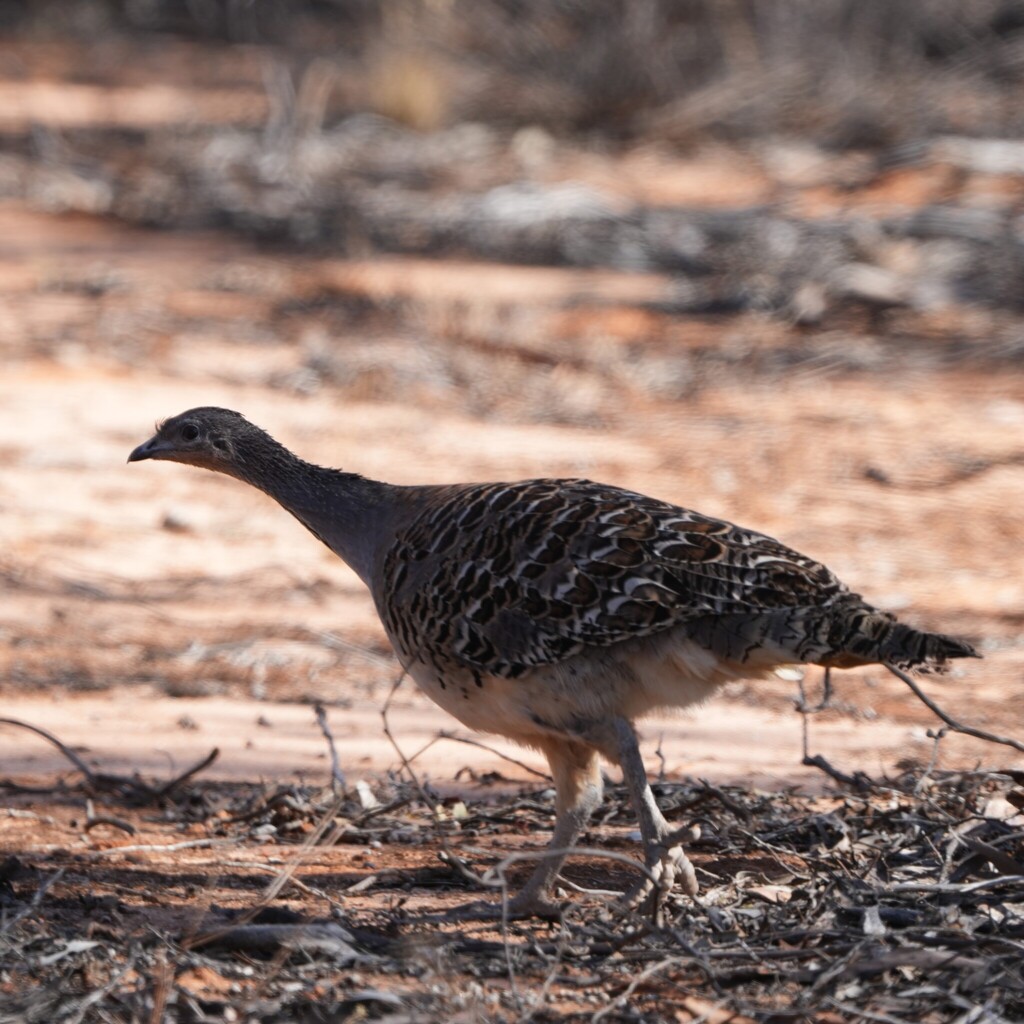
Malleefowl
Photo © themaskedlapwing
Photo © themaskedlapwing — CC0 1.0 — Source: iNaturalist #271419390Identification
The malleefowl is a stocky, ground-dwelling Australian bird about the size of a domestic chicken. It is notably shy and wary, relying on its intricately patterned plumage to blend seamlessly into its surroundings. When disturbed, the bird typically freezes in place rather than taking flight, rendering itself nearly invisible among the mallee scrub. Its cryptic colouration and reluctance to fly make it a challenging species to spot, though patient observers may catch sight of birds fading silently into the undergrowth or, if startled, flying to a tree to roost.
Range & Habitat
The malleefowl occupies semiarid mallee scrub on the fringes of southern Australia's relatively fertile areas. Today it is restricted to three separate populations: the Murray–Murrumbidgee basin, areas west of Spencer Gulf along the fringes of the Simpson Desert, and the semiarid fringe of Western Australia's fertile southwest corner. This fragmented distribution represents a dramatic decline from pre-European times, when the species was found over vast stretches of the continent.
Behaviour & Diet
Malleefowl are solitary, very active birds that usually fly only to escape danger or reach trees for roosting. Pairs occupy territories but typically roost and feed apart. These birds are famous for their extraordinary breeding behaviour: males construct large nesting mounds by scraping depressions in sandy soil and filling them with organic material such as sticks, leaves, and bark. These mounds, which can span about 3 metres across and nearly 1 metre deep, rise roughly 0.6 metres above ground level. Males continuously maintain the mound, turning and mixing material to encourage decay and adding soil as summer approaches to regulate internal temperature.
Females lay clutches of 15 eggs on average—ranging from 2 or 3 to over 30—between September and February, with each egg weighing about 10% of the female's body weight. Over a breeding season, females commonly lay eggs totalling 250% of their own weight. Incubation depends on temperature but typically lasts 50 to 100 days. Hatchlings are entirely independent from the moment they emerge, struggling for 2 to 15 hours to dig themselves free and reaching full flight capability within a day. Chicks receive no parental care and have no contact with other birds except during mating or territorial disputes.
Best Time & Places to See It
The malleefowl's shy, elusive nature and small, fragmented populations make it a challenging species to observe. Important bird areas across southern mainland Australia, including Central NSW Mallee and several other designated conservation sites, offer the best opportunities. The breeding season from winter through early spring may provide the best chance to locate birds near active mounds, though their cryptic behaviour means sightings remain unpredictable.
Photography Tips
Patience and stealth are essential when photographing malleefowl. Early morning visits to known mound sites during the breeding season offer the best opportunities, as males are most active during nest maintenance. Approaching slowly and quietly, with minimal sudden movements, will reduce the chance of triggering the bird's freeze response or causing it to flee. Wide-angle lenses may be useful for capturing the distinctive nesting mounds and surrounding mallee habitat, helping to tell the story of this remarkable bird's extraordinary breeding strategy.
Little Desert National Park
Australia
+200 birds+11 mammals
Across northwestern Victoria's semi-arid interior, sandstone ridges and heathland plateaus rise from red earth in a landscape sculpted by fire and drought rather than water. Little…
VIEW NATIONAL PARKLincoln National Park
Australia
+149 birds+5 mammals
Across the mid-north of South Australia, where the landscape transitions from coastal lowlands toward semi-arid interior plains, sprawls a wilderness of 2,671 square kilometres where red-earth…
VIEW NATIONAL PARKInnes National Park
Barcelona, Australia
+141 birds+10 mammals
Granite ridges and weathered stone outcrops rise across South Australia's Fleurieu Peninsula, defining a landscape where ancient rock formations meet open eucalypt woodland and heathland scrub.…
VIEW NATIONAL PARKFitzgerald River National Park
Fitzgerald River National Park, Australia
+209 birds+11 mammals
Where granite peaks rise above windswept heathlands and pristine river systems carve through untamed wilderness, one of Australia's most biodiverse landscapes unfolds across the southwestern corner…
VIEW NATIONAL PARKMungo National Park
Australia
+135 birds+7 mammals
Across the semi-arid inland plains of New South Wales, where sparse shrubland and scattered grassland stretch beneath enormous skies, lies a landscape shaped by ancient geological…
VIEW NATIONAL PARKMurray-Sunset National Park
Australia
+205 birds+2 mammals
Across the semi-arid borderlands of northwestern Victoria, where the Murray River defines the state's edge, sprawls a landscape of remarkable resilience and subtle beauty. Murray-Sunset National…
VIEW NATIONAL PARKCoorong National Park
Australia
+217 birds+15 mammals
Where the Murray River meets the Southern Ocean, a chain of shallow lagoons stretches across the South Australian coast, separated from the sea by a ribbon…
VIEW NATIONAL PARKKalbarri National Park
Australia
+157 birds+6 mammals
Where ochre cliffs and weathered gorges slice through Western Australia's semi-arid interior, Kalbarri National Park reveals a landscape shaped by millions of years of erosion and…
VIEW NATIONAL PARKStirling Range National Park
Australia
+149 birds+7 mammals
Where ancient quartzite ranges rise abruptly from the southwestern Australian plateau, Stirling Range National Park unfolds as a realm of dramatic escarpments, deep valleys, and surprising…
VIEW NATIONAL PARKNo community photos yet. Log in to add the first one.
No community observations of this species yet.