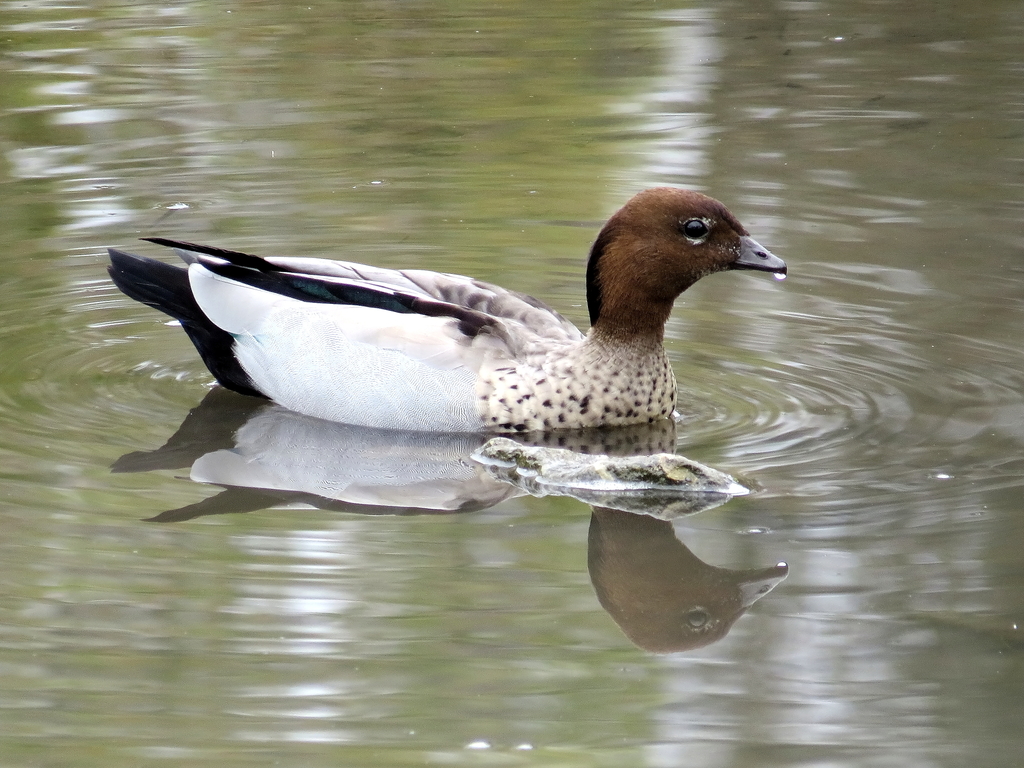
Maned Duck
Photo © Graham Winterflood
Photo © Graham Winterflood — CC BY-SA 4.0 — Source: iNaturalist photo #53239779Identification
The Maned Duck is a distinctive 45–51 cm dabbling duck that resembles a small goose more than a typical duck. Males are unmistakable with their dark brown heads, grey bodies, mottled breasts, and very thin white and black stripes on the sides and flanks. Females are more subdued, featuring white stripes above and below the eye and mottled underparts. Both sexes display grey wings with black primaries and a white speculum—a useful field mark when the birds take flight. Juveniles resemble adult females but are lighter in plumage with streakier breasts.
Range & Habitat
The Maned Duck is widespread throughout much of Australia, including Tasmania, making it one of the continent's most accessible waterfowl. It shows remarkable adaptability, inhabiting grasslands, open woodlands, wetlands, flooded pastures, coastal inlets and bays. The species thrives around farmland dams, rice fields, sewage ponds, and urban parks—environments where other waterbirds may struggle. Unlike many ducks, it prefers deeper lakes unsuitable for typical waterfowl foraging, as it is primarily a land feeder. The species has been recorded as a vagrant to New Zealand and has been introduced to western Europe, including the United Kingdom, Belgium, Germany, and the Netherlands.
Behaviour & Diet
The Maned Duck is highly vocal, particularly the females, which produce a loud, rising croaky "gnow" sound; males produce a similar but smoother, shorter, and higher call. Staccato chattering often accompanies flocking birds. This species is gregarious and mostly feeds by grazing in flocks, consuming grasses, grains, clover, and other herbs, with occasional insects supplementing the diet. It is rarely seen on open water, preferring to forage by dabbling in shallow water or in grasslands and crops. Nesting occurs in tree cavities or nest-boxes, where females lay 9–11 cream-white eggs and incubate them while males stand guard. Once ducklings are ready to leave the nest, they leap to the ground and follow their parents.
Best Time & Places to See It
The Maned Duck is very common and can be observed year-round throughout its range, particularly in urban areas near permanent water sources such as dams, ponds, swimming pools, and irrigated grass areas including sporting facilities, parks, and residential gardens. Its environmental adaptability means populations are ascending, making sightings highly reliable. Urban parks and farmland with water sources offer the best viewing opportunities, especially where grazing habitat adjoins water.
Photography Tips
Photograph males during breeding season when their contrasting plumage is most striking—the dark brown head against grey body provides excellent contrast. Capture them grazing in flocks on grasslands for distinctive behavioural shots. The white speculum is best photographed in flight, so be ready for takeoff moments. Early morning light is ideal for capturing the subtle mottling on breasts and the thin flank stripes. Urban park locations offer approachable subjects with minimal disturbance, allowing close-range portraits of both males and females.
Alpine National Park
Bald Rock National Park
Barrington Tops National Park
Belair National Park
Ben Boyd National Park
Blue Mountains National Park
Bouddi National Park
Bribie Island National Park
Budj Bim National Park
Nothing matches these filters.
No community photos yet. Log in to add the first one.
No community observations of this species yet.