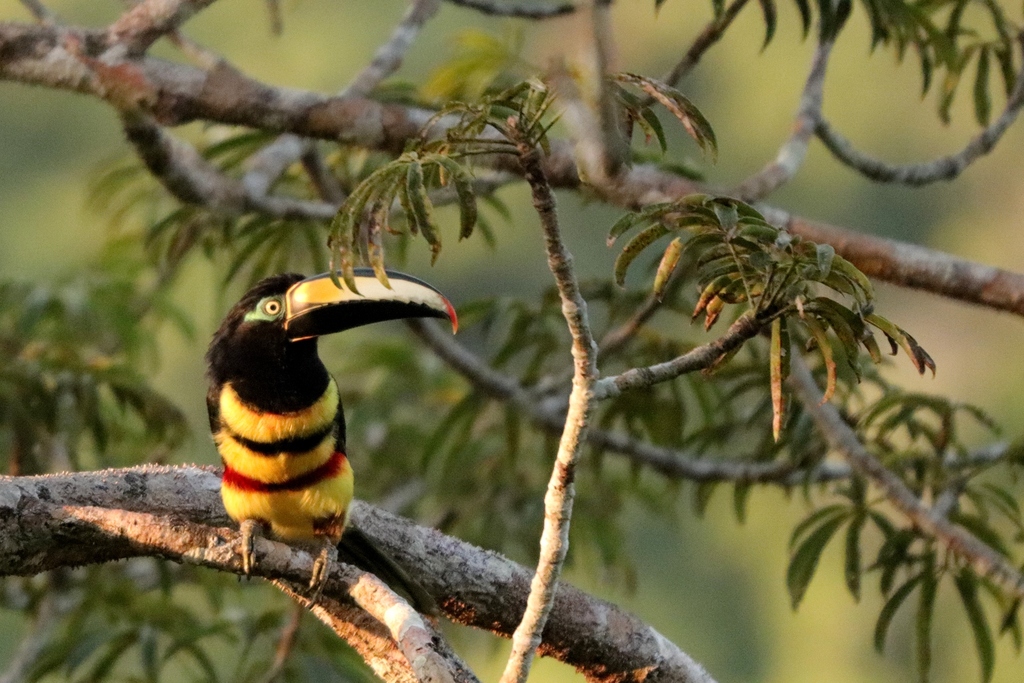
Many-banded Aracari
Photo © Ian Adams
Photo © Ian Adams — CC BY 4.0 — Source: iNaturalist photo #468743527Identification
The many-banded aracari is a medium-sized toucan measuring 43 to 46 cm in length, with a distinctive bill comprising nearly a quarter of its body size at 11 to 12.5 cm long. This striking bird weighs between 215 to 302 grams. Males display a mostly black head, throat, and neck, contrasted by bare blue-green to green skin encircling the eye and a chestnut patch behind it. The back is dark green, while the rump is vivid red. The underparts are yellow marked with two bands—an upper black band and a lower black-and-red band. Females are similar but typically lack or have minimal chestnut behind the eye, and their black breast band is usually wider than males'. The bill itself is orange-yellow with a distinctive black stripe along its upper ridge and black base; an orange-yellow line marks the bill's base. In flight, immature birds appear noticeably duller than adults, particularly in their yellow coloration, and their bills lack the diagnostic yellow basal line, appearing instead gray, brown, and horn-colored.
Range & Habitat
This species inhabits the northwestern regions of South America, found across northeastern Colombia, northwestern and southeastern Venezuela, eastern Ecuador, northeastern Peru, and northwestern Brazil north of the Amazon River, extending east to Roraima state. The many-banded aracari predominantly occupies terra firme forest—undisturbed upland rainforest—with lesser use of várzea and gallery forests. It is primarily a lowland species, ranging mostly up to 750 meters elevation, though it occasionally ventures as high as 1,000 meters.
Behaviour & Diet
The many-banded aracari is believed to be a year-round resident throughout its range. It forages singly, in pairs, or in small groups, feeding primarily on fruit with a supplementary diet of insects, small birds, bird eggs, and lizards. The species plays an important ecological role in seed dispersal, with seeds traveling hundreds of meters from their source—the bird typically regurgitates rather than excretes seeds. The breeding season varies geographically: November through March in Colombia and Ecuador, and March through October elsewhere in its range, though detailed breeding biology remains poorly documented. Its vocalizations are distinctive, variously described as "seeent," "seeet," "see-yeet," "kyseek," and "kyeek."
Best Time & Places to See It
The many-banded aracari is described as fairly common throughout its range from Colombia to Peru, though it is not well known in other areas. The species occurs in several protected areas across its distribution. Year-round residency means sightings are possible throughout the year, though the varying breeding seasons suggest birds may be more active and vocal during their respective breeding periods. Terra firme forest habitat offers the best opportunities for encounters, particularly in protected reserves across Colombia, Ecuador, Peru, and Brazil.
Photography Tips
Photographers should focus on the bird's striking color contrasts: the brilliant red rump, yellow underparts with bold black banding, and the colorful facial markings. The bare skin around the eye and chestnut patch provide excellent focal points. The large, prominently patterned bill is a signature feature worth capturing. Since the species forages in small groups, patience in productive fruit-bearing trees during early morning hours may yield multiple individuals. The bird's relatively small size compared to larger toucans means close focusing capability is advantageous.
Yasuní National Park
Aguarico, Ecuador
+601 birds+43 mammals
Where the western Amazon basin converges with Ecuador's Orellana Province, lowland rainforest reaches toward the horizon in an unbroken canopy of staggering botanical density. Yasuní National…
VIEW NATIONAL PARKSumaco Napo-Galeras National Park
Loreto, Ecuador
+563 birds+4 mammals
Where Ecuador's Amazon transitions into cloud forest, a massive shield volcano rises from the emerald lowlands of Orellana Province, anchoring one of the continent's most biodiverse…
VIEW NATIONAL PARKNatural Sierra de Chiribiquete National Park
Solano, Colombia
+359 birds+27 mammals
Massive table-top mountains rise abruptly from the lowland rainforest of southeastern Colombia, their sheer sandstone cliffs and isolated summits creating some of the most dramatic topography…
VIEW NATIONAL PARKNatural la Paya National Park
Puerto Leguízamo, Colombia
+262 birds+4 mammals
Where the Amazon's western reaches fold into the Andes foothills, La Paya National Park sprawls across more than 8,500 square kilometers of pristine Amazonian rainforest in…
VIEW NATIONAL PARKNatural Sumapaz National Park
Cubarral, Colombia
+368 birds+1 mammals
Where the Andes descend toward the Amazon basin, the high páramo grasslands of Sumapaz National Park sprawl across more than five thousand square kilometers of Meta…
VIEW NATIONAL PARKEl Tamá National Park
Toledo, Colombia
+435 birds
Where the Andes descend toward the Caribbean coastal lowlands of northern Colombia, El Tamá National Park sprawls across nearly 3,800 square kilometres of montane forest, cloud…
VIEW NATIONAL PARKNatural Sierra de la Macarena National Park
Vista Hermosa, Colombia
+566 birds+15 mammals
Across nearly 20,000 square kilometres of Colombia's Meta Department, the terrain rises from lowland savanna into Andean foothills through a mosaic of gallery forests, palm-fringed wetlands,…
VIEW NATIONAL PARKAmacayacu National Park
Leticia, Colombia
+567 birds+25 mammals
Where the Rio Amazonas curves through the tri-border region where Colombia, Peru, and Brazil converge, Amacayacu National Park sprawls across more than 5,250 square kilometres of…
VIEW NATIONAL PARKPico da Neblina National Park
Brazil
+103 birds
Where the Amazon's western rampart rises into perpetual mist, Pico da Neblina National Park sprawls across more than 33,000 square kilometres of some of Earth's least…
VIEW NATIONAL PARKNo community photos yet. Log in to add the first one.
No community observations of this species yet.