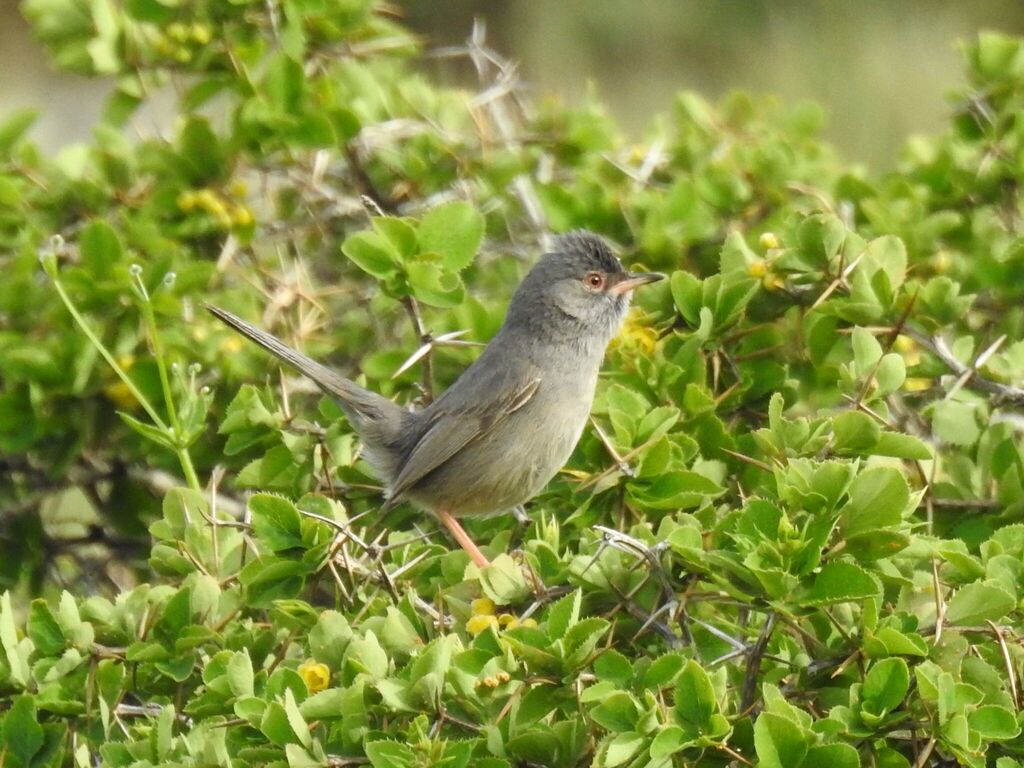
Marmora’s Warbler
Photo © Yves Bas
Photo © Yves Bas — CC BY 4.0 — Source: iNaturalist #333858182Identification
Marmora's warbler is a small, long-tailed bird with a distinctively large head relative to its body size. Overall plumage is grey above and below, which immediately sets it apart from the closely related Dartford warbler, whose underparts are brick-red. Adult males display darker patches on the forehead and between the eye and pointed bill, features that are less pronounced in females. Both sexes have striking red legs and a red iris, making these small warblers instantly recognizable once you've picked them out of the scrub. The song is a characteristic fast rattle that often gives away their presence before you spot them.
Immature birds present a greater identification challenge, as young Marmora's warblers can be confused with juvenile Dartford warblers, which are similarly grey below. The key distinguishing feature is Marmora's paler throat, and the iris colour is darker in young birds compared to adults. Once familiar with these subtle differences, separating them from other Mediterranean warbler species becomes straightforward.
Range & Habitat
Marmora's warbler breeds on Mediterranean islands, with Corsica and Sardinia being the typical strongholds of the species—indeed, the name "sarda" honours Sardinia. These small warblers are generally resident year-round, though some populations migrate south to winter in North Africa. They are rare vagrants to northern and western Europe, making sightings outside the Mediterranean exceptional and noteworthy for birders.
The species favours open country with thorny bushes and heather, habitat types that offer both foraging opportunities and protective cover. They nest in bushes, where females lay clutches of 3–5 eggs. Like most warblers, they are insectivorous, gleaning small prey from the vegetation and occasionally catching insects in flight.
Behaviour & Diet
Marmora's warbler is an active insectivore, hunting small arthropods among thorny scrub and heather. The species is skulking and keeps close to dense vegetation, though the loud, rattling song often betrays its presence even when the bird itself remains hidden. The fast, energetic song is a reliable indicator of breeding males during the nesting season.
These small passerines are generally resident on their Mediterranean island homes, maintaining territories year-round, though populations in the north of the range may shift south seasonally. They are typically seen singly or in pairs, moving restlessly through their preferred scrub habitat.
Best Time & Places to See It
Corsica and Sardinia are the primary destinations for encountering Marmora's warbler. The breeding season, when males are most vocal and active, is the best time to locate them. Their preference for open country with thorny bushes and heather means that exploring scrubland and garrigue habitats offers the greatest chance of success. Look in areas of low, spiny vegetation typical of Mediterranean islands.
Given that some birds migrate to North Africa in winter, the species is more reliably found during the breeding season. Patience and careful listening for the distinctive rattling song will help pinpoint individuals in dense vegetation.
Photography Tips
Marmora's warbler presents a genuine challenge for photographers due to its skulking nature and preference for dense thorny scrub. The bird's small size and restless behaviour demand a fast shutter speed and quick reflexes. Early morning, when birds are most active and vocal, offers the best light and highest activity levels for photography attempts.
The distinctive red legs and iris are key features worth capturing, as they help confirm identification in photographs. Use a telephoto lens to maintain distance and avoid flushing the bird from its favoured scrub habitat. Approaching slowly and quietly along likely patches of heather and thorny bushes may yield opportunities for closer shots, though patience and luck are essential.
Bannau Brycheiniog National Park
Powys, United Kingdom
+178 birds+36 mammals
Where sandstone ridges rise above the rolling moorlands of mid-Wales, Bannau Brycheiniog National Park protects one of Britain's most compelling upland landscapes. The park's dramatic peaks,…
VIEW NATIONAL PARKCamargue Regional Nature Park
Saintes-Maries-de-la-Mer, France
+378 birds+48 mammals
Where the Rhône Delta sprawls into the Mediterranean, a landscape of stark and haunting beauty emerges—vast salt marshes punctuated by shallow lagoons, reed beds, and scrubland…
VIEW NATURAL PARKLa Maddalena Archipelago National Park
La Maddalena, Italy
+86 birds+1 mammals
Crystalline waters lap against granite islands scattered across the Tyrrhenian Sea, where Dell'Arcipelago di la Maddalena unfolds as a Mediterranean archipelago of raw geological beauty and…
VIEW NATIONAL PARKTuscan Archipelago National Park
Rio, Italy
+174 birds+8 mammals
Where the Tyrrhenian Sea fragments into granite and schist islands, the Arcipelago Toscano National Park protects one of the Mediterranean's most biodiverse maritime realms. Scattered across…
VIEW NATIONAL PARKAsinara National Park
Porto Torres, Italy
+103 birds+5 mammals
Rocky limestone cliffs plunge toward the Tyrrhenian Sea where Dell'Asinara National Park guards a slender island sanctuary off Sardinia's northwestern coast. The park's terrain is a…
VIEW NATIONAL PARKNo community photos yet. Log in to add the first one.
No community observations of this species yet.