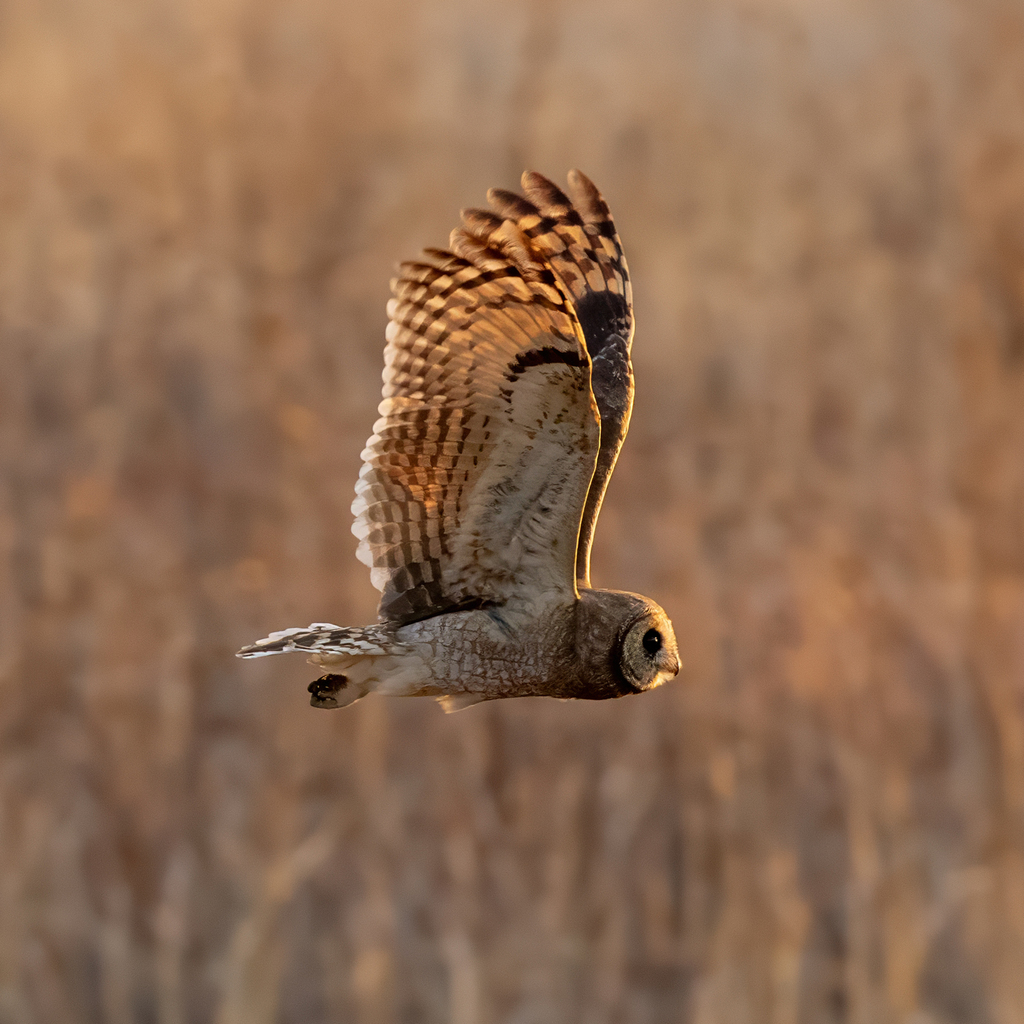
Marsh Owl
Photo © Dan Vickers
Photo © Dan Vickers — CC BY 4.0 — Source: iNaturalist photo #463380545Identification
A medium-sized owl with distinctive features that make it recognizable in its open grassland habitat. The marsh owl has a pumpkin-shaped head with small, often inconspicuous ear-tufts set near the centre of the forehead. Its plumage is predominantly dark brown, contrasting with a pale buff facial disc rimmed in dark brown with buff speckles. Dark brown patches surround the dark brown eyes, creating an intense gaze. The tail is dark brown with pale buff barring and a whitish tip. The feathered tarsi and toes are pale tawny-buff with dark brown tips, and the claws are blackish. Males are generally paler than females, with some individual variation in overall tone. Measurements range from 31–38 cm in length, with wing length 284–380 mm and weight 225–485 g.
Range & Habitat
The marsh owl has a fragmented distribution across Africa. It is common in the grasslands of southern Africa, occurring from the northern regions of South Africa down to the Eastern Cape province, and is found in Zimbabwe on the Mashonaland plateau and in the Makgadikgadi lacustrine depression in Botswana. Smaller populations occur on the floodplains of the Namibian coast and in isolated regions of Morocco and Madagascar. The species shows a strong preference for open grassland, marshlands and short scrub, typically near marshy ground, vleis and dams. These owls nest on the ground and may abandon certain areas during drought conditions. Unfortunately, their preferred habitats remain vulnerable to destruction from agricultural expansion and overgrazing.
Behaviour & Diet
Marsh owls are typically found singly or in pairs and are primarily nocturnal, though they may also be active during early morning and late afternoon hours. They are monogamous and often territorial, sometimes nesting in loose colonies. Territory size ranges from 0.8–2.5 square km, though may be smaller in denser populations, and hunting areas of neighbouring pairs may overlap. The species feeds on a diverse range of small prey, including small rodents (mice, voles, rats and shrews), young hares, bats, birds up to the size of small ducks and doves, frogs, lizards, scorpions, beetles and grasshoppers.
Best Time & Places to See It
Nesting typically occurs towards the end of the wet season or start of the dry season. The southern African grasslands—particularly in South Africa, Zimbabwe and Botswana—offer the most reliable opportunities to encounter this species. Females lay 2–6 white eggs with an incubation period of 27–28 days, and chicks fledge at 29–35 days. Visiting protected grassland reserves and wetland areas during the breeding season increases your chances of observation, particularly during early morning or dusk when the owls may be active.
Photography Tips
The marsh owl's ground-nesting behaviour and preference for open habitat make it relatively accessible for patient photographers, though its nocturnal habits present a challenge. Focus on early morning or late afternoon sessions when the owl may be active and light is favourable. The bird's striking pale facial disc and dark eye patches provide excellent compositional elements. Wide-angle shots capturing the owl in its grassland habitat can be particularly effective, while telephoto lenses will allow you to frame close-up details of the head and plumage. Ground-level perspectives can emphasize the owl's connection to its grassland environment.
Aberdare National Park
Amboseli National Park
Arusha National Park
Bwabwata National Park
Chobe National Park
Etosha National Park
Ithala Game Reserve
Kafue National Park
Kruger National Park
Nothing matches these filters.
No community photos yet. Log in to add the first one.
No community observations of this species yet.