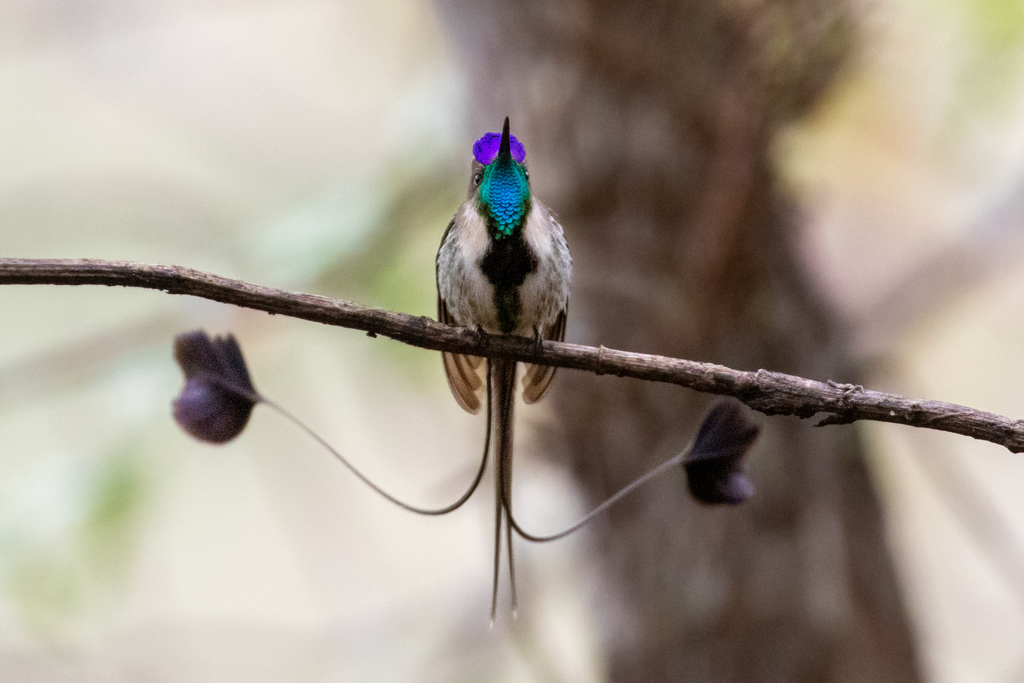
Marvelous Spatuletail
Photo © Thibaud Aronson
Photo © Thibaud Aronson — CC BY-SA 4.0 — Source: iNaturalist photo #114707771Identification
The marvelous spatuletail is a striking hummingbird with highly distinctive features, particularly in males. Males measure 15 to 17 cm long including an extraordinarily long tail of 11 to 13 cm—making the tail nearly as long as the body itself. The male's most remarkable characteristic is a pair of outer tail feathers with bare shafts that cross each other and terminate in large purplish-black racquets or "spatules," which give the species its name. The remaining tail feathers are very short, supported by two elongated undertail coverts. Females are considerably smaller at 9 to 10 cm with tails of only 5 to 7 cm, and their outer tail feathers, though long, lack the distinctive racquets.
Both sexes share a slightly curved black bill and a white spot behind the eye. Males display mostly green upperparts with a striking blue crest and brownish hindneck, combined with a glossy blue-green gorget and white underparts marked by a black line down the center. Females are green above without a crest or gorget, and their plain white underparts lack the male's central black line.
Range & Habitat
This species is endemic to a small area in the Andes of northern Peru, making it exceptionally restricted in range. Most records come from the Utcubamba River valley in Amazonas Department, with a few sightings further east in San Martín Department. The marvelous spatuletail inhabits the edges of mature forest, secondary forest, and montane scrublands, showing a particular preference for thickets of thorny Rubus (bramble) mixed with alder trees. Elevations range between 2,100 and 2,900 meters, though unconfirmed reports suggest occasional occurrences both higher and lower.
Behaviour & Diet
The marvelous spatuletail is a year-round resident that feeds by trap-lining—visiting a circuit of flowering plants where it perches to feed. The species shows a marked preference for a red-flowered lily (Bomarea formosissima) but has been documented feeding in at least five other flowering plant species. Like many hummingbirds, it is dominated by other hummingbird species sharing its range. Little is known about breeding phenology, though the breeding season appears to occur between December and February, with possible extension from October to May. Males gather at leks to perform elaborate aerial displays, during which they produce distinctive vocalizations.
The male's display calls include a repeated high-pitched buzzy metallic note described as "tzzz...tzzz..." Along with these, the species produces an upslurred high-pitched sweet note "tswee" and a more strident "tsik" call.
Best Time & Places to See It
The marvelous spatuletail's restricted range in the Utcubamba River valley in Amazonas Department, northern Peru, is the primary location for viewing. The species is a permanent resident, so it is theoretically present year-round, though the breeding season from December to February may offer opportunities to observe male display behavior at leks. Habitat preferences for forest edges, secondary growth, and montane scrubland edges should guide search efforts. Given its endangered status and small population—fewer than 1,000 mature individuals—sightings require patience and local expertise.
Photography Tips
The marvelous spatuletail's extraordinary tail spatules make it one of the most visually spectacular hummingbirds to photograph. Capturing the crossed tail feathers with their distinctive racquets in sharp detail will require fast shutter speeds and careful positioning. Males performing their aerial displays at leks offer the most dramatic photographic opportunities; the high-pitched vocalizations can help locate these display sites. Look for feeding birds at red-flowered lilies and other flowering plants where the species trap-lines. The small population and restricted range mean that working with local guides in the Utcubamba valley is essential for locating this species and gaining access to protected habitat where photography may be possible.
No community photos yet. Log in to add the first one.
No community observations of this species yet.