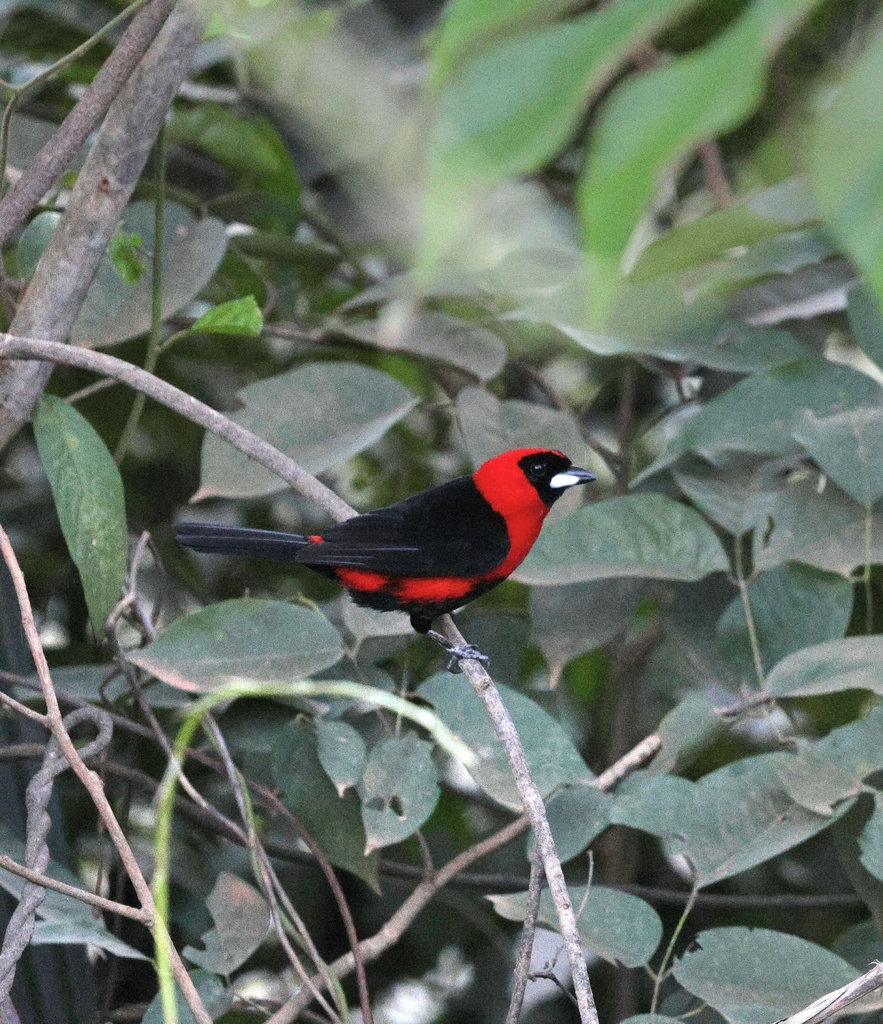
Masked Crimson Tanager
Photo © Miguel
Photo © Miguel — CC BY-SA 4.0 — Source: iNaturalist #330161532Identification
The masked crimson tanager is a compact bird measuring 18 to 19 cm in length, belonging to a genus of nine brightly coloured tanagers. The adult male is unmistakable: it displays a striking pattern of jet-black plumage on the face, wings, mantle, belly and tail, contrasted dramatically with brilliant red colouration elsewhere on the body. The bill has a distinctive silver sheen. Females are more subdued, resembling the male in pattern but with duller overall plumage and a brownish belly, while juveniles are duller still. The species bears some resemblance to the vermilion tanager, though that species inhabits higher altitudes, making confusion unlikely in the field.
Range & Habitat
The masked crimson tanager is found across Amazonia in Bolivia, Brazil, Colombia, Ecuador, Peru, and Venezuela, where it is abundant. The species shows a strong preference for wetland and riparian environments, dwelling near bodies of water such as lakes, swamps and rivers, and favouring subtropical or tropical moist shrubland. It generally remains below altitudes of 600 metres, with a particular affinity for oxbow lakes—a characteristic geographical feature of the Amazon basin.
Behaviour & Diet
These social birds move about in troops of 10 to 12 individuals and frequently form mixed-species flocks with the silver-beaked tanager, a behaviour that correlates with the extent of broad-leafed canopy in their habitat. The masked crimson tanager is primarily frugivorous, supplementing its fruit diet with small insects, particularly flying termites during the breeding season when these insects are nutrient-rich. The species also feeds opportunistically on flower nectar, and in doing so contacts the anthers with its head, making it an effective pollinator of plants such as Erythrina fusca. They produce a distinctive high-pitched single note transcribed as "tchlink" or "tink," and sing a simple melody particularly at dawn.
Best Time & Places to See It
The masked crimson tanager breeds between the dry and wet seasons in the seasonal tropics it occupies, making these transition periods potentially productive for observation. As an abundant species that prefers wetland margins and riparian zones throughout Amazonia, it can be encountered year-round across its range, particularly around oxbow lakes and river systems in lowland forest areas below 600 metres elevation.
Photography Tips
The male's striking contrast of brilliant red and jet-black plumage is highly photogenic and renders it relatively easy to identify and frame against typical rainforest vegetation. Look for birds near water margins and oxbow lakes in early morning, when dawn singing is most active. Photography is best conducted near bodies of water where the species congregates. The silver-sheened bill is a subtle but attractive detail worth capturing in good light.
Yasuní National Park
Aguarico, Ecuador
+601 birds+43 mammals
Where the western Amazon basin converges with Ecuador's Orellana Province, lowland rainforest reaches toward the horizon in an unbroken canopy of staggering botanical density. Yasuní National…
VIEW NATIONAL PARKNatural la Paya National Park
Puerto Leguízamo, Colombia
+262 birds+4 mammals
Where the Amazon's western reaches fold into the Andes foothills, La Paya National Park sprawls across more than 8,500 square kilometers of pristine Amazonian rainforest in…
VIEW NATIONAL PARKNatural Sierra de la Macarena National Park
Vista Hermosa, Colombia
+566 birds+15 mammals
Across nearly 20,000 square kilometres of Colombia's Meta Department, the terrain rises from lowland savanna into Andean foothills through a mosaic of gallery forests, palm-fringed wetlands,…
VIEW NATIONAL PARKAmacayacu National Park
Leticia, Colombia
+567 birds+25 mammals
Where the Rio Amazonas curves through the tri-border region where Colombia, Peru, and Brazil converge, Amacayacu National Park sprawls across more than 5,250 square kilometres of…
VIEW NATIONAL PARKSerra do Divisor National Park
Brazil
+448 birds+10 mammals
Where the western Amazon meets the Andes foothills, Serra do Divisor National Park sprawls across one of South America's most biodiverse and least accessible frontiers. Spanning…
VIEW NATIONAL PARKYanachaga–chemillén National Park
Palcazu, Peru
+639 birds+6 mammals
Where the eastern slopes of Peru's central cordillera plunge into cloud forest, Yanachaga–Chemillén National Park protects nearly three thousand square kilometres of montane wilderness that few…
VIEW NATIONAL PARKManu National Park
Manu, Peru
+892 birds+26 mammals
Across the eastern slopes of the Peruvian Andes, tropical rainforest descends into the Amazon basin with a complexity that few terrestrial ecosystems match. Manu National Park…
VIEW NATIONAL PARKSierra del Divisor National Park
Alto Tapiche, Peru
+298 birds+2 mammals
Where the western Amazon meets the Andes foothills, nearly 41,000 square kilometres of pristine rainforest rise across Peru's Alto Tapiche region in a landscape of extraordinary…
VIEW NATIONAL PARKBahuaja Sonene National Park
San Pedro de Putina Punco, Peru
+602 birds+8 mammals
Where the Madre de Dios and Heath rivers converge in southeastern Peru rises one of South America's most biodiverse wilderness regions: a vast protected realm of…
VIEW NATIONAL PARKIchigkat Muja – Cordillera del Cóndor National Park
Río Santiago, Peru
+101 birds
Where the Andes descend into the western Amazon, the Río Santiago carves through a landscape of profound biological complexity. Ichigkat Muja – Cordillera del Cóndor National…
VIEW NATIONAL PARKTingo Maria National Park
Mariano Dámaso Beraún, Peru
+423 birds
Where the eastern slopes of the Peruvian Andes descend toward the Amazon basin, the landscape fractures into a maze of limestone ridges, humid gorges, and cloud-wrapped…
VIEW NATIONAL PARKNo community photos yet. Log in to add the first one.
No community observations of this species yet.