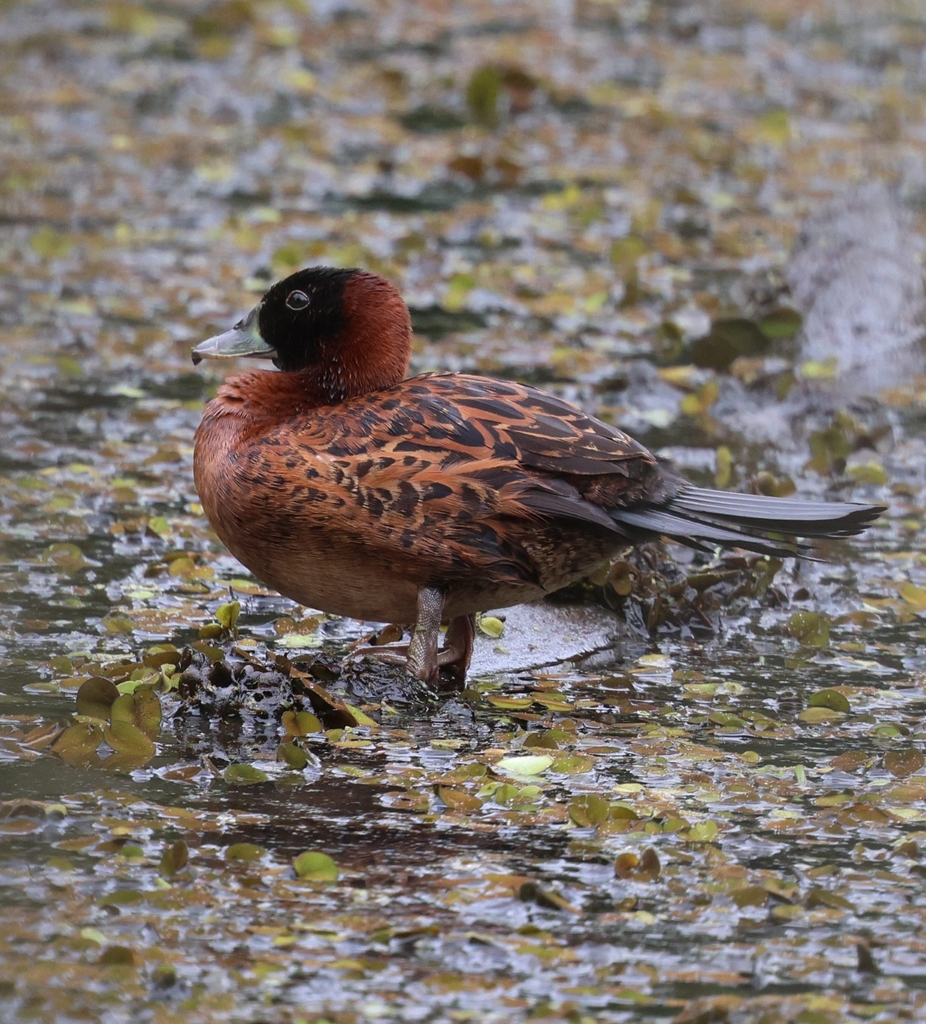
Masked Duck
Photo © Miguel
Photo © Miguel — CC BY-SA 4.0 — Source: iNaturalist #318288896Identification
The Masked Duck is a tiny stiff-tailed duck with distinctly dimorphic plumage. Breeding adult males are unmistakable, displaying a rust-colored body contrasted sharply with a black face that gives the species its common name, along with mottled wings. Adult females, winter males, and juveniles present a more subtle appearance: a barred brownish-gray body with two distinctive horizontal dark stripes running through a buff-colored face. This combination of features makes the Masked Duck readily identifiable once observed, despite its small size and secretive nature.
Range & Habitat
The Masked Duck ranges through the tropical Americas, distributed from southern Texas and Mexico southward through Central America to South America, with populations also present in the Caribbean. While primarily non-migratory throughout most of their range, they are reported as very uncommon vagrants in the southernmost United States, particularly along the Mexican border and in Florida. As of 2000, the conservation status recorded approximately 3,800 birds in Texas alone.
These ducks favor freshwater bodies with marsh vegetation surrounded by heavy tree cover for breeding. They also occur in mangrove swamps, demonstrating adaptability to various wetland environments where adequate vegetation provides both food and concealment.
Behaviour & Diet
Masked Ducks are characteristically secretive birds, though they are not rare and face no significant conservation threats according to the IUCN. They are diving ducks that feed by submerging to access food sources. Their diet consists primarily of seeds, roots, stems, and leaves of aquatic plants, supplemented by aquatic insects and crustaceans. This preference for plant material and small invertebrates makes them well-adapted to their marsh and swamp habitats.
Best Time & Places to See It
For nature travellers seeking the Masked Duck, the species' tropical American range offers the best opportunities. Freshwater marshes with dense vegetation and surrounding tree cover in Mexico, Central America, and South America represent prime habitat. Given their secretive nature and preference for areas with heavy vegetation, patience and careful observation in suitable wetland environments during breeding season will yield the best results. Birders should focus on freshwater bodies rather than open water, and mangrove swamps also warrant attention.
Photography Tips
Photographing Masked Ducks presents challenges due to their secretive behaviour and preference for densely vegetated areas. A telephoto lens is essential to capture details from a distance without disturbing these shy birds. The dramatic plumage of breeding males—particularly the striking black face and rust body—makes them highly photogenic subjects when successfully located. Exercise patience in or near suitable marshes and allow adequate time for birds to emerge from vegetation. Early morning light can enhance the visibility of their distinctive plumage patterns, and the horizontal face stripes of females and non-breeding birds make excellent compositional elements when properly lit.
Santa Rosa National Park
Santa Elena, Costa Rica
+359 birds+30 mammals
Where Pacific-facing slopes descend from volcanic uplands toward the Guanacaste lowlands, Santa Rosa National Park unfolds across a mosaic of tropical dry forest, gallery woodland, and…
VIEW NATIONAL PARKCotopaxi National Park
Mulaló, Ecuador
+211 birds+6 mammals
High in Ecuador's volcanic corridor, where the páramo transitions into cloud forest along the slopes of Cotopaxi volcano, the national park unfolds across nearly 500 square…
VIEW NATIONAL PARKPuracé National Natural Park
Puracé, Colombia
+327 birds+2 mammals
Where the Andes thrust upward across southwestern Colombia, Puracé National Natural Park spans nearly 2,631 square kilometers of some of South America's most dramatic montane terrain.…
VIEW NATIONAL PARKItatiaia National Park
Brazil
+519 birds+12 mammals
Where granite peaks pierce the Atlantic rainforest canopy in southeastern Brazil, Itatiaia National Park rises as one of the country's oldest and most ecologically vital protected…
VIEW NATIONAL PARKPeixe National Park Lagoon
Brazil
+293 birds+4 mammals
Where the coastal plains of Rio Grande do Sul meet the Atlantic, Peixe National Park Lagoon sprawls across nearly 2,200 square kilometres of shallow waters, reed…
VIEW NATIONAL PARKViruá National Park
Brazil
+389 birds+6 mammals
Across the northern frontier of Roraima, where the forest canopy rises from ancient Amazonian lowlands, Viruá National Park protects nearly 3,700 square kilometres of terra firme…
VIEW NATIONAL PARKIguaçu National Park
Brazil
+387 birds+17 mammals
Where the Paraná Plateau plunges toward the Atlantic watershed, six thousand square kilometers of subtropical rainforest cling to steep gorges and river valleys in this corner…
VIEW NATIONAL PARKSerra dos Órgãos National Park
Brazil
+446 birds+13 mammals
Granite peaks thrust skyward through the Atlantic Forest canopy in the mountains immediately north of Rio de Janeiro, their bare rock faces rising above a landscape…
VIEW NATIONAL PARKChapada dos Veadeiros National Park
Brazil
+324 birds+6 mammals
Where granite plateaus rise above the cerrado savanna in central Brazil, Chapada dos Veadeiros National Park unfolds across 6,665 square kilometres of some of the world's…
VIEW NATIONAL PARKSoberanía National Park
Cristóbal, Panama
+495 birds+34 mammals
Rainforest and riverine woodland blanket the rolling terrain of this 714-square-kilometre national park in Colón Province, where the Caribbean watershed feeds a maze of streams and…
VIEW NATIONAL PARKChagres National Park
Caimitillo, Panama
+486 birds+19 mammals
Where the Chagres River carves through the humid tropics of central Panama, a vast montane and lowland forest sprawls across more than 2,300 square kilometers, anchoring…
VIEW NATIONAL PARKIguazú National Park
Puerto Iguazú, Argentina
+346 birds+15 mammals
Where the Paraná Plateau plunges toward the Atlantic watershed, nearly 800 square kilometers of subtropical rainforest drape across Misiones Province in a landscape carved by millennia…
VIEW NATIONAL PARKEl Rey National Park
Municipio de Las Lajitas, Argentina
+317 birds+4 mammals
Where the eastern slopes of the Andes descend into northwestern Argentina's subtropical transition zone, El Rey National Park unfolds across 841 square kilometers of dramatically varied…
VIEW NATIONAL PARKChaco National Park
Municipio de Presidencia de la Plaza, Argentina
+258 birds+7 mammals
Across the humid subtropical lowlands of northeastern Argentina, where the Paraná River basin feeds vast seasonal wetlands and gallery forests, Chaco National Park protects one of…
VIEW NATIONAL PARKPalo Verde National Park
Bagaces, Costa Rica
+318 birds+24 mammals
Dry forest spreads across Palo Verde's low-lying terrain in northwestern Guanacaste, where seasonal rivers and lagoons etch through deciduous woodland that sheds its canopy each winter.…
VIEW NATIONAL PARKCaño Negro National Wildlife Refuge
Caño Negro District, Costa Rica
+486 birds+16 mammals
Where the San Juan River's seasonal floodplain opens into expansive wetlands, Caño Negro Wildlife Sanctuary sprawls across one of Central America's most productive freshwater ecosystems. This…
VIEW WILDLIFE SANCTUARYNo community photos yet. Log in to add the first one.
No community observations of this species yet.