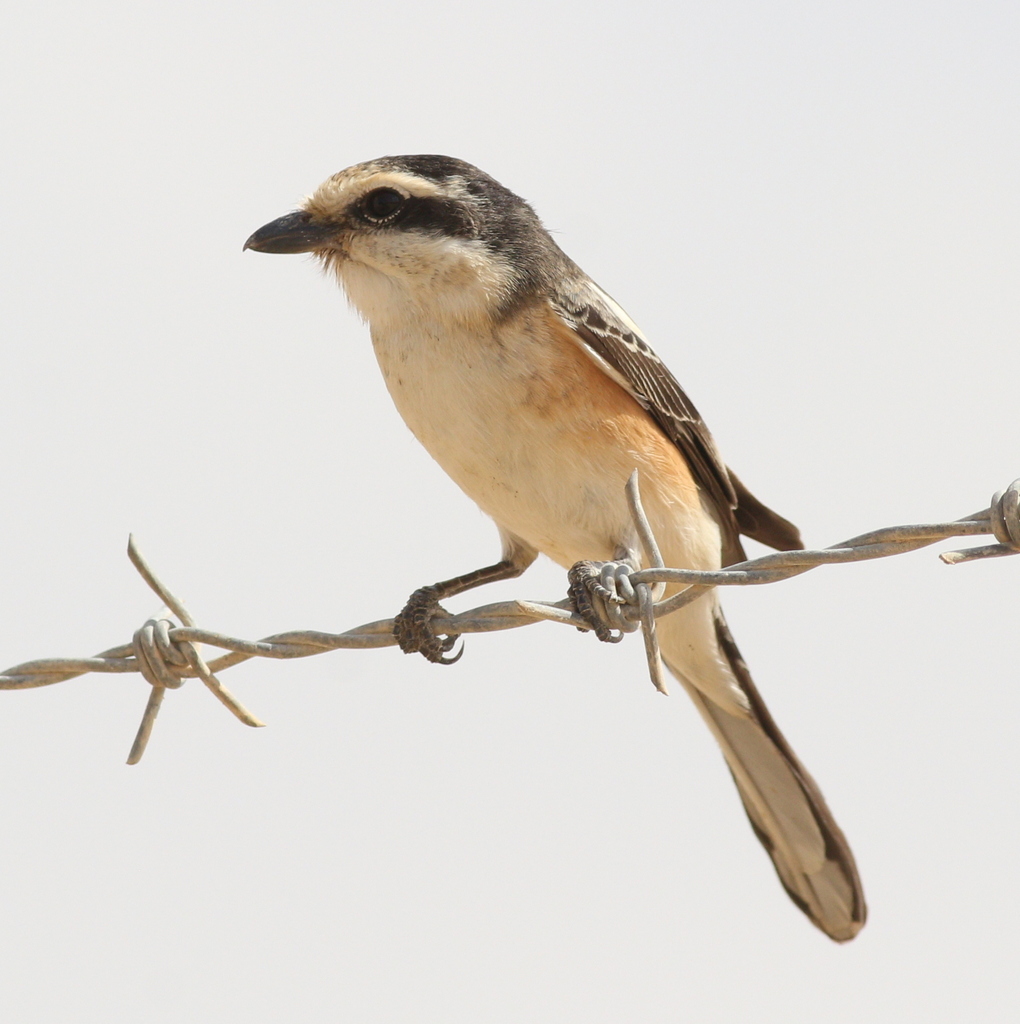
Masked Shrike
Photo © Jan Ebr & Ivana Ebrová
Photo © Jan Ebr & Ivana Ebrová — CC BY 4.0 — Source: iNaturalist #73870579Identification
The Masked Shrike is the smallest member of its genus, a slender and long-tailed bird measuring 17–18.5 cm in length with a distinctive hooked bill. Males are striking birds, featuring mainly black upperparts contrasted by a white crown, forehead and supercilium, along with large white patches on the shoulders and wings. The underparts are white with orange flanks and breast. Females are duller, displaying brownish-black upperparts with greyish or buff tones to the shoulders and underparts. Juveniles show grey-brown upperparts with barring, a paler forehead, and barred underparts. The species is most easily confused with the larger Woodchat Shrike, but Masked Shrikes are noticeably smaller, more slender, longer-tailed, and have white on the head and a dark rump, whereas Woodchats have black crowns and white rumps.
Range & Habitat
The Masked Shrike breeds in southeastern Europe and at the eastern end of the Mediterranean, with a separate population in eastern Iraq and western Iran. As a migratory species, it winters mainly in northeast Africa, though vagrants have been recorded widely across northern and western Europe. The bird favours open woodland with scattered bushes and some large trees, preferring less exposed perching locations and avoiding very open country. This preference for semi-sheltered habitats makes it less conspicuous than its relatives.
Behaviour & Diet
Masked Shrikes are insectivorous, feeding mainly on large insects and occasionally taking small vertebrates. True to their family name, they sometimes impale their prey on thorns or barbed wire. Both adults cooperate in building a neat cup-shaped nest in a tree. Clutches typically contain 4–6 eggs, which the female incubates for 14–16 days. Chicks are fed by both parents and fledge after 18–20 days, remaining dependent on their parents for approximately 3–4 weeks thereafter. The species produces harsh, grating calls typical of shrikes, including repeated tsr, tzr or shek notes, but its song is notably softer and more melodic than most shrikes, with warbler-like components and rich warbles interspersed with chattering sounds.
Best Time & Places to See It
Masked Shrikes can be encountered in their breeding range across southeastern Europe and the eastern Mediterranean during the breeding season, and in northeast Africa during winter. Their preference for open woodland with scattered trees makes them moderately accessible to patient observers, though they often perch in less exposed locations. The species' decreasing populations in parts of its European range suggest that sightings may become less frequent in some traditional locations.
Photography Tips
The Masked Shrike's contrasting plumage—particularly the male's striking black and white head pattern with orange flanks—offers excellent photographic potential. However, the bird's preference for less exposed perching positions requires patience and careful approach. Early morning light will best reveal the subtle orange tones of the breast and flanks. The bird's relatively small size demands good optical quality; a telephoto lens is recommended. Watching for perching behaviour, particularly when the bird is scanning for insects, will yield the best opportunities for focused, behavioural shots.
Camargue Regional Nature Park
Saintes-Maries-de-la-Mer, France
+378 birds+48 mammals
Where the Rhône Delta sprawls into the Mediterranean, a landscape of stark and haunting beauty emerges—vast salt marshes punctuated by shallow lagoons, reed beds, and scrubland…
VIEW NATURAL PARKAbijata-Shalla Lakes National Park
Ethiopia
+438 birds+7 mammals
Two crater lakes of contrasting chemistry define this remote corner of Ethiopia's Rift Valley, where soda lakes and freshwater basins create a mosaic of distinct aquatic…
VIEW NATIONAL PARKAwash National Park
Didiga, Ethiopia
+473 birds+23 mammals
Where the Ethiopian Rift Valley carves through volcanic plateaus, a ribbon of riverine forest winds through acacia scrubland and grassland, creating a mosaic of habitats that…
VIEW NATURAL PARKOlympos National Park
Pieria Regional Unit, Greece
+137 birds+3 mammals
Where the Thessalian plains give way to soaring limestone massifs, Olympos National Park rises as one of the Aegean's most dramatic mountain wilderness areas. This IUCN…
VIEW NATIONAL PARKKerkini Lake National Park
Serres, Greece
+291 birds+18 mammals
Where the Strymon River widens into a sprawling freshwater lake hemmed by the Rhodope Mountains, Kerkini National Park unfolds across northern Greece as one of southeastern…
VIEW NATIONAL PARKNo community photos yet. Log in to add the first one.
No community observations of this species yet.