Identification
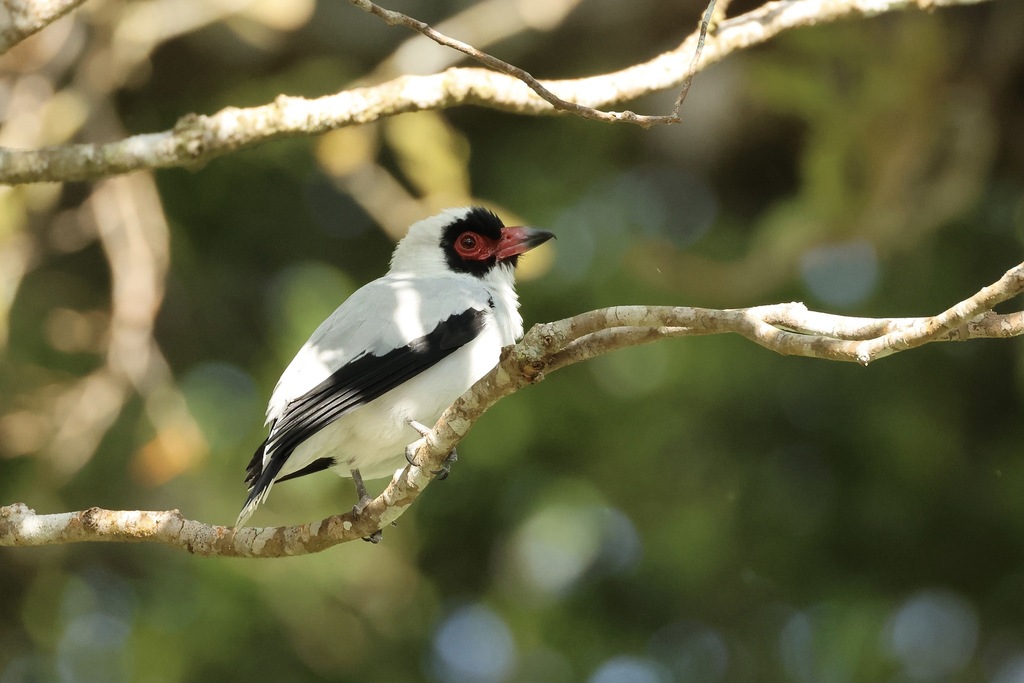
The Masked Tityra is a medium-sized passerine measuring 20–24 cm in length and weighing 77–88 g. This species is distinctly sexually dimorphic. Males of the widespread nominate subspecies display striking bare rosy-red skin extending from the bill around the eye, contrasted by a black forecrown. The rest of the head and upperparts are pale grayish-white with a pearly-gray cast, while the mostly black wings feature grayish-white tertials. The tail is grayish-white with a bold black subterminal band. The throat and underparts are whitish. Females share the bare red facial skin but lack the black crown; their plumage is smokier gray on the head with darker, brown-streaked upperparts and dingy pale underparts. Both sexes have a distinctive reddish-brown to brick-red iris, a slightly hooked rosy-red bill with a black tip, and blackish legs and feet. Nine subspecies occur across the range, varying in the extent of black on the male's face, overall gray tones, and breast coloration.
Range & Habitat
The Masked Tityra is found throughout Mexico, every Central American country, and northern and central mainland South America, with nine subspecies distributed from northwestern Mexico south to Brazil, Paraguay, and possibly northeastern Argentina. It inhabits a variety of forested landscapes in tropical and lower subtropical zones, including canopy, clearings, and edges of lowland and montane evergreen forest, secondary forest, semi-open woodland, savanna with scattered trees, and plantations. Elevational range extends from sea level to 2,500 m in western Mexico and northern Central America, decreasing to 1,800 m in Costa Rica and Venezuela, 1,600 m in Colombia and Peru, and 1,100 m in Ecuador.
Behaviour & Diet
The Masked Tityra is a year-round resident throughout its range, though individual vagrants occasionally occur in extreme northern areas. It feeds predominantly on fruits, supplemented with invertebrates and occasionally small lizards. This species forages singly, in pairs, or in small groups from the mid-story to the canopy, typically perching openly and gleaning while stationary or hopping along branches. It occasionally sallies briefly from a perch with or without hovering to capture food. Unlike many forest birds, it does not associate with mixed-species feeding flocks.
Best Time & Places to See It
The Masked Tityra's breeding season varies geographically, with records from March through July across its range. Year-round residency means it can be found in suitable habitat throughout the year. Look for this species in open areas within forested landscapes—particularly in the mid-canopy and canopy levels where it feeds most actively. Lowland and foothill forests with scattered clearings and semi-open woodlands provide the best opportunities for observation across Central America and South America.
Photography Tips
The Masked Tityra's striking sexual dimorphism and contrasting plumage make it an attractive photographic subject. Males are more conspicuous with their distinctive red facial patches and black crown markings. Position yourself to capture the bird's characteristic open perching behavior—it often remains exposed in the mid-canopy, providing good photographic opportunities. Early morning light will best reveal the delicate pearly-gray tones of the upperparts and highlight the vivid bare facial skin of males. A focal length of 300–500 mm works well for canopy-feeding birds, and patience at fruiting trees or along forest edges increases your chances of productive encounters.
Amacayacu National Park
Amazônia National Park
Anavilhanas National Park
Antisana National Park
Arenal Volcano National Park
Bahuaja Sonene National Park
Barbilla National Park
Barra del Colorado National Wildlife Refuge
Baru Volcano National Park
Nothing matches these filters.
No community photos yet. Log in to add the first one.
No community observations of this species yet.