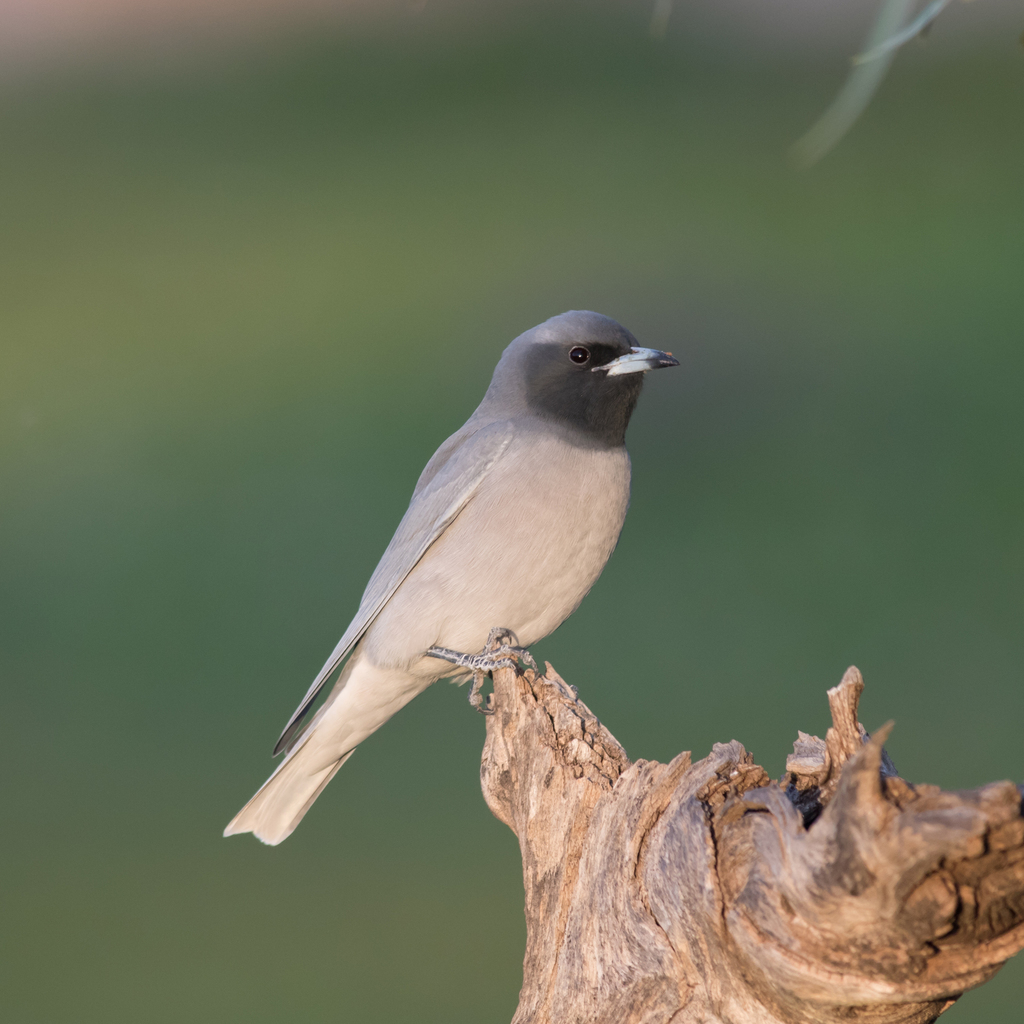
Masked Woodswallow
Photo © Kym Nicolson
Photo © Kym Nicolson — CC BY 4.0 — Source: iNaturalist #46466556Identification
The masked woodswallow is a small passerine, measuring 18–20 centimetres in length with a wingspan of 32–34 centimetres and weighing approximately 37 grams. Adult males are unmistakable, featuring a sharply defined black face mask with a pale edge covering the lores, ear coverts, chin and throat. The upperparts are dark blue-grey with a prominent white tip on the tail, while the underbody is pale grey, fading to greyish white on the under tail coverts. The legs and feet are grey to black. Adult females are similar but slightly browner with a more indistinct mask, while juveniles resemble females but are browner with fletched and mottled buff plumage. This striking sexual dimorphism is unique to the masked and white-browed woodswallows among Australian species.
Range & Habitat
The masked woodswallow is widespread across mainland Australia, though less common in coastal and near-coastal areas. Vagrants have occasionally been recorded in Tasmania, New Zealand, Norfolk Island and Lord Howe Island. This highly nomadic species primarily inhabits open forest, woodland, heath, roadside and farm tree belts, with a preference for arid and semi-arid zones. It does not breed in eastern and south-eastern coastal areas or north of latitude 20°.
Behaviour & Diet
A gregarious and highly nomadic species, the masked woodswallow typically appears in large flocks, often alongside white-browed woodswallows. It is mainly insectivorous, hawking or pouncing on prey with agility. Nectar also forms part of its diet, and the species has been observed occasionally eating fruit. Uniquely among passerines, it possesses powder down distributed throughout its plumage. The masked woodswallow is an exclusive pair breeder, with no cooperative breeding recorded despite sharing habitat with other Artamus species.
Best Time & Places to See It
The masked woodswallow breeds throughout most of its distribution during spring and summer, though timing varies annually, with most pairs raising one brood per year and occasionally two. Look for large flocks in open woodlands and arid country across inland Australia. The species' nomadic nature means that timing and location of sightings can be unpredictable, but inland semi-arid regions offer the best opportunities, particularly during the breeding season.
Photography Tips
The male's striking black face mask provides excellent contrast for photography, particularly in the harsh Australian sunlight typical of arid habitats. Photograph males in profile to capture the sharply defined mask edge and the prominent white tail tip in flight. Flocking behaviour offers opportunities for dynamic group shots, especially when birds are hawking insects in open spaces. Early morning light will best reveal the dark blue-grey upperparts and pale underparts. Exercise patience near open woodlands and farm tree belts, where the species often hunts insects in flight or perches conspicuously on low branches.
Blue Mountains National Park
Boodjamulla National Park
Bribie Island National Park
Budj Bim National Park
Cape Range National Park
Carnarvon National Park
Chiltern-Mt Pilot National Park
Coffin Bay National Park
Coorong National Park
Nothing matches these filters.
No community photos yet. Log in to add the first one.
No community observations of this species yet.