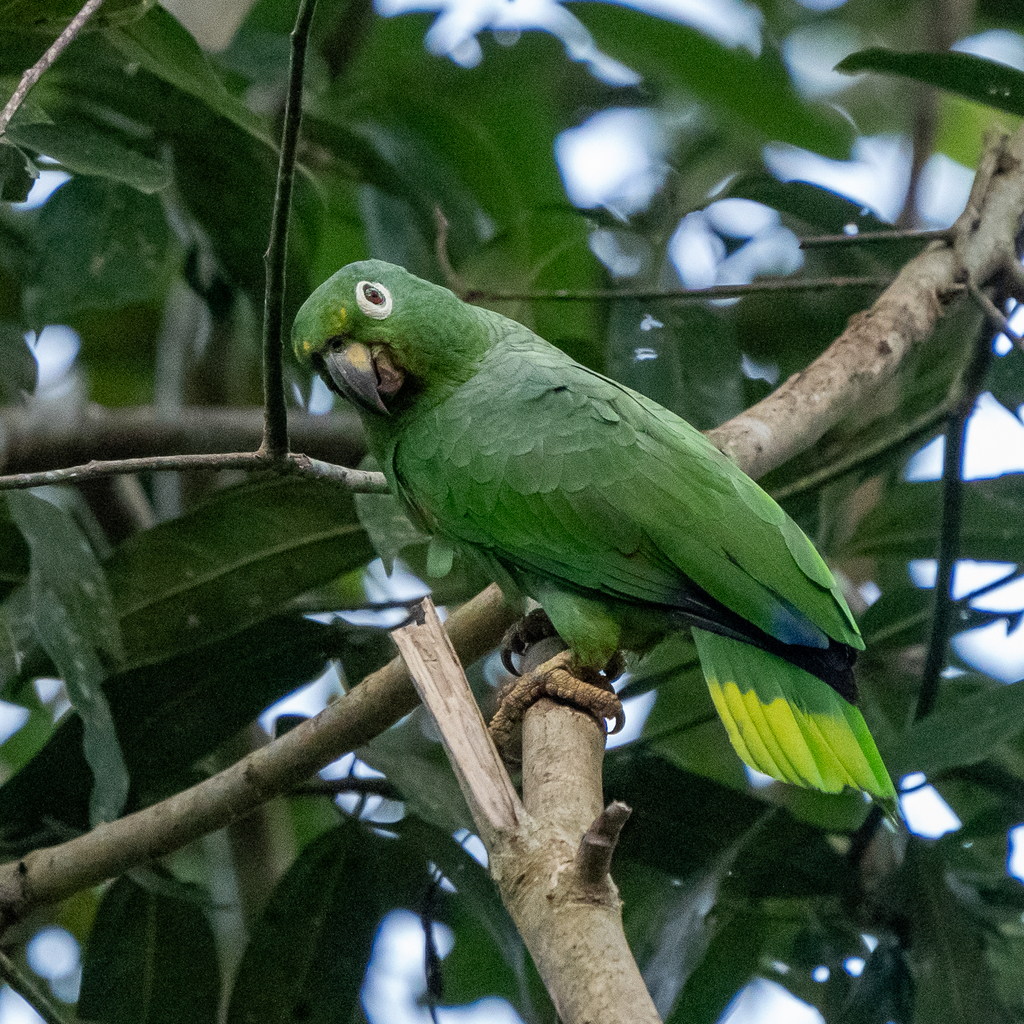
Mealy Amazon
Photo © Anthony Batista
Photo © Anthony Batista — CC BY 4.0 — Source: iNaturalist photo #349915792Identification
The mealy amazon is among the largest parrots in the Americas, measuring 38–41 cm (15–16 in) in length and weighing 540–700 g. It is predominantly green with a distinctive whitish tinge to the back and nape, as if dusted with flour—a characteristic that inspired its common name. The tail is relatively short and square-shaped, with a distinctly bi-colored appearance: the basal half is darker green while the distal half is paler and more yellow. In flight, the species displays a conspicuous red speculum and a bluish-black trailing edge to the wing. Occasionally, a few yellow feathers appear on the crown.
In South American range, the mealy amazon may be confused with the yellow-crowned amazon, but can be distinguished by its larger size, less yellow on the crown, the characteristic whitish plumage tinge, a broader white eye-ring, and red on the leading edge of the wing positioned near the inner flight feathers. Their voices are strikingly different, providing another useful identification cue.
Range & Habitat
The mealy amazon occurs throughout tropical Central and South America, with three recognized subspecies. The northern mealy amazon (A. f. guatemalae) ranges from southeastern Mexico to Honduras. The green-headed variant (A. f. virenticeps) is found from Nicaragua to western Panama. The southern mealy amazon (A. f. farinosa) inhabits the broader tropical regions of Central and South America.
This species frequents humid to semi-humid forests, plantations, and occasionally deciduous forest. In regions dominated by open or dry habitats, it is restricted to gallery forests along waterways and may be entirely absent from arid areas.
Behaviour & Diet
Mealy amazons are highly social birds, found in pairs or large flocks, and are known to interact with other parrot species including macaws. They are generally quiet but become vocal at dusk and dawn. In captivity, they have earned a reputation as one of the gentlest and calmest of all amazon parrots.
Their diet consists primarily of fruits, seeds, berries, nuts, blossoms, and leaf buds. During breeding season, which typically begins in early spring, pairs form monogamous bonds. Females lay three or four white eggs in tree-cavity nests and incubate them for approximately 26 days, while males provide regurgitated food. Chicks fledge about 60 days after hatching.
Best Time & Places to See It
The mealy amazon is fairly common throughout most of its range, though populations have declined locally due to habitat loss and capture for the pet trade. The species is found in humid lowland forests and wooded plantations from Mexico through Central America and into the Amazon Basin and other tropical South American regions. Dawn and dusk hours often provide the best viewing opportunities, as birds become more vocal and active during these times.
Travelers should look for this species in intact humid forests and forest-edge habitats, particularly near fruiting trees. Their large size and social nature make them relatively conspicuous when present, though their predominantly green plumage provides effective camouflage in the canopy.
Photography Tips
The mealy amazon's size and relatively calm demeanor make it an approachable subject for photographers, particularly when birds are feeding in fruiting trees. The species' striking field marks—the red wing speculum, bi-colored tail, and whitish plumage dusting—are best captured in good lighting. Photograph birds in flight to showcase the red speculum and bluish-black wing trailing edge, or wait for perched birds to capture the facial characteristics and eye-ring detail.
Early morning and late afternoon light will enhance the subtle green hues and powder-down texture that characterize this species. When photographing feeding birds, position yourself to capture interactions within flocks or the distinctive postures birds adopt while manipulating fruits and seeds with their feet.
Amacayacu National Park
Amazônia National Park
Anavilhanas National Park
Arenal Volcano National Park
Bahuaja Sonene National Park
Barbilla National Park
Barra del Colorado National Wildlife Refuge
Braulio Carrillo National Park
Cahuita National Park
Nothing matches these filters.
No community photos yet. Log in to add the first one.
No community observations of this species yet.