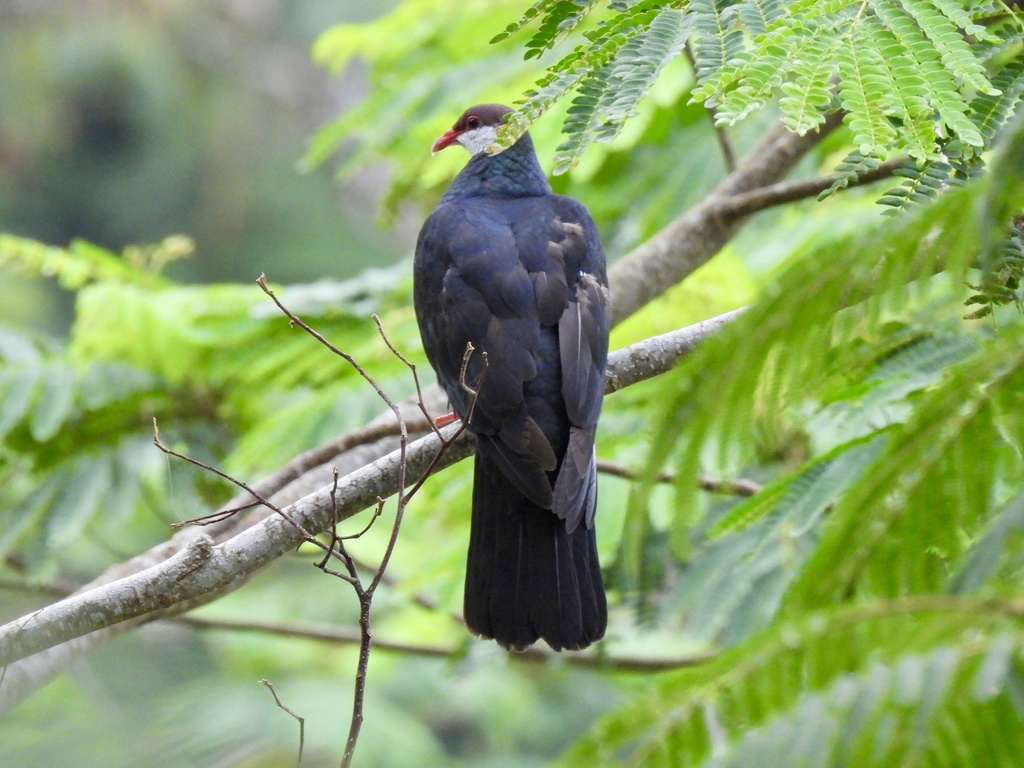
Metallic Pigeon
Photo © Caroline Quinn
Photo © Caroline Quinn — CC BY 4.0 — Source: iNaturalist #248232701Identification
The Metallic Pigeon is a medium-sized bird reaching up to 37 cm in length. Adults display a striking iridescent purple and green crown, black wing and upper tail coverts, and a yellowish-red iris. The bill is yellow with distinctive red orbital skin, while the chin and ear coverts range from white to grey depending on subspecies. The feet are purplish. Below, plumage varies from dull chestnut to glossy purple-green, with considerable variation among subspecies—the Fiji form shows duller underparts, while the widespread halmaheira subspecies exhibits the most brilliant iridescence. Sexual dimorphism appears subtle overall, though females tend to be duller than males. Notably, throat color dimorphism is constant in several subspecies, with males typically showing white throats while females are washed grey. All subspecies except castaneiceps display a pigmented malar spot and line beneath the eye. Young birds are duller than adults.
Range & Habitat
This species is distributed across a vast range spanning the Philippines, Indonesia (east of the Wallace Line, excluding Sulawesi), Papua New Guinea, the Solomon Islands, Vanuatu, New Caledonia, Fiji, Samoa, and small islands off northwestern Borneo. Eight living subspecies occupy this chain extending from near Japan to Australia, each with distinct plumage characteristics. While most subspecies are common within their ranges, C. v. halmaheira is uncommon in the Bismarck Islands and Bougainville, and C. v. metallica remains rare except on Timor.
The Metallic Pigeon occupies an impressive elevational and ecological range, from coastal mangroves and sea-level forests to montane forests at altitudes reaching 2,750 meters. Although preferring tropical forests, they demonstrate remarkable habitat adaptability, thriving in degraded forests, forest edges, and on smaller islands where they may approach human settlements.
Behaviour & Diet
Rather than undertaking long-distance migrations, Metallic Pigeons are nomadic, making irregular local movements between islands in search of food. They are typically encountered singly or in pairs. Their diet is diverse and opportunistic, comprising various fruits, grains, seeds, and berries. The average lifespan is approximately 3 to 4 years.
Best Time & Places to See It
To encounter Metallic Pigeons, visit their island strongholds across the Indo-Pacific, particularly Fiji, Vanuatu, New Caledonia, the Solomon Islands, and throughout Indonesia east of the Wallace Line. Their nomadic habits mean that sighting success can vary seasonally depending on local fruit abundance. Forest edges and degraded habitats often provide better viewing opportunities than pristine forest interiors. Early morning hours are typically most productive for observing these birds.
Photography Tips
The iridescent crown and body plumage of Metallic Pigeons require careful exposure metering to capture their metallic sheen effectively. Shoot in bright, indirect light to reveal the purple and green iridescence without blown highlights. Position yourself at eye level or slightly below to showcase the distinctive crown and throat markings. Patient observation is essential, as these birds are often solitary and may move between fruiting trees unpredictably. A telephoto lens (at least 300mm) is recommended for unobtrusive shooting. The white or grey throat patches and facial markings provide useful compositional focal points, while the malar spot and eye-line detail reward close attention in post-processing.
Aketajawe Lolobata National Park
Oba Tengah, Indonesia
+123 birds+2 mammals
Across the northeastern arm of Halmahera, where the Wallace Line once marked the boundary between Asian and Australasian fauna, lies a sprawling wilderness of over 13,800…
VIEW NATIONAL PARKMutis Timau National Park
Timor Tengah Selatan, Indonesia
+77 birds
Where the volcanic highlands of Timor Tengah Selatan rise above the surrounding lowlands, Mutis Timau National Park unfolds across approximately 224 square kilometres of mountain forest…
VIEW NATIONAL PARKNo community photos yet. Log in to add the first one.
No community observations of this species yet.