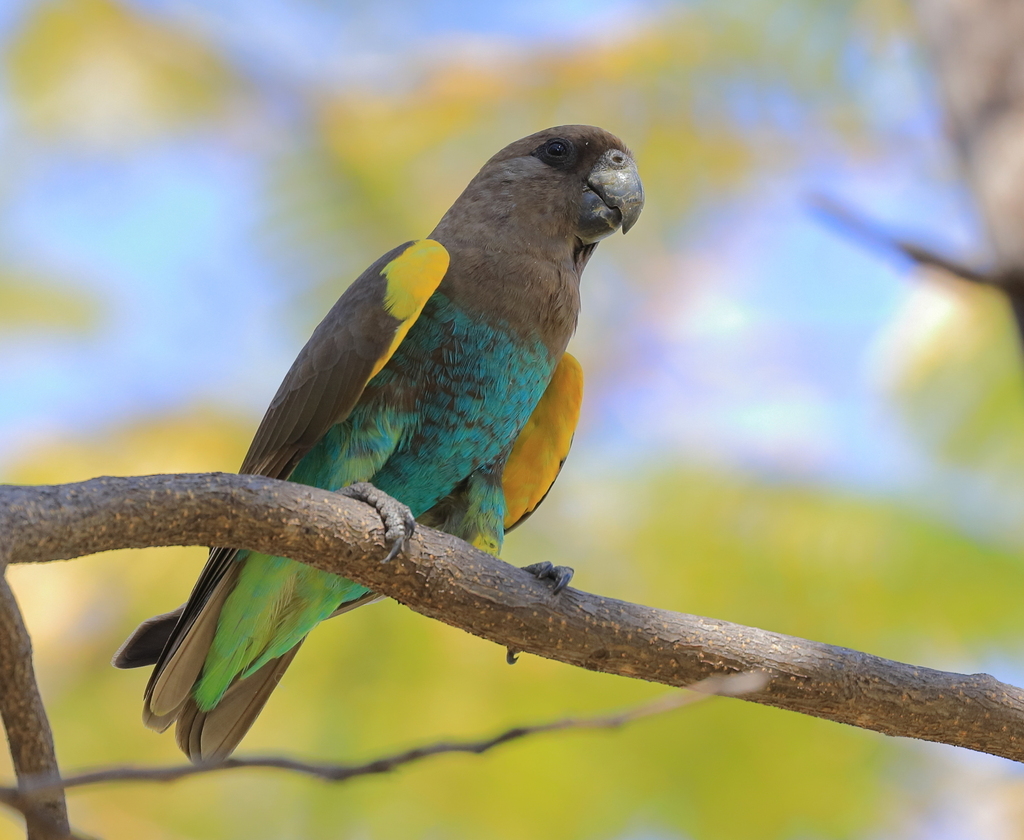
Meyer’s Parrot
Photo © Darren Obbard
Photo © Darren Obbard — CC BY 4.0 — Source: iNaturalist photo #566180584Identification
Meyer's parrot is a striking African species, also known as the brown parrot, distinguished by its bold plumage pattern. The bird displays black feathers as its base colour, contrasting sharply with a turquoise belly and blue rump. Bright yellow markings on the carpal joint of the wings are a key identifying feature, and most subspecies also show yellow on the crown of the head. Six recognized subspecies vary considerably in their extent of yellow markings and the intensity of turquoise and blue coloration, making regional identification rewarding for experienced birdwatchers.
Range & Habitat
This parrot is native to sub-Saharan Africa, with a vast range spanning from Chad and Ethiopia in the north to South Africa in the south. Meyer's parrots favour plateau woodlands, including miombo, savanna woodlands, wooded grasslands, and forests bordering watercourses or agricultural land. They occur across Congo, Angola, Tanzania, Zambia, Zimbabwe, Mozambique, Namibia, and other central and southern African nations. The Okavango Delta region of Botswana supports exceptionally high densities of these birds.
Behaviour & Diet
Meyer's parrots typically travel in pairs or small flocks, though they congregate in larger numbers where food is abundant. They are opportunistic foragers with a diet of fruit, seeds, nuts, berries, and cultivated crops, with leguminous tree seeds forming their staple in many areas. During drought years, they become nomadic, wandering widely in search of sustenance. These parrots nest in tree cavities, laying three or four white eggs that are incubated for approximately 28 days, with chicks fledging around 60 days after hatching.
Best Time & Places to See It
The Okavango Delta in Botswana offers the highest probability of sighting Meyer's parrots in exceptional numbers. Broader opportunities exist across miombo and savanna woodland habitats throughout central and southern Africa. Visiting during periods of fruit abundance increases your chances of locating feeding flocks. Early morning hours are typically best for observation and photography, as parrots are most active during cooler parts of the day.
Photography Tips
The striking colour contrast of Meyer's parrot makes it a rewarding photographic subject. Position yourself near woodland areas with abundant fruiting trees, where parrots gather to feed. The bright yellow wing markings and turquoise underparts photograph best in soft, early morning light that avoids harsh shadows. When photographing flocks, anticipate their rapid, direct flight patterns. A telephoto lens (at least 300mm) is essential for capturing frame-filling portraits while maintaining safe distance from these wary birds.
Bwindi Impenetrable National Park
Lake Mburo National Park
Mabamba Swamp
Murchison Falls National Park
Queen Elizabeth National Park
Arusha National Park
Bwabwata National Park
Chobe National Park
Kafue National Park
Nothing matches these filters.
No community photos yet. Log in to add the first one.
No community observations of this species yet.