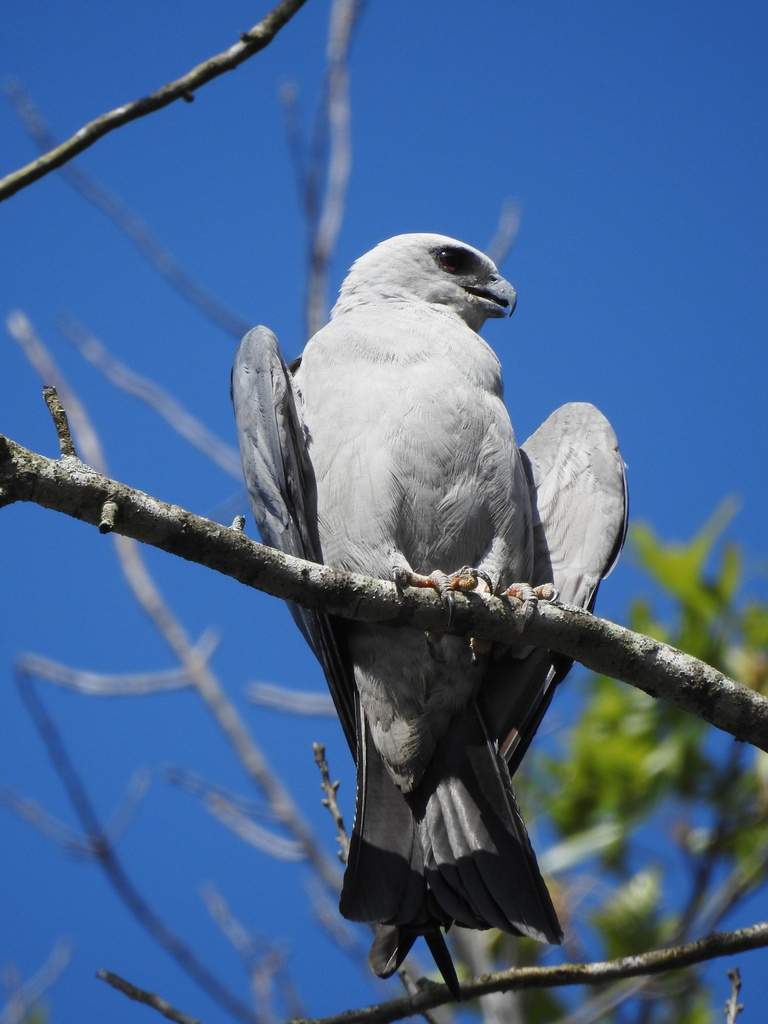
Mississippi Kite
Photo © Laura Mae
Photo © Laura Mae — CC BY 4.0 — Source: iNaturalist photo #422300611Identification
The Mississippi kite is a small raptor measuring 12 to 15 inches in length with a wingspan of approximately 3 feet and weighing between 7.6 and 13.7 ounces. Adult birds are characterized by light grayish-blue plumage with darker gray on the head and a pale underbelly. The species has narrow, pointed wings and a forked tail, giving it a graceful silhouette in flight. Most striking are their bright red eyes, which provide exceptional vision for locating prey while airborne.
Range & Habitat
Mississippi kites breed across the Central and Southern United States, with the southern Great Plains serving as a stronghold for the species. Sightings are regularly documented in Florida, Kansas, Louisiana, Missouri, Oklahoma, Tennessee, Texas, and Virginia. The species' breeding range has expanded significantly during the early 21st century, now stretching from Southern California to southern New England, with records as far north as Nova Scotia. This expansion has been facilitated by the creation of shelterbelts in grassland habitats. For winter, the species migrates to subtropical and temperate regions of South America, primarily northern Argentina and southern Brazil, though they are also found in Belize, Costa Rica, El Salvador, Mexico, and Panama.
Behaviour & Diet
Mississippi kites are graceful, buoyant fliers often seen circling in groups, sometimes numbering in the thousands during migration. They are monogamous, forming breeding pairs before or shortly after arriving at breeding sites. The species feeds primarily on larger-bodied invertebrates and insects captured in flight—particularly cicadas, crickets, grasshoppers, and locusts—making them valuable for natural pest control. They occasionally hunt small vertebrates including birds, amphibians, reptiles, and small mammals, typically hunting from low perches and consuming prey in-flight. They often patrol around livestock herds to catch insects stirred up from the ground. Nesting occurs in colonies within deciduous trees such as elm, eastern cottonwood, hackberry, oak, or mesquite. Pairs typically lay two white eggs in twig-constructed nests, with both parents incubating and caring for young. Eggs hatch in 30 to 32 days, and young fledge 30 to 34 days after hatching.
Best Time & Places to See It
The Mississippi kite is best observed during the breeding season across its range in the Central and Southern United States, particularly in the southern Great Plains. For large flocking events during migration, exceptional opportunities occur in South America, notably at locations such as Fuerte Esperanza, Argentina, where groups of up to 10,000 birds may be observed. Migration typically occurs in groups of 20 to 30 birds. In recent years, the species has become increasingly common in urban and suburban areas throughout the western south-central states, making it accessible to birders in populated regions.
Photography Tips
The Mississippi kite's graceful, buoyant flight makes it a rewarding subject for action photography. Capture birds circling together, which is common behavior, or photograph them in their characteristic hunting posture as they hover and patrol. Their striking bright red eyes are a key identifying feature—use telephoto lenses to capture this detail. The contrast between their grayish-blue upperparts and pale underside is best rendered in good light. In breeding areas, look for them near elm, oak, and cottonwood trees where they nest; colonial nesting provides opportunities to photograph multiple birds. During migration, scout known gathering points for large flocking events.
Alaska Maritime National Wildlife Refuge
Alligator River National Wildlife Refuge
Amacayacu National Park
Arenal Volcano National Park
Barra del Colorado National Wildlife Refuge
Big Bend National Park
Bitter Lake National Wildlife Refuge
Blackwater National Wildlife Refuge
Bombay Hook National Wildlife Refuge
Nothing matches these filters.
No community photos yet. Log in to add the first one.
No community observations of this species yet.