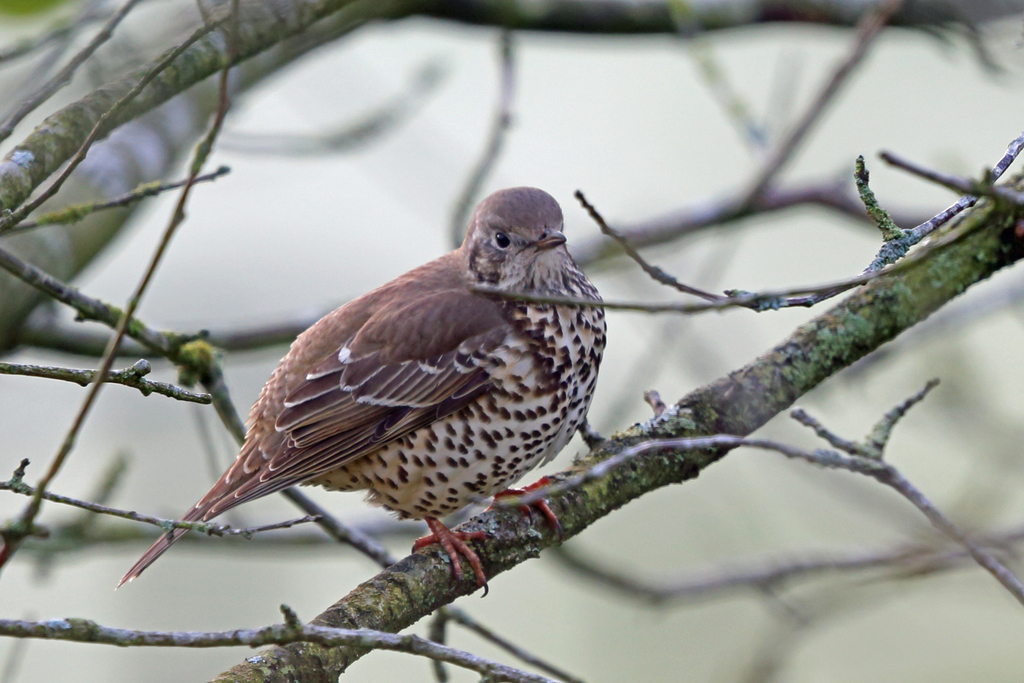
Mistle Thrush
Photo © Nigel Voaden
Photo © Nigel Voaden — CC BY 4.0 — Source: iNaturalist photo #6271368Identification
The mistle thrush is the largest thrush native to Europe, measuring 27–28 cm in length with a 45 cm wingspan. It has a stocky, upright posture on the ground and is characterized by pale grey-brown upperparts, a greyish-white chin and throat, and a yellowish-buff breast and off-white belly marked with distinctive round black spots that become denser on the lower chest. The long tail displays white tips on the outer feathers, and the underwing coverts are white. The eyes are dark brown, the bill is blackish with a yellowish base, and the legs are yellowish-brown. The sexes are similar in plumage, and juveniles resemble adults but have paler upperparts with creamy 'teardrop' centres to many feathers and smaller spots on the underparts.
Range & Habitat
The mistle thrush is common throughout much of Europe, temperate Asia, and North Africa. It is a year-round resident in much of its range, though northern and eastern populations migrate south for winter, often in small flocks. The species inhabits open woods, parks, hedges, and cultivated land across its distribution.
Behaviour & Diet
This thrush is renowned for its loud, far-carrying song, which it delivers even in wet and windy weather—a characteristic that earned it the old name "stormcock." The mistle thrush feeds on a wide variety of invertebrates, seeds, and berries, with preferred fruits including mistletoe, holly, rowan, and yew. Mistletoe is especially favoured where available, and the bird plays an important ecological role by dispersing the plant's seeds through its droppings. In winter, mistle thrushes vigorously defend mistletoe clumps and other fruit-bearing trees as food reserves, chasing off competing thrushes and fruit-eating birds such as waxwings.
Breeding birds build open cup nests against tree trunks or in forked branches, which they defend fearlessly against predators, including humans and cats. Clutches typically contain three to five eggs, incubated for 12–15 days mainly by the female. Chicks fledge approximately 14–16 days after hatching, and there are normally two broods per year.
Best Time & Places to See It
The mistle thrush can be observed year-round throughout much of its range. Winter is an excellent time to locate them, as they become more conspicuous when defending fruiting trees, particularly mistletoe and holly. Look for them in open woodlands, parks, and cultivated landscapes across Europe, temperate Asia, and North Africa. Their loud song and vigorous territorial behaviour in winter make them relatively easy to find during this season.
Photography Tips
Photograph mistle thrushes in winter when they concentrate around fruiting trees, making them more predictable and accessible. Their stocky posture and pale underparts with distinctive spotting are best captured in good light. The white underwing coverts and white tail tips are useful identifying features to highlight. Their fearless defensive behaviour means they often remain visible despite human presence, offering good opportunities for close-range photography. The species' large size and bold markings make it a rewarding subject, particularly when perched prominently on berry-bearing branches.
Abruzzo, Lazio and Molise National Park
Alpilles Regional Nature Park
Alta Murgia National Park
Altai Tavan Bogd National Park
Appennino Lucano Val d’Agri Lagonegrese National Park
Appennino Tosco-Emiliano National Park
Åsnens National Park
Aspromonte National Park
Avesnois Regional Nature Park
Nothing matches these filters.
No community photos yet. Log in to add the first one.
No community observations of this species yet.