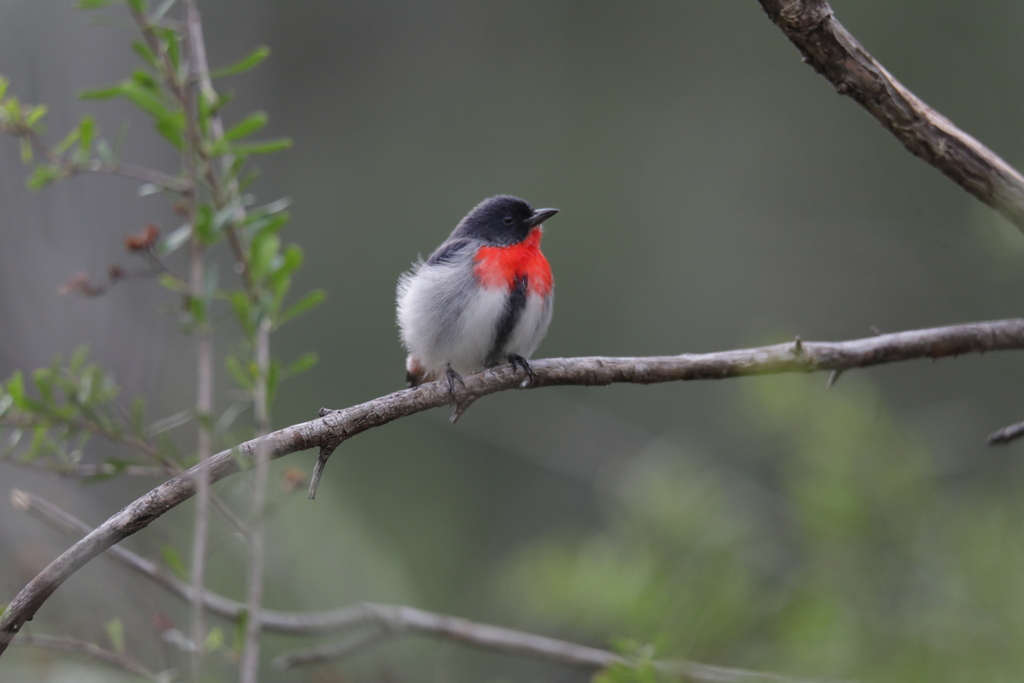
Mistletoebird
Photo © Liam southwell
Photo © Liam southwell — CC BY 4.0 — Source: iNaturalist photo #389332121Identification
The mistletoebird is a diminutive flowerpecker, measuring just 9–10 cm in length. Males are unmistakable: glossy blue-black above with a striking red chest, red under-tail coverts, and a distinctive black stripe running down the white belly. Females are more subdued, appearing dark grey above with a white throat and light grey underparts touched with pinkish-red under the tail. Both sexes have black eyes, bills, and legs, with bills just over a centimetre long—slender, slightly down-curved, and sharply pointed. Immature birds resemble females but possess an orange-pink bill. The species is characterized by long, pointed swallow-like wings and a short square tail. Their swift, high flight and distinctively pointed wing silhouette make them recognizable in the canopy, though they are occasionally confused with scarlet or flame robins—distinctions that become clear upon noting the absence of a forehead spot and the presence of the belly stripe.
Range & Habitat
The mistletoebird is endemic to most of Australia, notably absent from Tasmania and the driest desert regions, and also occurs in the eastern Maluku Islands of Indonesia in the Arafura Sea. The species is a relatively recent Australian arrival, having colonized the continent from Southeast Asia approximately two million years ago. These birds favour forests and woodlands dominated by Eucalyptus species, ranging from dry interior to coastal rainforest, though they avoid high-altitude areas in winter. They show a strong preference for mature tree stands where mistletoe infestation is more likely, rather than regenerated areas.
Behaviour & Diet
Mistletoebirds are nomadic, with movements closely tied to mistletoe fruiting cycles. They are primarily solitary or occur in pairs, though small family groups and occasional mixed-species flocks form when food is abundant. Their posture when perched is typically upright, but they adopt a horizontal, swaying posture when alarmed. The species is a dietary specialist, feeding almost exclusively on mistletoe berries—a specialization that has evolved independently across eight avian families worldwide. In Australia, they consume berries from the approximately 100 mistletoe species present, including the grey mistletoe common in drier regions. As a vector for mistletoe seed dispersal, the mistletoebird plays a crucial ecological role, though unlike the mutually dependent relationship once thought to exist, the mistletoe does not depend on the mistletoebird for survival.
Best Time & Places to See It
Timing visits to coincide with mistletoe fruiting periods greatly increases the likelihood of encounters. Search Eucalyptus-dominated forests and woodlands across mainland Australia outside of desert regions and high altitudes. Mistletoebirds are most active and visible during daylight hours when they forage high in the tree canopy. Their distinctive call—a short, sharp, high-pitched tzew or dzee uttered mainly in flight—can aid in locating them, as can their repeated perched song, a whistled wissweet wissweet.
Photography Tips
The mistletoebird's small size and predominantly high canopy habitat present significant photographic challenges. Fast shutter speeds are essential to freeze their swift flight and pointed-wing silhouette. Focus on mature Eucalyptus trees laden with mistletoe, where birds are most predictable. Males in breeding plumage offer striking colour contrast; photograph from below when possible to capture the distinctive red chest against the blue-black upperparts. Early morning light enhances the iridescent gloss of male plumage. Patient observation of specific fruiting trees often rewards photographers with repeated visits to the same individuals.
Annan River (Yuku Baja-Muliku) National Park
Bald Rock National Park
Barrington Tops National Park
Belair National Park
Ben Boyd National Park
Blue Mountains National Park
Boodjamulla National Park
Bouddi National Park
Bribie Island National Park
Nothing matches these filters.
No community photos yet. Log in to add the first one.
No community observations of this species yet.