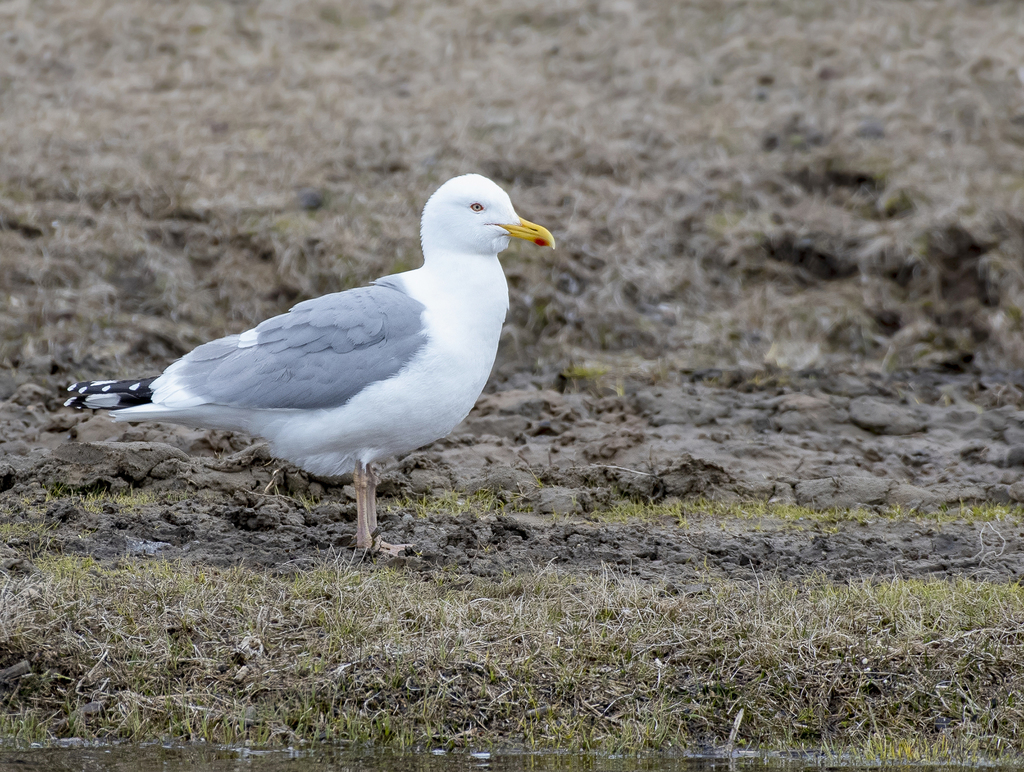
Mongolian Gull
Photo © Griha Hasanov
Photo © Griha Hasanov — CC BY 4.0 — Source: iNaturalist #77763533Identification
The Mongolian gull is a large white-headed gull closely resembling its relatives the Caspian gull and Vega gull, as well as the European herring gull. Careful examination is needed to distinguish it from these similar species, particularly paying attention to wing pattern and moult details. In young birds, focus on the wing and tail patterns for reliable identification.
Males weigh 1.15–1.58 kg and females 0.85–1.1 kg, making them somewhat heavier than Caspian gulls but comparable to Vega gulls and European herring gulls. The mantle and wings are mid grey with black primary tips—distinctly darker than European herring gulls and slightly darker than Caspian gulls, though similar to Vega gulls. Some geographic variation exists, with darker grey birds in northwest Mongolia and paler birds from Lake Baikal that can resemble European herring gull subspecies. Most individuals have pink legs, though some show yellow tinges; eyes are dull yellowish or brownish, and the bill is stout, resembling European herring and Vega gulls rather than the finer bill of Caspian gulls.
Range & Habitat
This species breeds primarily on large inland lakes—both fresh and saline—stretching from the Altai Republic to Lake Baikal in central southern Russia, across northern Mongolia, and at Lake Khanka in northeast China. A small breeding population also occupies islands in the Yellow Sea west of South Korea, within the species' normal wintering range.
In winter, Mongolian gulls migrate southeast to coastal areas including Japan, the Korean Peninsula, eastern and southern China, Taiwan, and northern Vietnam. Reports from the Indian Ocean region, including claimed sightings from India, Pakistan, and the Persian Gulf, are considered unreliable, with no confirmed ringing recoveries from those areas—only from Pacific coasts of Asia.
Behaviour & Diet
Like other large gulls, the Mongolian gull is an opportunistic feeder and skilled scavenger, though specific dietary details for this recently recognized species remain understudied. As a migratory species, it breeds on inland lakes during the breeding season before undertaking a seasonal journey to coastal wintering grounds.
Best Time & Places to See It
The breeding season offers the best opportunity to observe Mongolian gulls at their inland lake colonies, particularly around Lake Baikal and the lakes of northern Mongolia and the Altai region. During winter months, coastal areas of Japan, Korea, China, Taiwan, and northern Vietnam provide excellent viewing opportunities as the species congregates in these regions.
Photography Tips
Photographing Mongolian gulls requires attention to subtle plumage details that distinguish them from closely related species. Focus on capturing the mid-grey mantle and wing coloration, the black primary tips, and leg and eye color, as these diagnostic features are essential for reliable field identification. Winter coastal locations offer the most accessible photography opportunities, while breeding colonies at inland lakes present chances to document breeding plumage and behavior.
Baikal National Park
Ольхонский район, Russia
+184 birds+11 mammals
Where the world's deepest freshwater lake meets ancient Siberian taiga, Baikal National Park sprawls across 66,203 square kilometers of one of Earth's most singular ecosystems. The…
VIEW NATIONAL PARKTransbaikal National Park
Barguzinsky Rayon, Russia
+83 birds+7 mammals
Where the eastern shore of Lake Baikal meets the Barguzinsky Range, a vast wilderness of boreal forest, alpine tundra, and rocky shoreline unfolds across more than…
VIEW NATIONAL PARKAltai Tavan Bogd National Park
Tsengel, Mongolia
+146 birds+3 mammals
Where the Altai Mountains rise in jagged defiance along Mongolia's western frontier, the terrain transforms into a realm of alpine tundra, rocky plateaus, and glacier-carved valleys…
VIEW NATIONAL PARKNo community photos yet. Log in to add the first one.
No community observations of this species yet.