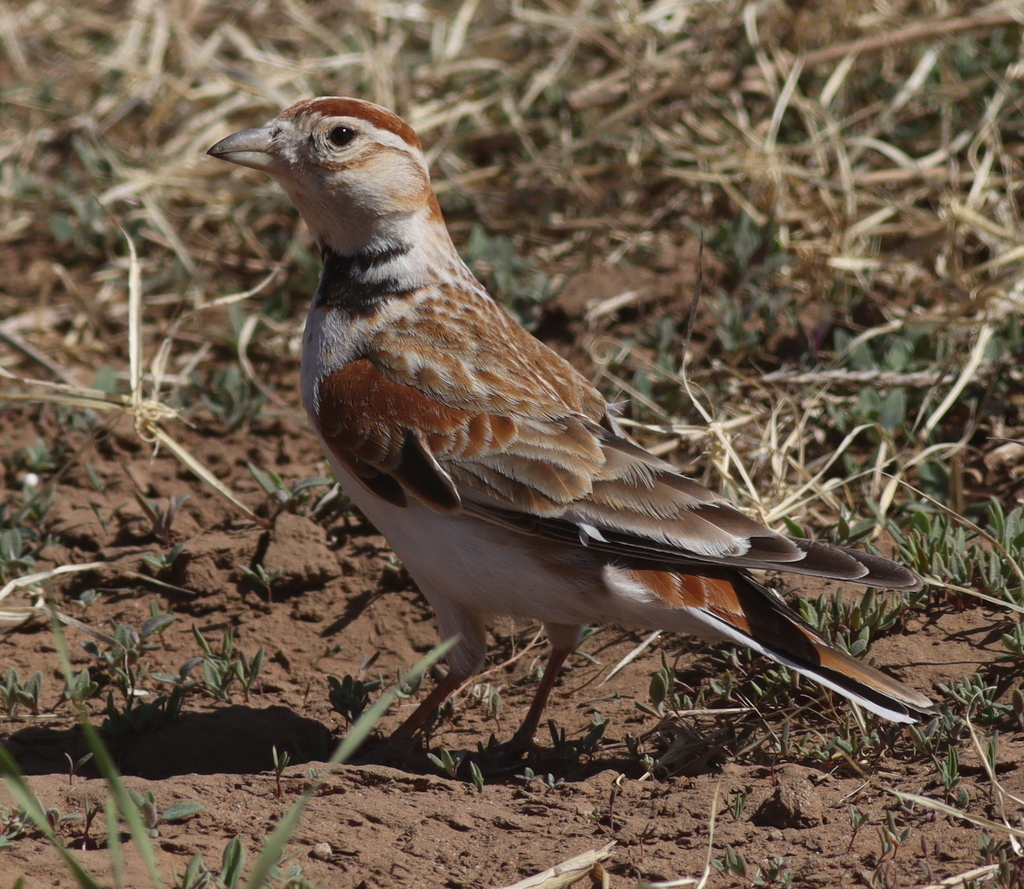
Mongolian Lark
Photo © Jan Ebr & Ivana Ebrová
Photo © Jan Ebr & Ivana Ebrová — CC BY 4.0 — Source: iNaturalist #218952569The Mongolian lark (Melanocorypha mongolica) is a species of lark in the family Alaudidae found from southern Russia and Mongolia to central China. The Mongolian lark is known for its elaborate singing and even well into adulthood, is able to learn new songs. While female Mongolian larks don't sing, they have noteworthy song control nuclei with strong connectivity. Male Mongolian larks have large song bouts and song phrases that allow them to have extremely large song control nuclei. It is an indicator species for avian biodiversity in the Mongolian steppes. It is most often seen alone. Its predators include the Saker Falcon. == Taxonomy and systematics == The black lark was originally placed in the genus Alauda. Alternate names for the black lark include Mongolian sand-lark and Mongolian skylark. == Description == Its head is pale brown, with a red crown. Its upper part is reddish-brown, and its lower part is yellowish-white. == Nesting == On average, it lays clutches of 3.3 eggs and incubates them for 13 days. They remain nestlings for 10 days. About half of its eggs tend to survive.
Khangai Nuruu National Park
Erdenetsogt, Mongolia
+136 birds+7 mammals
Where granite ridges pierce Mongolia's central steppe, alpine meadows give way to dense coniferous forests that climb toward windswept summits. Khangai Nuruu sweeps across 1.2 million…
VIEW NATIONAL PARKGorkhi-Terelj National Park
Ulaanbaatar, Mongolia
+137 birds+5 mammals
Where granite monoliths rise abruptly from rolling steppe grasslands, Gorkhi-Terelj National Park unfolds across the landscape north of Ulaanbaatar, a sanctuary where forest and alpine meadow…
VIEW NATIONAL PARKHustai National Park
Altanbulag, Mongolia
+198 birds+16 mammals
Where the steppe rolls endlessly beneath vast Mongolian skies, Hustai National Park preserves one of Central Asia's most dynamic grassland ecosystems. Rolling hills and open prairie…
VIEW NATIONAL PARKGobi Gurvan Saikhan National Park
Tsagaan Subarga Hural, Mongolia
+183 birds+23 mammals
Where rust-coloured badlands rise from the southern Gobi steppe, the terrain transforms into a landscape of geological drama that few visitors expect to find in Mongolia's…
VIEW NATIONAL PARKKhoridol Saridag National Park
Khatgal, Mongolia
+164 birds+6 mammals
Where granite peaks thrust skyward across Mongolia's remote southeastern reaches, a landscape of raw geological drama unfolds. Deep river gorges carved through ancient stone create a…
VIEW NATIONAL PARKQinghai Lake National Nature Reserve
Hainan Tibetan Autonomous Prefecture, China
+243 birds+11 mammals
At 3,200 metres above sea level on the Tibetan plateau, where winter temperatures plunge far below freezing and snow blankets the landscape for half the year,…
VIEW NATURE RESERVENo community photos yet. Log in to add the first one.
No community observations of this species yet.