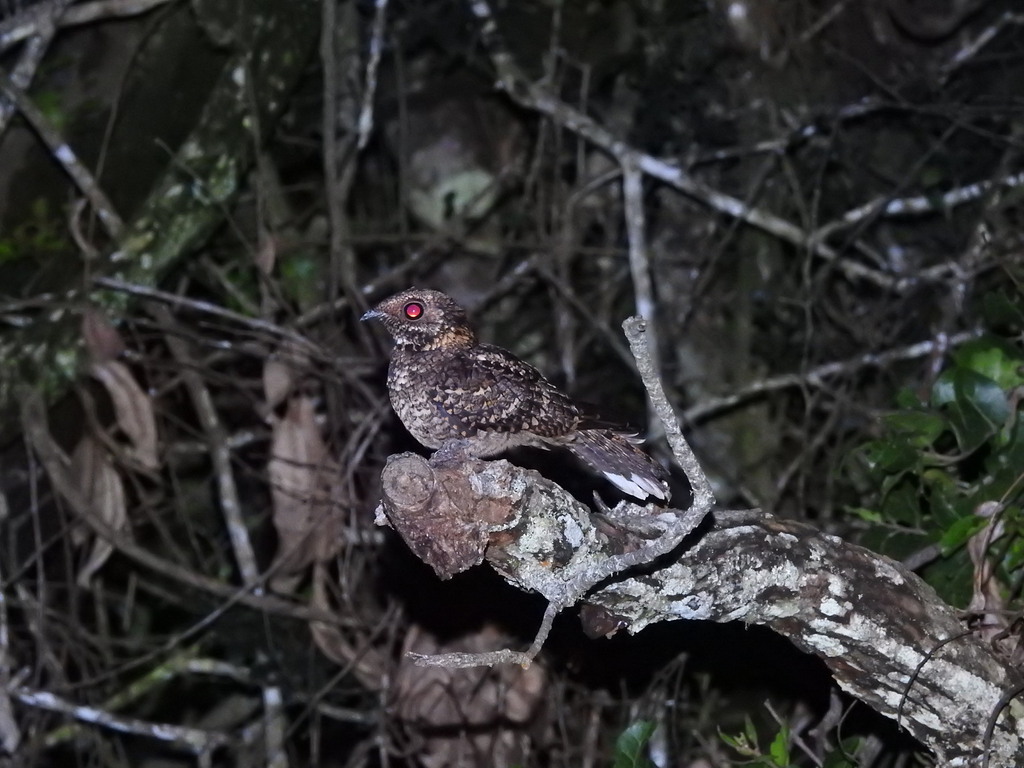
Montane Nightjar
Photo © Ryan van Huyssteen
Photo © Ryan van Huyssteen — CC BY 4.0 — Source: iNaturalist #214947141Identification
The montane nightjar is a rather dark nightjar, measuring about 23 cm in length. It displays tawny, blackish, or chocolate-brown dappled plumage that provides excellent camouflage in its forest habitat. The most reliable field marks for distinguishing this species are sexual dimorphism in wing and tail markings: males show white spots on the four main primary feathers and white on the outer edge of the tail, while females have buff-coloured spots on the primaries and less white on the tail. The bird's distinctive call is a nasal ank-ank-ank, often followed by a high-pitched whistle piiiyu-pirrr, with the first syllable descending and then rising, and the second syllable tremulous and descending.
Range & Habitat
This species is native to upland regions of Central and Eastern Africa, with a range spanning Angola, Democratic Republic of the Congo, Eritrea, Ethiopia, Kenya, Malawi, Saudi Arabia, Sudan, Tanzania, Uganda, and Zambia. The montane nightjar occurs at altitudes between approximately 1,000 and 3,350 metres, preferring the cooler montane zones across this vast territory. Four subspecies are recognized, each occupying distinct geographical areas across this range.
The species is primarily a forest bird, though it has adapted to inhabit plantations, cultivated areas adjacent to forests, and well-wooded urban areas. Like all nightjars, it is strictly nocturnal, emerging at dusk to hunt its preferred prey of moths and other large insects. This habitat flexibility, combined with its wide altitudinal range, has allowed the montane nightjar to establish itself as a locally common species across its extensive distribution.
Behaviour & Diet
The montane nightjar is a nocturnal insectivore, spending daylight hours roosting concealed within forest vegetation before becoming active at night. It feeds primarily on moths and other large flying insects, which it pursues with the aerial agility characteristic of nightjars. The bird's cryptic plumage and nocturnal habits make daytime observation challenging, but its vocal activity at night makes it detectable to patient listeners. The distinctive nasal and whistling calls serve important territorial and breeding functions within montane forest communities.
Best Time & Places to See It
The montane nightjar is best located by listening for its calls during the early evening and throughout the night. Its wide distribution across montane forests from Ethiopia to southern Africa means that birdwatchers visiting upland regions throughout Central and Eastern Africa have opportunities to encounter this species. The bird's status as a locally common species suggests reasonable chances of detection in suitable habitat, particularly in montane forest and well-wooded areas at elevations between 1,000 and 3,350 metres. Visiting during the species' breeding season when calling activity is most pronounced will increase detection rates.
Photography Tips
Photographing the montane nightjar presents significant challenges due to its strictly nocturnal habits and cryptic plumage. Night photography techniques using flash or infrared illumination may be necessary to capture images of this dark forest bird. Daytime roosting birds are extremely difficult to locate and photograph given their excellent camouflage and preference for dense forest cover. Alternatively, photographers may focus on recording the species' distinctive vocalizations, which are far more accessible than visual documentation. Visiting known localities in montane forest habitat during peak calling periods offers the best opportunity to document this fascinating and elusive species.
Serengeti National Park
Tanzania
+558 birds+57 mammals
Across Tanzania's northern plateau, where volcanic soils meet acacia woodland and open grassland, unfolds one of Earth's most dynamic ecosystems. The Serengeti National Park sprawls across…
VIEW NATIONAL PARKArusha National Park
Tanzania
+555 birds+16 mammals
Where the slopes of Mount Mawenzi rise above the Arusha region, a compact yet ecologically rich national park unfolds across montane forest, moorland, and alpine zones.…
VIEW NATIONAL PARKBwindi Impenetrable National Park
Kanyashogi, Uganda
+603 birds+26 mammals
Steep ridges cloaked in montane forest rise from Uganda's southwestern borderlands, where the landscape grows so dense and tangled that early explorers named it impenetrable. At…
VIEW NATIONAL PARKMurchison Falls National Park
Uganda
+608 birds+33 mammals
Where the Victoria Nile compresses through a narrow gorge and explodes across a 45-meter precipice, the landscape speaks in thunder. Murchison Falls National Park sprawls across…
VIEW NATIONAL PARKMgahinga Gorilla National Park
Cyanika, Uganda
+429 birds+6 mammals
Where the Virunga Mountains rise steeply from the Uganda–Rwanda–Democratic Republic of Congo frontier, montane forest cloaks the volcanic slopes in a dense, moisture-laden embrace. Mgahinga Gorilla…
VIEW NATIONAL PARKKilimanjaro National Park
Kenya
+207 birds+16 mammals
Africa's highest mountain rises not in isolation but as the centerpiece of a vast national park that sweeps across the borderlands of northern Tanzania, where savanna…
VIEW NATIONAL PARKMount-Kenya National Park
Abothuguchi west ward, Kenya
+334 birds+11 mammals
Where the slopes of Kenya's second-highest mountain rise steeply from the Meru County foothills, a landscape of profound ecological richness unfolds across Mount Kenya National Park.…
VIEW NATIONAL PARKTarangire National Park
Tanzania
+527 birds+50 mammals
Acacia woodland and grassland sweep across the Manyara Region where the Tarangire River carves through low hills and volcanic soils, creating one of East Africa's most…
VIEW NATIONAL PARKNgorongoro Conservation Area
Tanzania
+626 birds+55 mammals
Volcanic calderas and open grassland dominate this high plateau in northern Tanzania, where the landscape rises above 2,000 metres and ancient geological forces have shaped both…
VIEW WILDLIFE MANAGEMENT AREABale Mountains National Park
Ethiopia
+397 birds+20 mammals
Where the Ethiopian highlands rise above 4,000 metres, the Bale Mountains create a landscape of stunning ecological extremes—from afroalpine grasslands swept by wind and mist to…
VIEW NATIONAL PARKNairobi National Park
Nairobi, Kenya
+515 birds+35 mammals
Just minutes from Kenya's capital, where the Nairobi River winds through acacia woodland and open grassland, lies one of Africa's most paradoxical wildlife sanctuaries. The park's…
VIEW NATIONAL PARKLake Nakuru National Park
Nakuru West, Kenya
+494 birds+32 mammals
Alkaline waters ringed by acacia woodland and grassland create one of East Africa's most distinctive wetland ecosystems, where the interplay of geology and climate sustains a…
VIEW NATIONAL PARKAberdare National Park
Mweiga ward, Kenya
+394 birds+30 mammals
Where the central highlands of Kenya rise to their elemental grandeur, the Aberdare range unfolds across Nyeri County as a montane stronghold of cool, misty forest…
VIEW NATIONAL PARKSamburu National Reserve
Samburu, Kenya
+430 birds+42 mammals
Across the arid plains of northern Kenya, where scattered acacia woodland gives way to rocky outcrops and dry riverbeds, Samburu National Park unfolds as one of…
VIEW NATURE RESERVEHell’s Gate National Park
Olkaria ward, Kenya
+388 birds+18 mammals
Volcanic scarps and geothermal vents dominate the floor of Hell's Gate, where the East African Rift has carved a dramatic gorge through crystalline rock formations. The…
VIEW NATIONAL PARKNo community photos yet. Log in to add the first one.
No community observations of this species yet.