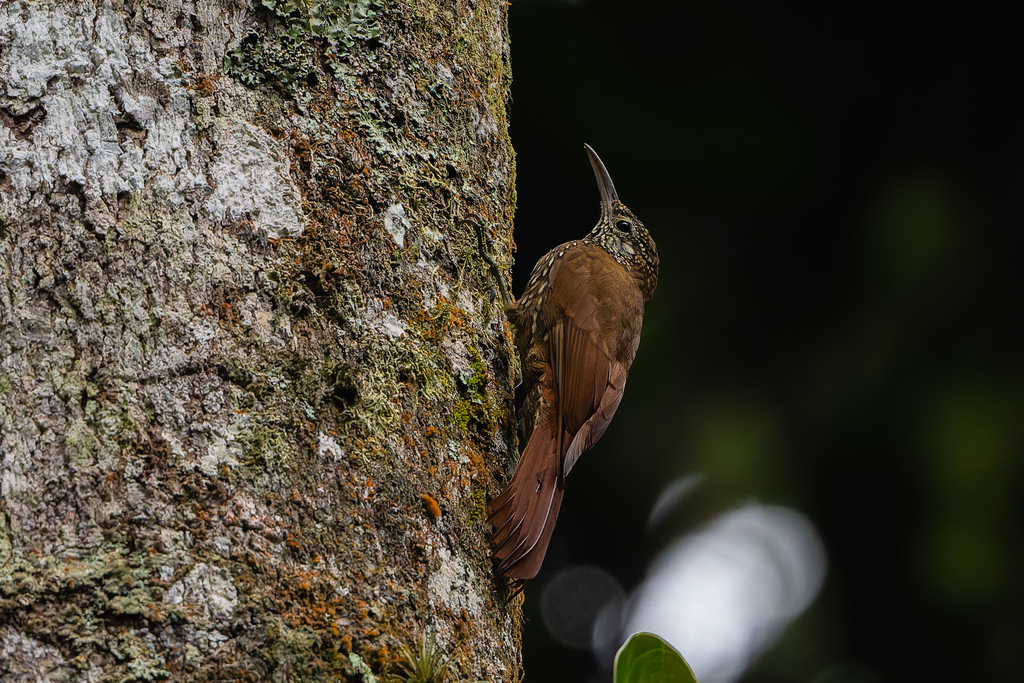
Montane Woodcreeper
Photo © Adam Jackson
Photo © Adam Jackson — CC0 1.0 — Source: iNaturalist photo #591316018Identification
The Montane Woodcreeper is a small to medium-sized woodcreeper, measuring 19 to 19.5 cm in length. It possesses a slim, slightly decurved bill and lacks sexual dimorphism. The nominate subspecies displays a markedly streaked face and neck with a whitish, often broken supercilium. The crown and nape are dusky brown with conspicuous whitish buff spots tipped in black, becoming streaks on the nape. The back and wing coverts are rufous-brown while the rump, wings, and tail are rufous-chestnut. Underparts are olive-brown with long, wide, black-edged and tipped buffy streaks. The iris is dark brown and the legs and feet are olive-gray to dark horn. Males typically weigh 31 to 35 g, females 29.5 to 33 g. Nine subspecies occur across the range, each showing subtle variations in coloration and patterning.
Juveniles can be distinguished from adults by less distinct borders on underpart streaks and a shorter, darker bill. Identification requires careful attention to the specific plumage characters of the nine recognized subspecies, which vary in the extent of streaking, rufescence, and the coloration of the throat and underparts.
Range & Habitat
The Montane Woodcreeper is found across the northern Andes and associated mountain ranges, with its distribution spanning Bolivia, Colombia, Ecuador, Peru, and Venezuela. Different subspecies occupy distinct geographic areas: sanctaemartae inhabits Colombia's Santa Marta region; sneiderni occupies Colombia's Western and Central Andes; lacrymiger is found on the eastern slope of Colombia's Eastern Andes and in western Venezuela; lafresnayi occurs in the Venezuelan Coastal Range; while the remaining subspecies are distributed across Ecuador, Peru, and Bolivia at various elevations and slopes.
The species favors montane evergreen forest and cloudforest but also occurs in somewhat open woodland, montane deciduous forest, and stunted forest near treeline. It inhabits the interior of primary forest but is more common at forest edges and in mature secondary forest, and also frequents clearings and pastures with trees. Elevation ranges typically between 1,750 and 3,000 m, though it occasionally descends to 900 m in Venezuela, 1,700 to 3,500 m in Colombia, and 1,500 to 3,000 m in Ecuador.
Behaviour & Diet
The Montane Woodcreeper is a year-round resident throughout most of its range, with some movement to lower elevations during the rainy season in Venezuela. It is a solitary or paired forager that regularly joins mixed-species feeding flocks. The species does not follow army ant swarms. Foraging typically occurs from the forest's midlevel to the subcanopy, seldom near the ground, as the bird hitches up trunks and along the underside of branches using its characteristic creeping behavior.
Diet consists primarily of arthropods, obtained by gleaning from surfaces and by probing bark crevices, epiphytes, and moss. Breeding seasons vary geographically but generally occur between April and August. The species nests in tree or stump cavities, either natural or excavated by woodpeckers. A documented nest contained three eggs, though incubation period and fledging time remain unknown. Pairs are thought to remain together year-round.
Best Time & Places to See It
The Montane Woodcreeper is a year-round resident, making it potentially observable throughout the year in its montane forest habitat. The species is most likely to be encountered in cloudforest and montane evergreen forest at mid to upper elevations, particularly at forest edges and in mature secondary growth where it is thought to be more common than in primary forest interior. Birdwatchers should focus on areas between 1,750 and 3,000 m elevation across the Andes of Colombia, Ecuador, Peru, Bolivia, and Venezuela, with lower elevations possible in Venezuela.
The Montane Woodcreeper's habit of joining mixed-species feeding flocks increases the likelihood of detection, especially when visiting these productive foraging associations. Early morning hours often provide the best viewing opportunities. The species' preference for forest edges and secondary growth makes it more accessible than species confined to primary forest interior.
Photography Tips
Photographing this species can be challenging due to its preference for the midlevel to subcanopy strata and its active, creeping behavior along branches and trunks. Use a telephoto lens (400 mm or longer) to capture detail while maintaining distance. Position yourself at eye level or slightly above to intersect the bird's typical foraging height, which is higher than many ground-feeding species. Overcast days are common in cloudforest habitats and can provide even lighting that reduces harsh shadows on the bird's streaked plumage.
Patience and careful observation of mixed-species feeding flocks will improve encounter rates. The bird's distinctive streaked underparts and spotted crown are key identification features; ensure sufficient resolution to render these details clearly. Since the species regularly joins feeding associations, stake out productive fruiting trees or areas where woodcreepers congregate with other species. Early morning light often provides warmer tones that complement the species' rufous and buff coloring.
Antisana National Park
El Tamá National Park
Guácharos Cave National Natural Park
Llanganates National Park
Manu National Park
Natural Chingaza National Park
Natural Farallones de Cali National Park
Natural Munchique National Park
Natural Nevado del Huila National Park
Nothing matches these filters.
No community photos yet. Log in to add the first one.
No community observations of this species yet.