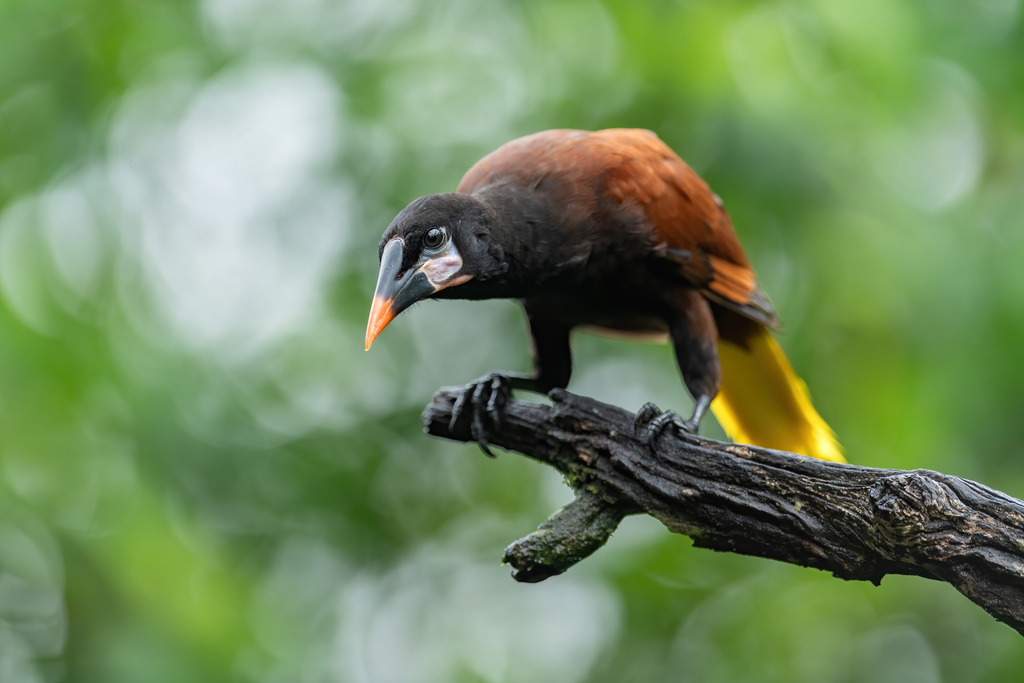
Montezuma Oropendola
Photo © Morten Ross
Photo © Morten Ross — CC BY 4.0 — Source: iNaturalist photo #110530181Identification
The Montezuma oropendola is a striking and unmistakable large icterid. Males are predominantly chestnut with a blackish head and rump, bright yellow tail feathers (except two dark central feathers), a bare blue cheek patch, and a prominent pink wattle. The long bill is black at the base with a red tip and brown iris. Females resemble males but are noticeably smaller with a smaller wattle. Young birds are duller with a paler, less defined bill. This species exhibits extreme sexual dimorphism: males reach 50 cm and weigh 520 g, while females are only 38 cm and weigh 230 g—a 2:1 body mass ratio that makes Montezuma oropendolas among the world's most sexually dimorphic birds.
The size difference correlates with foraging behaviour: females often work thin branches gleaning insects from curled leaves, while males perch on thick branches and forage in epiphytes and bromeliads. Males are substantially larger, reflecting their role in defending females and establishing dominance within colonies.
Range & Habitat
This species is a resident breeder in Caribbean coastal lowlands from southeastern Mexico to central Panama, extending to the Pacific slopes of Nicaragua and Honduras and northwestern and southwestern Costa Rica. It is notably absent from El Salvador and southern Guatemala. The Montezuma oropendola inhabits forest canopy, forest edges, and old plantations, often occurring in small to large foraging flocks outside the breeding season, when it shows considerable mobility.
Behaviour & Diet
Montezuma oropendolas are omnivorous, foraging in trees for small vertebrates, large insects, nectar, and fruits including bananas, Cecropia, gumbo-limbo, and Trophis racemosa. Males produce an unforgettable song during elaborate bowing displays—a conversational bubbling followed by loud gurgles (tic-tic-glik-glak-GLUUuuuuu)—and can adjust the depth and volume of their lowest frequency to out-compete rivals when songs overlap. Both sexes give loud cack and crrrk calls.
Montezuma oropendolas are colonial breeders with a female-defence mating system. Only females construct hanging woven nests of fibres and vines (60–180 cm long) suspended from trees up to 30 metres high. Colonies typically contain about 30 nests, though up to 172 have been recorded. A dominant alpha male mates with most females after ritualized bowing displays; males rank by combat, with the alpha male eventually excluding others until his departure. The female lays two dark-spotted white or buff eggs, incubating alone for 15 days until hatching; young fledge in 30 days and are fed spiders, arthropods, frogs, lizards, and fruits. Nest success is relatively low, with only one chick typically fledging and only one-third of nests successful. Females actively defend nests against Giant Cowbirds but lack defences against botflies.
Best Time & Places to See It
Montezuma oropendolas are quite common in parts of their range and are best located at active breeding colonies, where their loud vocalisations and impressive displays are most conspicuous. Visit forest canopy and edges or old plantations from southeastern Mexico through Central America, particularly in Caribbean lowland regions. Outside breeding season, birds are mobile but can still be found in fruiting trees and flowering canopy. Colonies are most active during breeding season when males perform bowing displays and engage in competitive vocal exchanges.
Photography Tips
The striking plumage, dramatic facial patches, and bright yellow tail make Montezuma oropendolas highly photogenic. Photograph males during bowing displays to capture their full visual repertoire—position yourself where backlighting illuminates the chestnut plumage and yellow tail. The contrast between the blackish head and bright body is best rendered in soft, directional light. Nest colonies provide opportunities for behavioural shots of courtship, nest-building, and parental care. A telephoto lens (400–600 mm) is essential for capturing detail from canopy height without disturbing birds. Early morning light and overcast conditions often produce the richest colour saturation in the chestnut and yellow plumage.
Corcovado National Park
Puerto Jiménez, Costa Rica
+444 birds+48 mammals
Where the Osa Peninsula juts into the Pacific, rainforest descends almost to the tide line, and Corcovado National Park protects one of Central America's most intact…
VIEW NATIONAL PARKManuel Antonio National Park
Quepos, Costa Rica
+426 birds+22 mammals
Where tropical rainforest descends steeply to a rocky Pacific coastline, Manuel Antonio National Park distills Central American biodiversity into one of Costa Rica's most compressed and…
VIEW NATIONAL PARKArenal Volcano National Park
Peñas Blancas, Costa Rica
+551 birds+21 mammals
Straddling the border between Alajuela and Guanacaste in northwestern Costa Rica, this national park rises dramatically around one of Central America's most active volcanic systems. The…
VIEW NATIONAL PARKTortuguero National Park
Roxana, Costa Rica
+420 birds+23 mammals
Canals and lagoons thread through a labyrinth of lowland rainforest where the Caribbean coast of Costa Rica meets the wetland frontier. This is terrain shaped by…
VIEW NATIONAL PARKBraulio Carrillo National Park
Las Horquetas, Costa Rica
+547 birds+18 mammals
Where the Caribbean slope descends from the central volcanic cordillera toward the humid lowlands of Heredia, Braulio Carrillo National Park preserves one of Costa Rica's most…
VIEW NATIONAL PARKPiedras Blancas National Park
Golfito, Costa Rica
+386 birds+24 mammals
Where the Golfo Dulce meets the southwestern Pacific coast of Costa Rica, Piedras Blancas National Park protects a dramatic transition zone where lowland rainforest descends toward…
VIEW NATIONAL PARKSanta Rosa National Park
Santa Elena, Costa Rica
+359 birds+30 mammals
Where Pacific-facing slopes descend from volcanic uplands toward the Guanacaste lowlands, Santa Rosa National Park unfolds across a mosaic of tropical dry forest, gallery woodland, and…
VIEW NATIONAL PARKGuanacaste National Park
Santa Elena, Costa Rica
+461 birds+17 mammals
Where the Pacific slopes of northwestern Costa Rica rise toward the Continental Divide, dry tropical forest gives way to cloud-laden peaks and misty ridges—a landscape that…
VIEW NATIONAL PARKGeneral de División Omar Torrijos Herrera National Park
La Pintada, Panama
+401 birds+2 mammals
Across the highlands of central Panama, where the continental divide funnels moisture-laden trade winds into steep river valleys, the terrain rises and falls in a landscape…
VIEW NATIONAL PARKParque Internacional la Amistad
Teribe, Panama
+325 birds+11 mammals
Where the continental divide rises between the Caribbean and Pacific watersheds, a wilderness of extraordinary biological richness unfolds across the Talamanca Range and into lowland rainforest—a…
VIEW NATIONAL PARKLagunas de Montebello National Park
Laguna de Montebello, Mexico
+360 birds+2 mammals
Where turquoise lagoons pierce the limestone plateau of southeastern Chiapas, the Lagunas de Montebello National Park unfolds across roughly 174 square kilometers of spectral water and…
VIEW NATIONAL PARKMontes Azules
Candelaria, Mexico
+395 birds+47 mammals
Where jungle-clad limestone plateaus plunge into canyon systems carved by the Usumacinta River, Mexico's most pristine rainforest reserve unfolds across the Lacandón region of Chiapas. Montes…
VIEW BIOSPHERE RESERVETikal National Park
Tikal, Guatemala
+399 birds+16 mammals
Dense rainforest canopy rises above the limestone plateau of Petén, where archaeological wonder and ecological richness merge seamlessly across one of Central America's most biodiverse landscapes.…
VIEW NATIONAL PARKLaguna del Tigre National Park
Petén, Guatemala
+399 birds+29 mammals
Where the Petén lowlands dissolve into wetland and forest, Laguna del Tigre National Park protects one of Guatemala's most ecologically vital landscapes. This sprawling reserve encompasses…
VIEW NATIONAL PARKSierra del Lacandón National Park
Petén, Guatemala
+348 birds+7 mammals
Where the Petén rainforest rises into limestone ridges and deep ravines, Sierra del Lacandón National Park protects one of Central America's most intact tropical wilderness zones.…
VIEW NATIONAL PARKCarara National Park
Tárcoles, Costa Rica
+397 birds+19 mammals
Where the Pacific coastal plain meets transitional forest, Carara National Park straddles one of Central America's most dynamic ecological boundaries. The park's landscape encompasses lowland deciduous…
VIEW NATIONAL PARKPalo Verde National Park
Bagaces, Costa Rica
+318 birds+24 mammals
Dry forest spreads across Palo Verde's low-lying terrain in northwestern Guanacaste, where seasonal rivers and lagoons etch through deciduous woodland that sheds its canopy each winter.…
VIEW NATIONAL PARKCahuita National Park
Talamanca, Costa Rica
+359 birds+15 mammals
Where the Caribbean shoreline dissolves into mangrove creeks and coral gardens, Cahuita's mosaic of habitats unfolds across the Limón coast. The park's signature feature—a living coral…
VIEW NATIONAL PARKRincón de la Vieja National Park
Liberia, Costa Rica
+451 birds+30 mammals
Where volcanic slopes rise abruptly from the Guanacaste lowlands, Rincón de la Vieja National Park sprawls across a landscape shaped by geothermal drama and seasonal extremes.…
VIEW NATIONAL PARKTapantí Macizo de la Muerte National Park
Orosi, Costa Rica
+503 birds+18 mammals
Where montane cloud forest rises steeply from the Orosi Valley, Tapantí Macizo de la Muerte National Park enfolds a landscape of perpetual moisture and emerald complexity.…
VIEW NATIONAL PARKLa Amistad International Park
Crorina, Costa Rica
+532 birds+20 mammals
Where the Caribbean slopes of Costa Rica's Talamanca Mountains rise steeply inland from Limón, the boundary between two nations dissolves into an unbroken expanse of rainforest.…
VIEW NATIONAL PARKBarbilla National Park
Chirripó, Costa Rica
+226 birds
Where the Caribbean slope of Costa Rica's eastern cordillera plunges into perpetual moisture, Barbilla National Park rises as one of Central America's most water-rich ecosystems. Fed…
VIEW NATIONAL PARKVolcán Tenorio National Park
Guatuso, Costa Rica
+480 birds+12 mammals
Where volcanic slopes rise through Costa Rica's northwestern borderlands, Volcán Tenorio National Park sprawls across terrain shaped by ancient lava flows and mineral-rich springs. The park's…
VIEW NATIONAL PARKMarino Ballena National Park
Bahía Ballena, Costa Rica
+336 birds+8 mammals
Where mangrove forests meet coral-fringed shorelines along Costa Rica's southern Pacific coast, Marino Ballena National Park encompasses a marine and terrestrial mosaic that ranks among Central…
VIEW NATIONAL PARKMarino Las Baulas National Park
Santa Cruz, Costa Rica
+246 birds+9 mammals
Where the Pacific meets a mosaic of dry forest and mangrove estuary, this coastal national park protects one of Central America's most dynamic wildlife theatres. The…
VIEW NATIONAL PARKCaño Negro National Wildlife Refuge
Caño Negro District, Costa Rica
+486 birds+16 mammals
Where the San Juan River's seasonal floodplain opens into expansive wetlands, Caño Negro Wildlife Sanctuary sprawls across one of Central America's most productive freshwater ecosystems. This…
VIEW WILDLIFE SANCTUARYGandoca-Manzanillo National Wildlife Refuge
Manzanillo, Costa Rica
+394 birds+18 mammals
Where the Caribbean coastal plain surrenders to water-logged forest and mangrove tangles, Gandoca-Manzanillo Wildlife Sanctuary shelters one of Costa Rica's most biodiverse lowland wetland ecosystems. The…
VIEW WILDLIFE SANCTUARYBarra del Colorado National Wildlife Refuge
Tortuguero, Costa Rica
+462 birds+36 mammals
Where the Caribbean's restless waters meet the Limón Province coastline, Barra del Colorado National Wildlife Sanctuary unfolds across a landscape of extraordinary ecological complexity. This equatorial…
VIEW WILDLIFE SANCTUARYCurú National Wildlife Refuge
Paquera, Costa Rica
+249 birds+8 mammals
Where the Pacific coast of Puntarenas dissolves into dry deciduous forest and mangrove fringe, Curú Wildlife Sanctuary holds one of Costa Rica's most ecologically vital yet…
VIEW WILDLIFE SANCTUARYNo community photos yet. Log in to add the first one.
No community observations of this species yet.