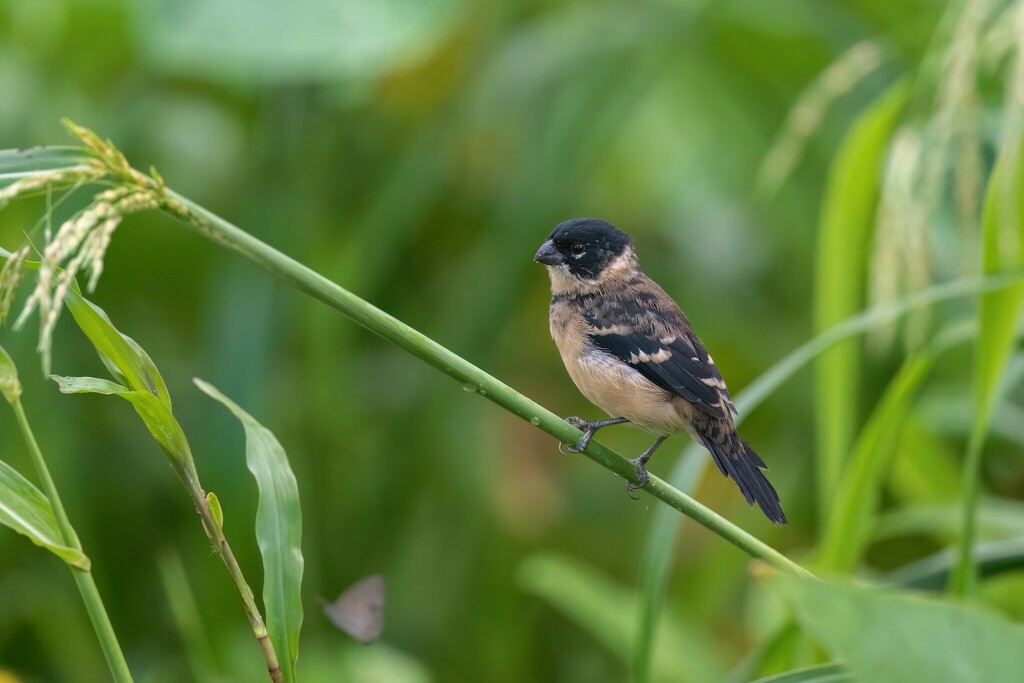
Morelet’s Seedeater
Photo © Adam Jackson
Photo © Adam Jackson — CC0 1.0 — Source: iNaturalist photo #339612040Identification
Morelet's seedeater is a tiny songbird, measuring just 11 cm (4.3 inches) and weighing around 8.7 grams. It has a short, thick bill adapted for cracking seeds. The species shows striking sexual dimorphism. Males display a blackish crown and nape with a distinctive white crescent below the eye, olive-gray upperparts with black mottling, and black wings marked with white at the base of the primaries and buffy-white wing bars. Their underparts range from buffy-white on the throat to cinnamon-buff below. Females are considerably duller, appearing mostly grayish to brownish olive with gray wings and tail, lacking the male's bold white markings. Both sexes have brown irises and gray legs; males show a black bill while females have a brown upper mandible and pale lower mandible.
Three subspecies are recognized across the bird's range. The nominate S. m. morelleti features a larger white eye crescent and solid black underparts below the white neck sides. S. m. sharpei shows less extensive black below. S. m. mutanda resembles morelleti but has a mostly black throat.
Range & Habitat
Morelet's seedeater is found from the Lower Rio Grande Valley in far southern Texas through Mexico and Central America to western Panama. The three subspecies occupy distinct ranges: sharpei inhabits southern Texas and northeastern Mexico; morelleti ranges from Veracruz through Guatemala, Belize, Honduras, Nicaragua, and Costa Rica to Panama's Caribbean lowlands, also occurring on nearby Caribbean islands; mutanda occupies southwestern Mexico through western Guatemala and El Salvador.
The species favors open grassy habitats including pastures, roadsides, weedy fields, and grassy marshes, often near water. It occurs from sea level to 2,000 meters elevation, making it accessible to travelers across a wide range of habitats and altitudes throughout Central America.
Behaviour & Diet
Morelet's seedeater is primarily a year-round resident, though northern populations in Texas and Mexico may migrate southward in winter. It feeds almost exclusively on grass seeds, plucking them while clinging to grass stems or gleaning from the ground. During the breeding season it supplements its diet with insects. These birds are highly social, feeding in small flocks throughout the year, often joining mixed-species feeding groups with other seed-eating birds.
Breeding occurs from April through December, with pairs often raising two or three broods annually. The female constructs a small cup nest from plant fibers and spider silk, typically placing it in a shrub or low tree up to 3 meters high. She lays two to four pale blue-gray eggs marked with dark spots and incubates them alone for about 13 days. Chicks fledge after 10-11 days, with both parents feeding the young.
Best Time & Places to See It
Morelet's seedeater is best found in open grassy areas with scattered trees and shrubs. Search pastures, agricultural margins, and grassy marshes, particularly near water sources. The species' preference for low elevation habitats and open country makes it relatively accessible compared to forest specialists. Year-round residency in most of its range means it can be encountered in any season, though activity levels and visibility may vary.
The bird's small flocks and seed-eating habits make them predictable in suitable habitat. Early morning visits to areas with seeding grasses offer the best viewing opportunities, as birds are more active during cooler hours.
Photography Tips
The bird's small size and preference for clinging to grass stems present both challenges and opportunities for photography. A telephoto lens of at least 400mm is essential to capture frame-filling images. Shoot during early morning or late afternoon when side-lighting reveals the subtle plumage details and the male's white eye crescent and wing markings stand out clearly against darker areas.
Position yourself downwind of feeding flocks to avoid disturbing them. The bird's habit of feeding in small groups means multiple photo opportunities often present themselves. Watch for males singing from low perches—these vantage points offer excellent shooting angles. Exercise patience in grassy habitats, as the bird's coloration provides effective camouflage. Focus on capturing the distinctive head pattern and wing markings that separate this species from similar seedeaters.
Arenal Volcano National Park
Barbilla National Park
Barra del Colorado National Wildlife Refuge
Braulio Carrillo National Park
Cahuita National Park
Caño Negro National Wildlife Refuge
Carara National Park
Coiba National Park
Corcovado National Park
Nothing matches these filters.
No community photos yet. Log in to add the first one.
No community observations of this species yet.