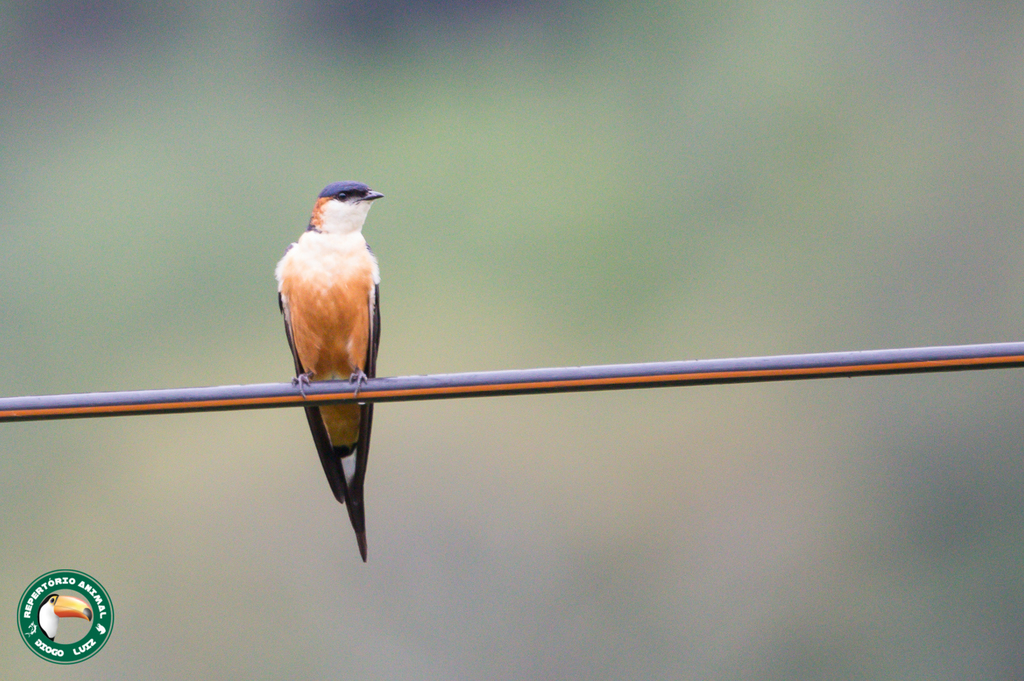
Mosque Swallow
Photo © Diogo Luiz
Photo © Diogo Luiz — CC BY 4.0 — Source: iNaturalist photo #63322305Identification
The mosque swallow is the largest and heaviest species of African swallow. It resembles the red-rumped swallow but is distinctly larger. The bird displays a glossy dark blue crown, upperparts, and tail, with whitish lores and sides of the head forming a distinctive collar. The rump is dark rufous, while the throat and upper breast are pale rufous, deepening to dark rufous across the remainder of the underparts. Very pale underwing coverts create a striking contrast with dark flight feathers. Females are similar to males but have shorter tail streamers, while juveniles are browner overall. Mosque swallows measure 21–23 cm in length.
Range & Habitat
This resident breeder is found throughout much of sub-Saharan Africa, from southern Mauritania and Senegal eastward to western South Sudan, and south to Namibia, northern Botswana, Zimbabwe, Mozambique, and northeastern South Africa. It is most common in western regions. The species does not migrate but follows the rains to some extent.
In southern Africa, the mosque swallow inhabits woodland bird, preferring dense broad-leaved woodland dominated by mopane or miombo, with scattered baobabs and leadwoods. In West Africa, it favors more open habitats including forest clearings, savanna, and areas around villages and towns.
Behaviour & Diet
Mosque swallows are aerial insectivores, feeding on flying insects such as ants, termite alates, and flies while foraging 2–30 meters above the ground. They are particularly attracted to termite emergence events and bushfires, where they may gather in flocks of up to 30 birds. Their flight is slow and somewhat falcon-like, characterized by considerable gliding, and they often forage high above the woodland canopy in association with other swallows and swifts.
These birds nest solitarily or in small groups. Nests are constructed from mud pellets lined with grass and feathers, shaped like a gourd with a long entrance tunnel attached to the side. Nesting sites include tree cavities—particularly baobabs—as well as under branches, in buildings, or road culverts. They breed year-round with peak breeding activity from August to April, laying clutches of 2–4 eggs.
Best Time & Places to See It
The mosque swallow is a resident species found year-round throughout its range, though breeding activity peaks from August to April. Birdwatchers should focus on woodland habitats in southern Africa and open savanna areas in West Africa. The species is often seen foraging high above the canopy, particularly during termite emergence events or after bushfires when birds gather in notable flocks.
Photography Tips
Photographing mosque swallows presents challenges due to their high-altitude foraging habits and rapid flight. Position yourself near nesting sites, particularly baobab trees, where birds are more predictable. Early morning and late afternoon often provide better lighting conditions. Anticipate their slow, gliding flight pattern to capture sharp images. During termite emergences or after fires, larger concentrations make photography more feasible. A fast shutter speed and telephoto lens are essential for capturing these aerial acrobats in flight.
Bwindi Impenetrable National Park
Lake Mburo National Park
Mabamba Swamp
Murchison Falls National Park
Queen Elizabeth National Park
Aberdare National Park
Abijata-Shalla Lakes National Park
Amboseli National Park
Arabuko Sokoke Forest Reserve
Nothing matches these filters.
No community photos yet. Log in to add the first one.
No community observations of this species yet.