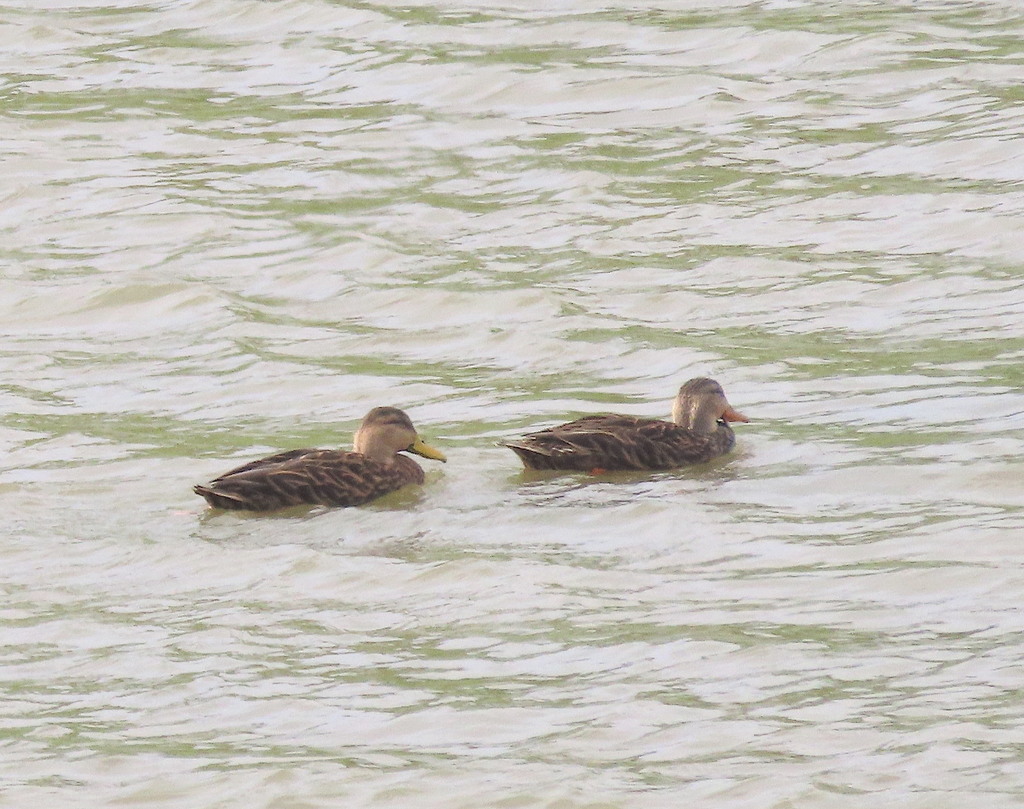
Mottled Duck
Photo © Mayela y Ramón
Photo © Mayela y Ramón — CC BY-SA 4.0 — Source: iNaturalist #103924826Identification
The mottled duck is a medium-sized dabbling duck measuring 44 to 61 centimetres in length, with males typically larger than females. It occupies an intermediate appearance between the female mallard and the American black duck, sharing behavioural and vocal characteristics with the mallard. Both sexes display a dark body with a lighter head and neck, orange legs, and dark eyes. The most distinctive feature is a shiny green-blue speculum (wing patch) on the wings, which crucially lacks the white border found on mallards—a key field identification feature in flight.
Sexual dimorphism is subtle compared to mallards. Males possess a bright yellow bill, while females display a deep to pale orange bill, occasionally marked with black splotches around the edges and base. The overall plumage is darker than female mallards, particularly on the tail. When distinguishing from the American black duck, note that the latter is generally darker overall with a more purple-toned wing patch. The two subspecies show minor variation: the Gulf Coast mottled duck (found from Alabama to Mexico) appears darker and more heavily marked, while the Florida mottled duck is somewhat lighter.
Range & Habitat
The mottled duck is restricted to coastal regions of the southeastern United States. Two distinct subspecies occupy separate ranges: the Gulf Coast mottled duck inhabits the Gulf of Mexico coast between Alabama and Tamaulipas in Mexico, occasionally venturing south to Veraçuz outside breeding season, while the Florida mottled duck is resident in central and southern Florida, with occasional stragglers reaching Georgia. A mixed-ancestry population, established through introductions to South Carolina in the 1970s and 1980s, has expanded considerably through the Atlantic coastal plain of Georgia into northeastern Florida.
These ducks favour brackish and intermediate coastal marshes for breeding, though they readily adapt to human-developed habitats including retaining ponds, water impoundments, and agricultural land. Nests may be found in pastures, levees, dry cordgrass marsh, cutgrass marsh, spoil banks, and small islands. Crucially, mottled ducks are largely non-migratory residents, remaining in their ranges year-round, which makes them particularly valuable for wildlife research and banding studies along the Gulf coast.
Behaviour & Diet
Mottled ducks feed by dabbling in shallow water and grazing on land, consuming predominantly plant material supplemented with mollusks and aquatic insects. They are fairly common within their restricted range and maintain resident populations throughout the year. During breeding, females construct round depression nests in grass, laying clutches of 8 to 12 dull white to olive-coloured eggs measuring approximately 5.4 to 6.2 centimetres in length.
As members of the "mallardine" clade, mottled ducks can produce fertile hybrids with closely related species including American black ducks and mallards. Migratory American black ducks occasionally overwinter in mottled duck territory and may interbreed, as may mallards. While gene flow has historically been limited, habitat destruction and excessive hunting could potentially reduce mottled duck populations to levels where hybridization poses a threat to their genetic distinctness.
Best Time & Places to See It
Year-round residents make mottled ducks reliably present in their range throughout the year, eliminating the need to time visits to specific seasons. The Gulf Coast region between Alabama and Tamaulipas offers the best opportunities for encountering the Gulf Coast subspecies, while central and southern Florida provides the most accessible locations for observing the Florida mottled duck. The expanded population in South Carolina and coastal Georgia offers additional viewing opportunities in the Atlantic coastal plain.
Coastal marshes, brackish water bodies, retaining ponds, and agricultural wetlands within these ranges offer the highest probability of sightings. The mottled duck's non-migratory nature and status as one of the most frequently banded waterfowl along the Gulf Coast—with approximately one in twenty birds banded—attests to their presence and accessibility within suitable coastal habitats.
Photography Tips
Photographing mottled ducks requires attention to subtle field marks that distinguish them from superficially similar species. Capture flight images to showcase the distinctive green-blue speculum without white borders, the most reliable identification feature in photographs. The bill colour provides excellent diagnostic detail for sexing: frame close-ups showing the bright yellow male bill against the orange female bill with potential black markings. The contrast between the lighter head and darker body is more pronounced in Gulf Coast birds and should be emphasized in composition.
Early morning light in coastal marsh habitats enhances the subtle plumage patterns and the sheen of the speculum. Since these ducks are non-migratory residents, consistent timing to specific locations improves predictability. Photograph dabbling and grazing behaviour in shallow water and on land to document natural feeding ecology. The year-round presence eliminates seasonal constraints, allowing photographers to revisit locations and refine their technique across various lighting conditions and water levels.
Everglades National Park
Monroe County, United States
+345 birds+22 mammals
Where freshwater marsh meets subtropical sky, the Everglades sprawls across southwestern Florida as one of North America's most expansive wetland ecosystems. Spanning over 13,000 square kilometers,…
VIEW NATIONAL PARKBiscayne National Park
Miami-Dade County, United States
+263 birds+7 mammals
Coral reefs and mangrove shallows dominate this marine sanctuary where the Florida Keys meet the Atlantic, creating a mosaic of shallow seagrass meadows, patch reefs, and…
VIEW NATIONAL PARKJ.N. “Ding” Darling National Wildlife Refuge
Sanibel, United States
+277 birds+6 mammals
Mangrove channels and coastal marshlands dominate this 6,400-acre sanctuary on Florida's Gulf coast, where brackish waterways weave between dense stands of red, black, and white mangrove…
VIEW WILDLIFE SANCTUARYMerritt Island National Wildlife Refuge
Brevard County, United States
+341 birds+19 mammals
Brackish marshes and palmetto scrub define this wildlife sanctuary spanning the coastal lowlands of central Florida, where the Atlantic tide meets freshwater systems in a dynamic…
VIEW WILDLIFE SANCTUARYLaguna Atascosa National Wildlife Refuge
Cameron County, United States
+365 birds+19 mammals
Where coastal prairie meets shallow lagoon along the southernmost tip of Texas, Laguna Atascosa National Wildlife Sanctuary sprawls across a landscape sculpted by salt spray and…
VIEW WILDLIFE SANCTUARYSanta Ana National Wildlife Refuge
Hidalgo County, United States
+349 birds+12 mammals
Where the Rio Grande delta meets the semi-arid scrublands of South Texas, Santa Ana National Wildlife Sanctuary preserves a rare mosaic of wetland and thornforest habitat…
VIEW WILDLIFE SANCTUARYLower Rio Grande Valley National Wildlife Refuge
Starbase, United States
+311 birds+11 mammals
Where the Rio Grande delta spreads across the coastal plain of South Texas, a sanctuary of subtropical wetlands and riparian corridors creates a landscape that pulses…
VIEW WILDLIFE SANCTUARYPelican Island National Wildlife Refuge
Windsor, United States
+265 birds+4 mammals
Where Florida's Indian River widens into a brackish estuary, a small island sanctuary commands the attention of waterbirds across the Atlantic Flyway. Pelican Island National Wildlife…
VIEW WILDLIFE SANCTUARYSt. Marks National Wildlife Refuge
Saint Marks, United States
+324 birds+16 mammals
Where the Apalachee Bay begins to define the Florida coastline, salt marshes and freshwater impoundments merge into one of the southeastern United States' most productive wildlife…
VIEW WILDLIFE SANCTUARYCedar Keys National Wildlife Refuge
Levy County, United States
+268 birds+8 mammals
Where the Florida Gulf Coast transitions from mainland to archipelago, Cedar Keys National Wildlife Sanctuary protects a mosaic of salt marshes, shallow estuaries, and maritime hammocks…
VIEW WILDLIFE SANCTUARYChassahowitzka National Wildlife Refuge
Homosassa, United States
+299 birds+14 mammals
Where the Gulf of Mexico's coastal marshes dissolve into brackish tidal flats and mangrove thickets, the Chassahowitzka National Wildlife Sanctuary near Homosassa represents one of Florida's…
VIEW WILDLIFE SANCTUARYNo community photos yet. Log in to add the first one.
No community observations of this species yet.