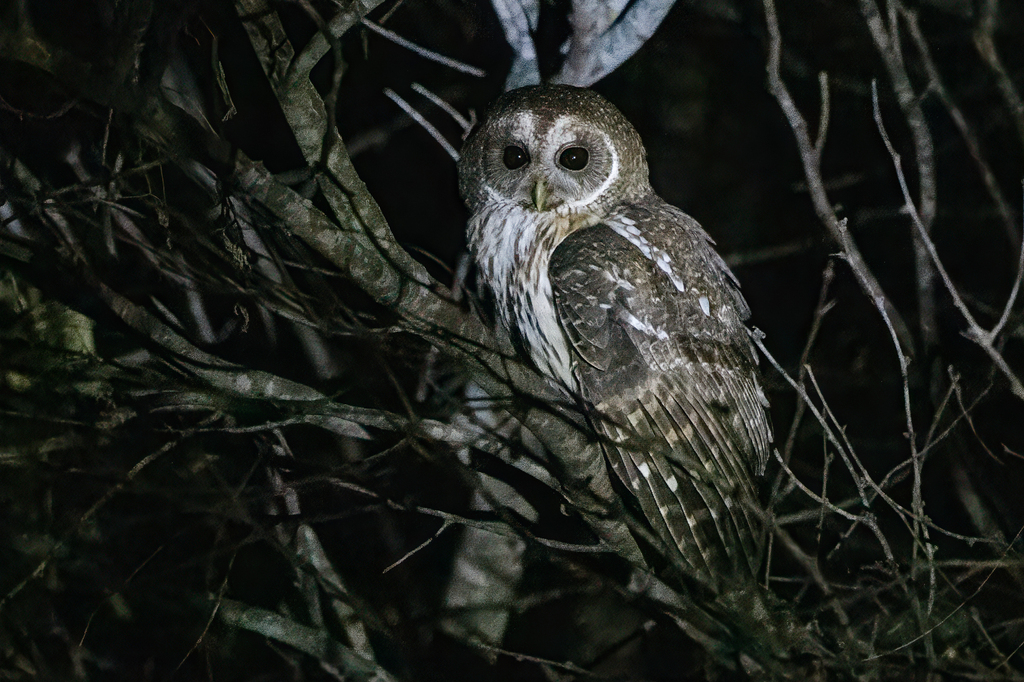
Mottled Owl
Photo © Emily Turteltaub Nelson
Photo © Emily Turteltaub Nelson — CC BY 4.0 — Source: iNaturalist photo #561415851Identification
The Mottled Owl is a medium-sized owl measuring 11 to 14 inches in length, with females considerably larger than males—a greater degree of sexual dimorphism than any other owl species. The crown, nape, and back are mottled in shades of dark brown, while the facial disc is pale brown. The throat, breast, and belly are off-white with distinctive vertical brown streaks. The large eyes are dark brown, the beak greyish-yellow or greyish-blue, and the legs and feet greyish-yellow. A darker plumage form exists with buff-colored breast and belly. The bird lacks ear tufts and has a round head. It produces various vocalizations including territorial hoots, whistles, screeches, and hisses.
Range & Habitat
This owl is native to Central and South America, with its range extending from Mexico south through Central America to Brazil and Argentina. It occurs at elevations up to approximately 8,200 feet. The Mottled Owl inhabits diverse wooded environments including rainforest, woodland verges, dry thorn forest, pine-oak woodland, plantations, and open countryside with scattered trees. It is often found close to human habitations and is common throughout much of its range. Notably, the species has recently expanded into the United States, with records from Texas in 2006 and 2021.
Behaviour & Diet
Strictly nocturnal, the Mottled Owl spends daylight hours hidden in dense vegetation, where it may be mobbed by other birds. Its large eyes are highly adapted for low-light vision, and it possesses acute hearing. At night, it typically perches on a branch beside a glade or at the woodland edge, watching for movement. When prey is detected, it swoops silently and pounces with precision. The diet is varied and includes small mammals, birds, reptiles, amphibians, large beetles, grasshoppers, and other insects and arthropods, as well as bats. Breeding occurs between February and May in Colombia and September to November in Argentina. The owl nests in tree cavities or abandoned nests of other species, laying one or usually two white eggs, with the female incubating and both parents caring for the young.
Best Time & Places to See It
The Mottled Owl is nocturnal and therefore most active after dark. Since it is often found close to human habitations and can be common throughout its range in suitable habitat, it may be located in wooded areas, forest edges, and plantations across Central and South America. Its presence in dry forests and jungles at various elevations provides multiple opportunities for observation across different regions and seasons.
Photography Tips
Photographing the Mottled Owl presents challenges due to its nocturnal habits and preference for dense vegetation. Night photography using infrared or specialized low-light equipment is essential. Position yourself near woodland edges or glades where the owl hunts, particularly near human settlements where it is more tolerant. A telephoto lens is necessary to capture detail from a safe distance without disturbing the bird. The owl's distinctive vertical chest streaks and pale facial disc are key identifying features worth highlighting in images.
Guided Birding Tour
Nothing matches these filters.
Amacayacu National Park
Anavilhanas National Park
Arenal Volcano National Park
Bahuaja Sonene National Park
Barbilla National Park
Barra del Colorado National Wildlife Refuge
Baru Volcano National Park
Braulio Carrillo National Park
Cahuita National Park
Nothing matches these filters.
No community photos yet. Log in to add the first one.
No community observations of this species yet.