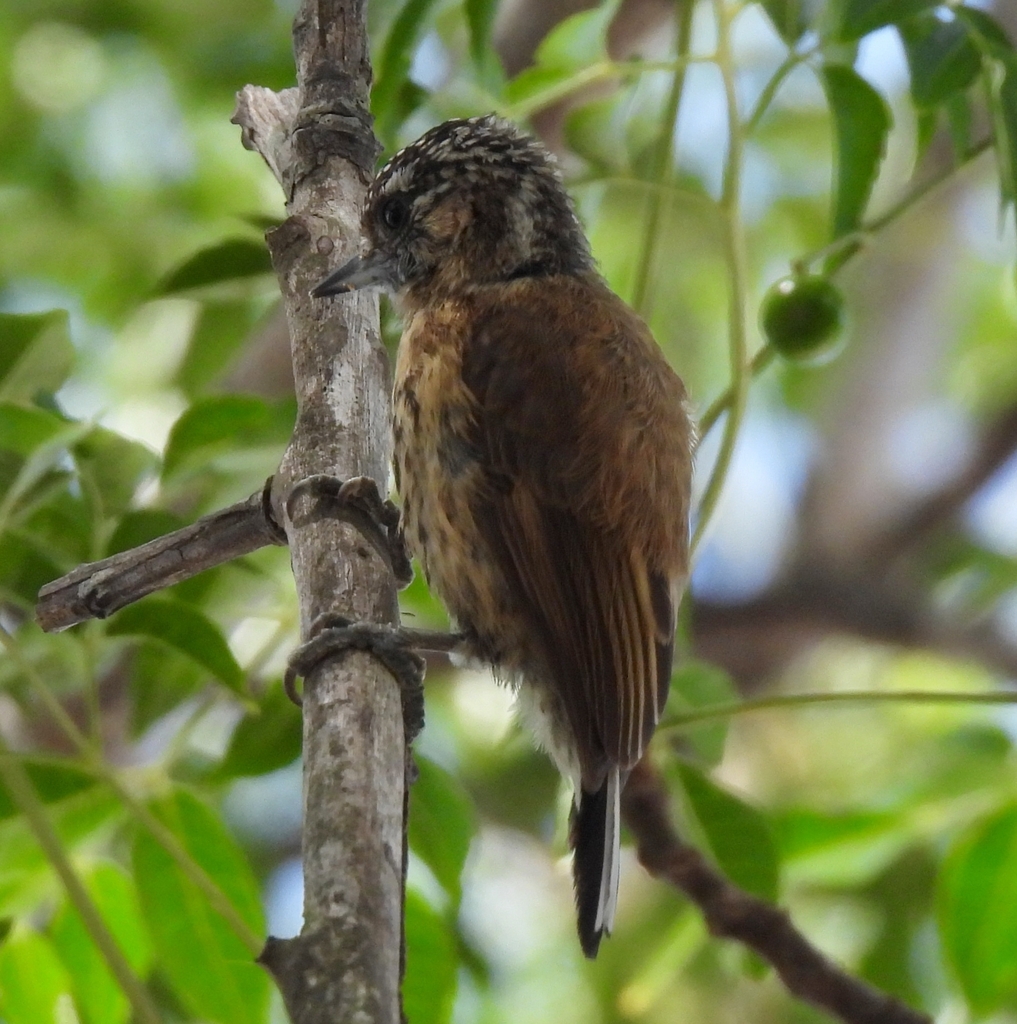
Mottled Piculet
Photo © Agustina Medina
Photo © Agustina Medina — CC BY 4.0 — Source: iNaturalist #169170521The mottled piculet (Picumnus nebulosus) is a Near Threatened species of bird in subfamily Picumninae of the woodpecker family Picidae. It is found in Argentina, Brazil, and Uruguay. == Taxonomy and systematics == The mottled piculet is monotypic. The population in southeastern Brazil was treated by some authors as a separate species P. iheringi but it is now known to be synonymous with P. nebulosus. == Description == The mottled piculet is 10 to 11 cm (3.9 to 4.3 in) long and weighs 11 to 12 g (0.39 to 0.42 oz). Adult males have a black cap and nape with a red patch on the forehead and white spots on the rest of it. Their face is mostly dark olive-brown with some white. Their hindneck and upperparts are warm olive-brown with a buff or rusty tinge on the back. Their flight feathers are dark brown to blackish with wide pale edges on the secondaries and tertials. Their tail is black; the innermost pair of feathers have mostly white inner webs and the outer three pairs have a white streak on the outer web. Their chin and throat are white with thin black bars. Their breast is buffish brown, sometimes with…
São Joaquim National Park
Brazil
+222 birds+9 mammals
Where the southern Brazilian highlands rise above the Atlantic Forest, São Joaquim National Park protects nearly 1,000 square kilometers of montane terrain that shifts between temperate…
VIEW NATIONAL PARKAraucárias National Park
Brazil
+231 birds+3 mammals
Where the southern Brazilian highlands rise into cool temperate forest, Araucárias National Park protects one of the Atlantic Forest's most distinctive ecosystems across 506 square kilometres…
VIEW NATIONAL PARKSerra Geral National Park
Brazil
+211 birds+2 mammals
Where basalt cliffs and sandstone escarpments rise above the subtropical forests of southern Brazil, Serra Geral National Park preserves one of the Atlantic region's most dramatic…
VIEW NATIONAL PARKNo community photos yet. Log in to add the first one.
No community observations of this species yet.